The Sultan · The Second City
Bangalore
The fort held one of Mysore's two arsenals, and inside it stood a palace built entirely of teak. When Cornwallis stormed the place in March 1791 its commandant would not leave the breach. The men who killed him buried him with honours beneath the wall he died on, and people still come to the grave.
- Mud fort
- 1537, Kempe Gowda I
- Rebuilt in stone
- 1761, Haidar Ali
- Stormed
- 21 March 1791
- Commandant
- Bahadur Khan, killed in the breach
What Bangalore was to Mysore
Srirangapatna was the capital and the fortress of last resort. Bangalore was the working city: the fort with its walled pettah — the merchant town beside it — sitting on the plateau astride the roads from Madras, holding one of the kingdom's two arsenals and brass foundries, one of the four taramandalpets where rockets were made, and the botanical garden at Lalbagh.
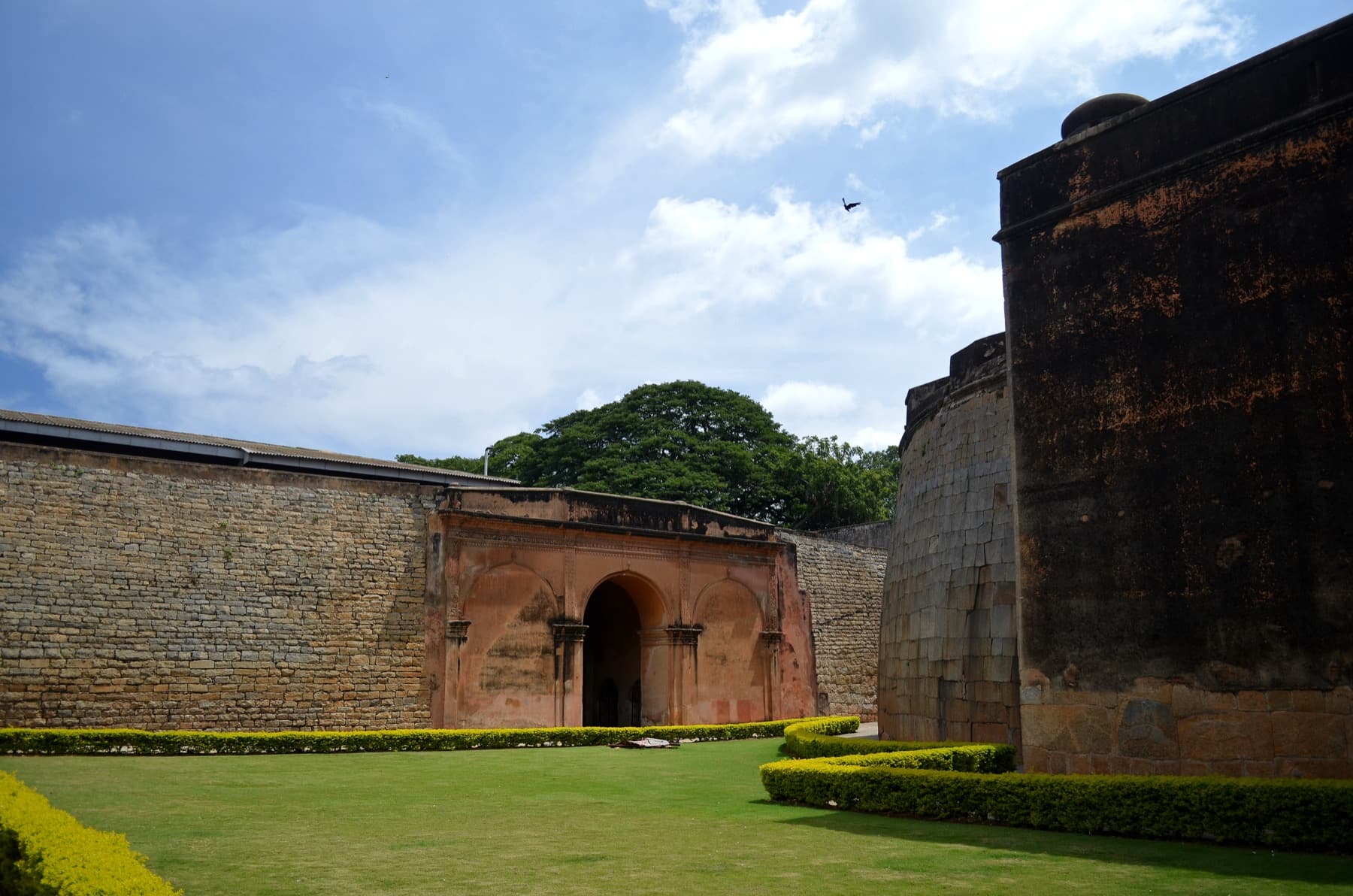
The fort itself was old. Kempe Gowda I, a Vijayanagara vassal and the founder of the city, raised a mud fort here in 1537. In 1761 Nawab Haidar Ali Khan replaced it in stone — an oval enceinte with bastions, a ditch and a glacis — and Tipu Sultan went on improving it. It was the northern anchor of the fortress system, and any British army marching on the capital from the east had to deal with it first.
The palace made of wood
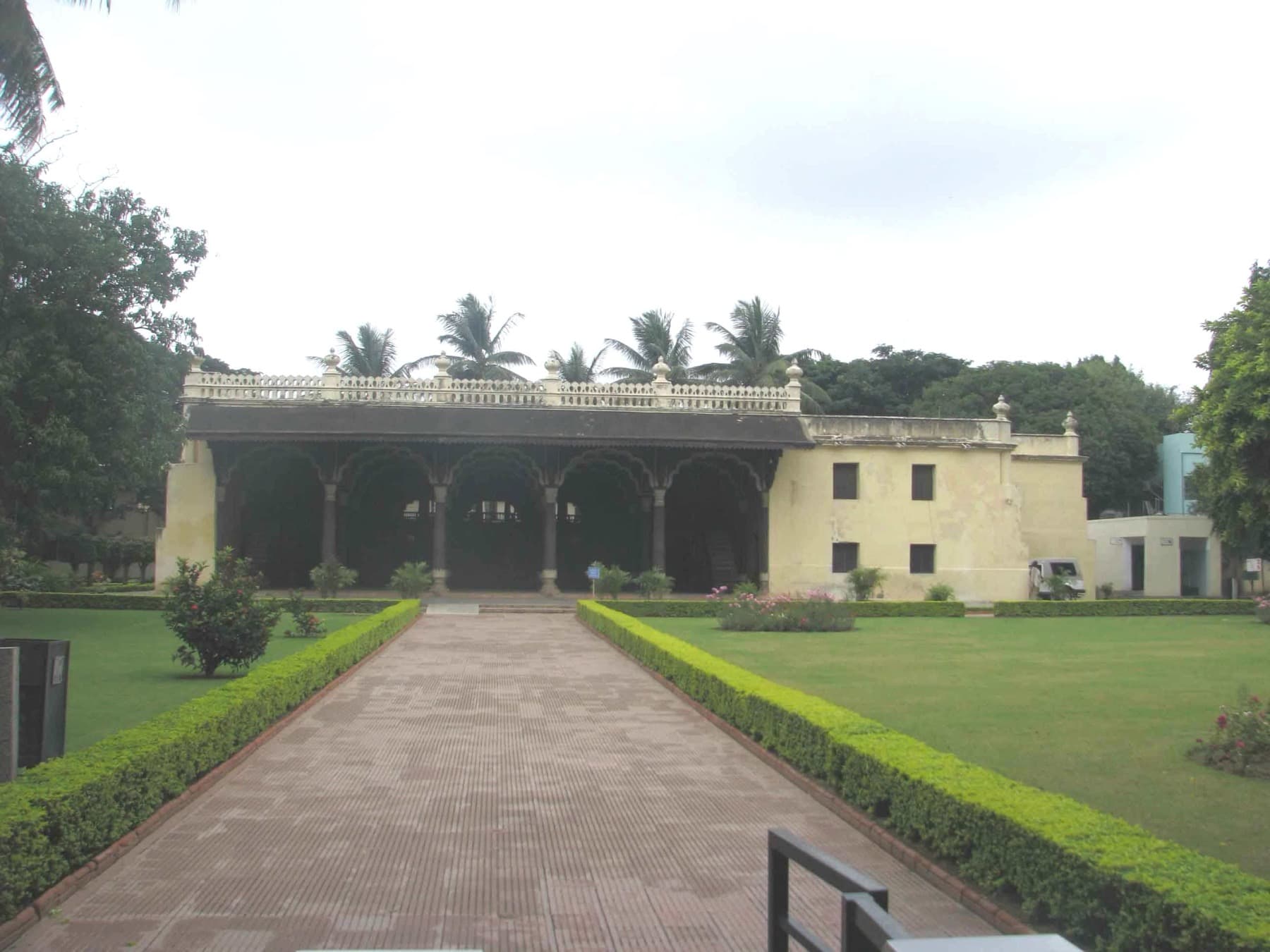
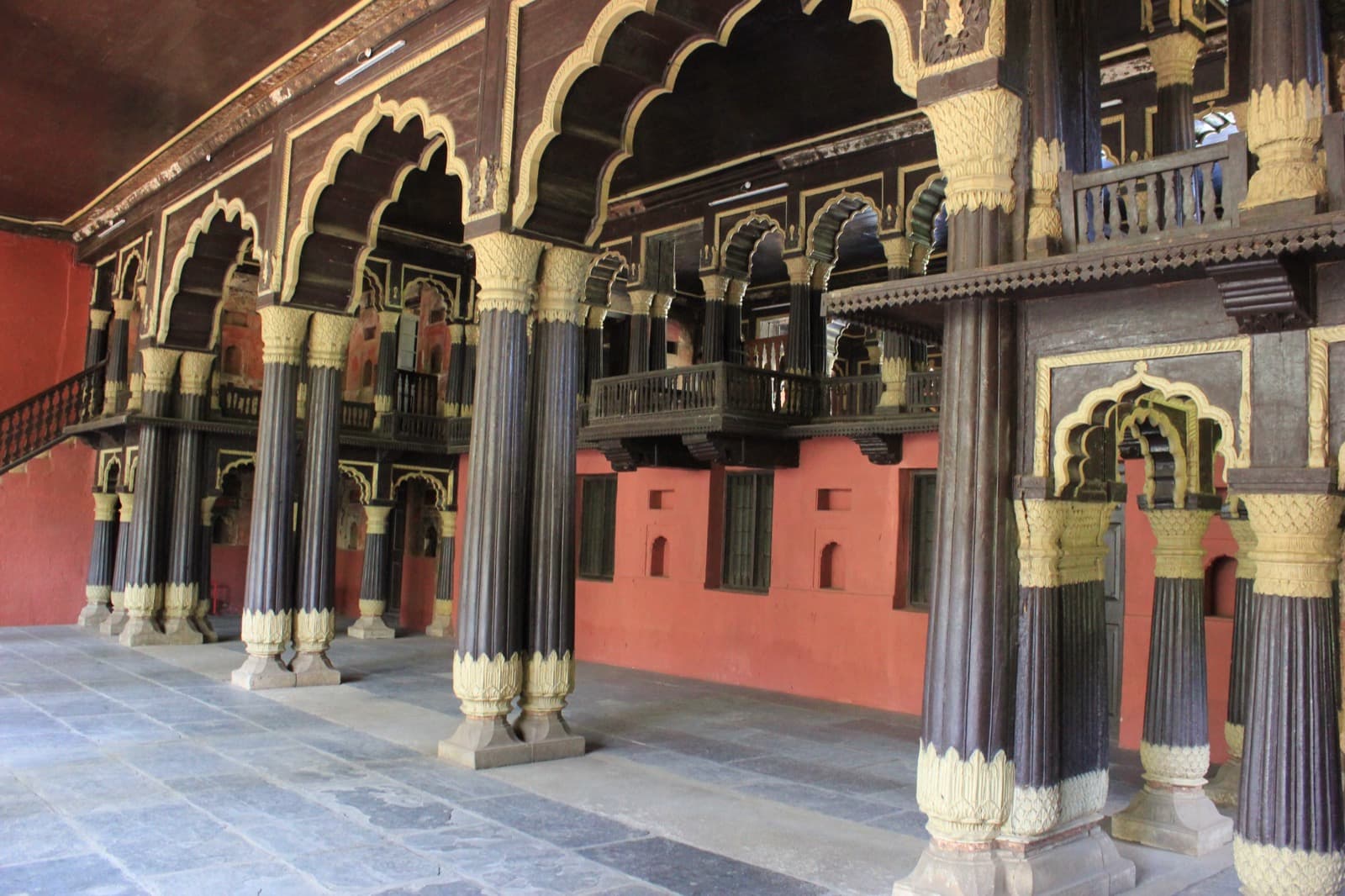
Inside the walls, Haidar Ali began a summer palace in 1781. It was finished ten years later under Tipu Sultan, in 1791 — the same year the fort fell, which gives the building an unfortunate distinction: it was completed just in time to be lost.
It is two storeys, Indo-Islamic in form, with cusped arches and balconied galleries, and it is built almost entirely of teak — the columns, the brackets, the floors, the galleries. Tipu Sultan called it the Rash-e-Jannat, the envy of heaven, and used it as a summer residence and audience hall. It is a near relation of Daria Daulat Bagh at Srirangapatna, and the two should be read together: the same idea of a palace as a light, painted, open pavilion rather than a mass of stone.
The odd result is that the softest thing on the site outlasted the hardest. The stone fort was pulled down; the wooden palace is still standing.
March 1791 — the siege
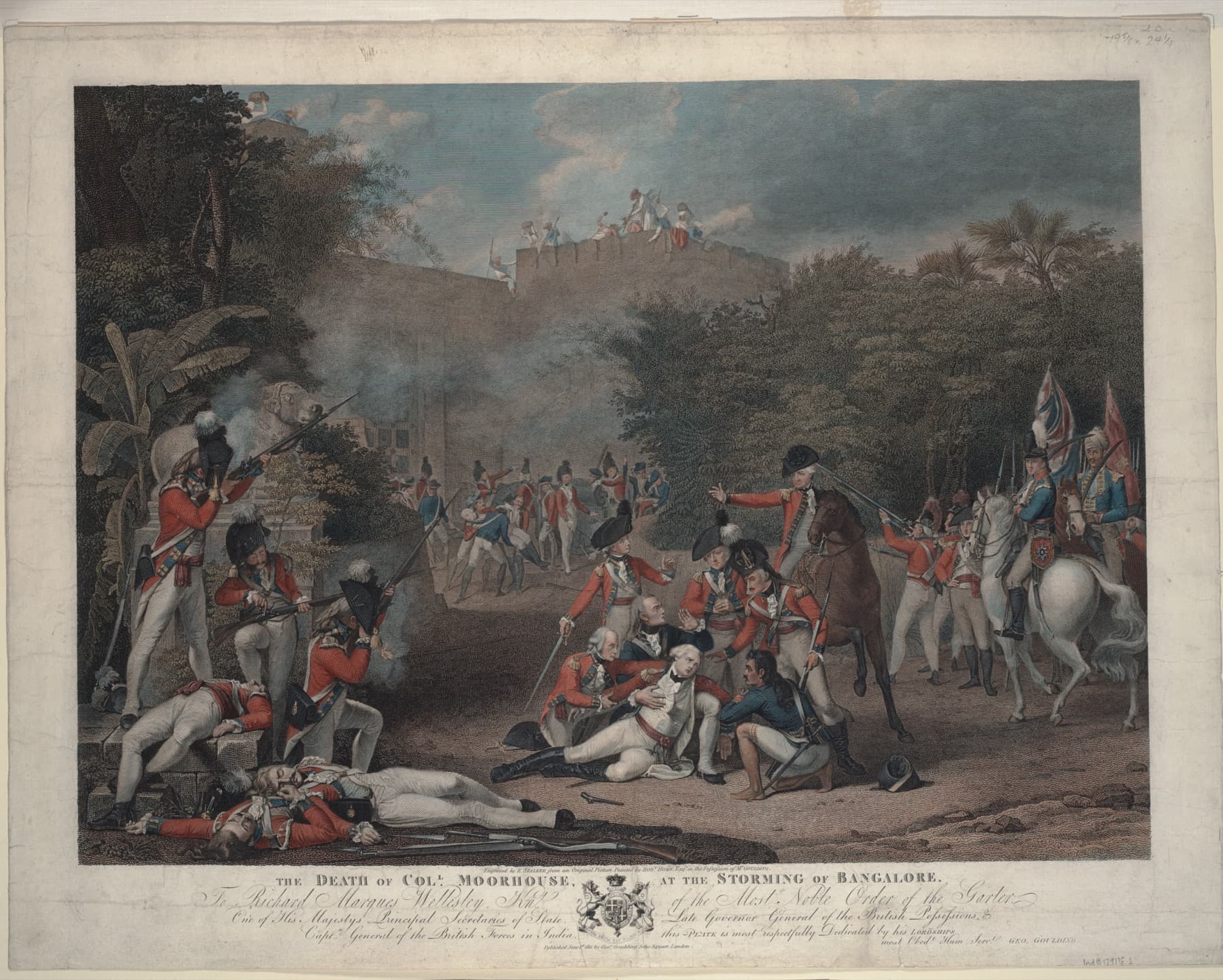
In the third war Cornwallis came up from the Carnatic and put Bangalore under siege. The pettah was carried first, in a night assault on its gate that cost the British Colonel Moorhouse his life — the subject of a Robert Home painting that made the action famous at home. The fort held out three weeks more.
The commandant, or killedar, was Bahadur Khan. On the night of 21 March 1791 the British stormed the breach their batteries had opened near the Delhi Gate. Bahadur Khan did not withdraw. He fought at the breach and was killed there, and by the end of the assault more than two thousand of the garrison and the attacking force were dead.
What was done with his body
This is the part people in the city still tell, and it is the reason this page exists.
When the news reached Srirangapatna, Tipu Sultan is said to have wept, and then to have answered that the Khan could be buried nowhere with greater propriety than in the neighbourhood of the place at the defence of which he had fallen. The East India Company — which had just spent three weeks being shot at by the man — buried him where he fell, with full military honours, a few minutes' walk from the Delhi Gate.
The grave stayed. Over two centuries it became a dargah, and the soldier became a saint: he is venerated there as Hazrat Meer Bahadur Shah, al-maroof Syed Pacha Shaheed. It stands now amid the produce stalls and traffic of K. R. Market, at the corner of S. J. P. Road and N. R. Road, and people come to it — not as a monument to a battle, but as a shrine.
What is not in doubt is the shape of the thing. A commander died at a breach; his enemies thought enough of him to bury him properly; his own sovereign wanted him left where he fell; and the city grew around the grave and kept honouring it long after the kingdom, the Company and the empire had all gone.
What is left
Very little of the fort. The British held Bangalore after 1791 and kept it after 1799, and the walls came down through the nineteenth century as the city spread. What survives is the Delhi Gate on Krishnarajendra Road with a fragment of curtain wall and two bastions — and set into the masonry nearby, a marble plaque put up by the victors to mark the exact point of the breach.
The summer palace stands a short distance away, a protected monument. Lalbagh is ten minutes to the south. Between the three of them, and the dargah in the market, the Mysorean city is still legible in a metropolis of many millions that mostly does not notice it.
Sources for this page
- Mohibbul Hasan, History of Tipu Sultan — on the third war and the loss of Bangalore.
- Major Alexander Dirom, A Narrative of the Campaign in India (1794) — a British participant's account of the siege and storming.
- Robert Home, Select Views in Mysore (1794) and 'The Death of Colonel Moorhouse at the Storming of the Pettah Gate of Bangalore' — eyewitness views of the campaign.
- British campaign narratives on the death of the killedar Bahadur Khan at the breach on 21 March 1791 and his burial with military honours near the Delhi Gate, including Tipu Sultan's reported response.
- Archaeological Survey of India and Karnataka state records on Bangalore Fort, the surviving Delhi Gate and breach plaque, and Tipu Sultan's Summer Palace (begun 1781, completed 1791).
- Local accounts of the dargah of Hazrat Meer Bahadur Shah, al-maroof Syed Pacha Shaheed, in K. R. Market — recorded here as living tradition rather than documentary evidence.
Full bibliography and how we weigh sources: Sources & Method