The Wars · The Adversaries
Lord Cornwallis
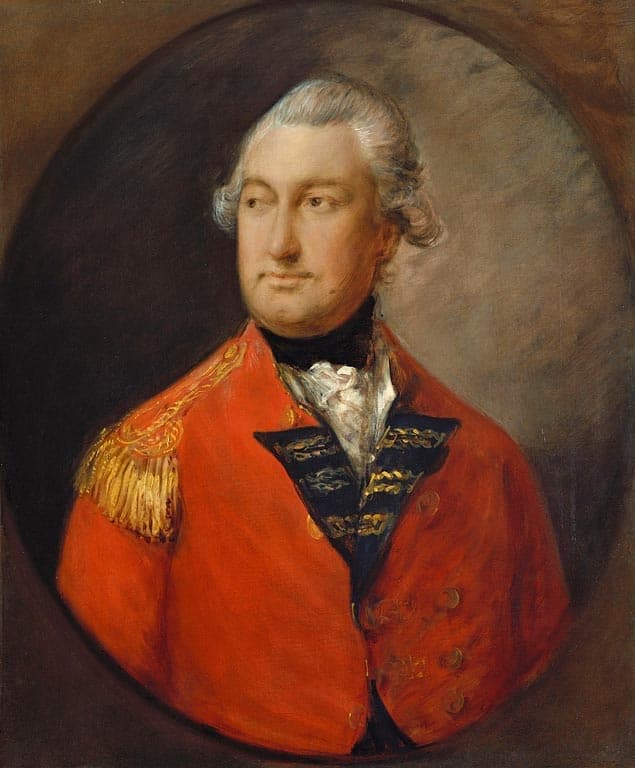
The most improbable career in the story. The British general who lost America surrendered his sword at Yorktown in 1781, was sent to India five years later, and took half of Tipu Sultan's kingdom — a defeat on one continent redeemed by a conquest on another.
- Yorktown
- Surrendered 1781
- Governor-General
- 1786–1793
- Took Bangalore
- March 1791
- Died
- Ghazipur, 1805
The man who lost America
On 19 October 1781, besieged by Washington's army and a French fleet, Charles Cornwallis surrendered his army at Yorktown. It was the effective end of British America. A commander who had presided over that ought to have finished his career quietly.
Instead he was given the Garter and, in 1786, made Governor-General of India and Commander-in-Chief. The British establishment concluded that the loss of America had been the fault of the ministry rather than the general — a judgement Tipu Sultan would have cause to regret.
What he understood that his predecessors did not
Two British armies had already been defeated in Mysore, not in battle but by supply: Mysorean cavalry stripped the country ahead of an invader and cut the convoys behind him. Cornwallis grasped that the problem was not tactical and could not be solved by another general.
His answer was diplomatic. Within months of the war opening in 1790 he had bound the Nizam of Hyderabad and the Marathas into a triple alliance. Allies meant a second and third source of supply, cavalry to screen his own convoys, and Mysorean forces pulled in three directions at once. It was the decisive move of the war, and it was made before a shot was fired.
The campaign, and the failure inside it
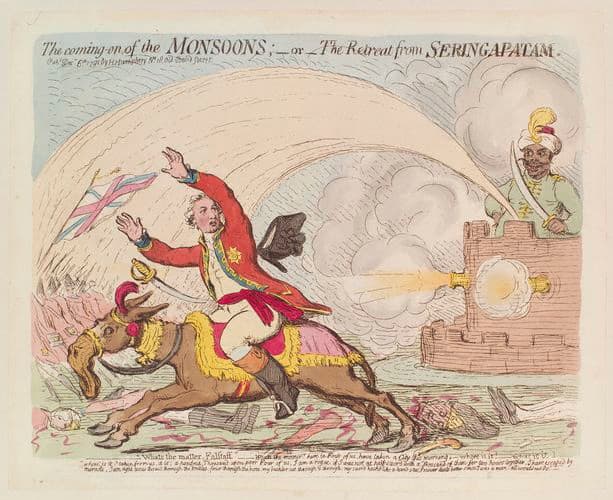
He took command in the field in December 1790 and stormed Bangalore in March 1791. Then he drove for the capital — and it went wrong exactly as it had for his predecessors. After beating Tipu Sultan outside Srirangapatna at Arakere in May 1791, his draught cattle were dead, his supplies gone and the monsoon coming; he destroyed his own siege guns and retreated.
British opinion enjoyed the spectacle. James Gillray published The Coming-on of the Monsoons — or, the Retreat from Seringapatam, showing Cornwallis bolting on a goat while Tipu Sultan fired after him from the walls.
The second try, and the terms
The difference from every earlier British commander is that Cornwallis could afford to fail once. His allies kept him supplied while he spent the rest of 1791 methodically reducing the hill forts — Nandidurg in October, Savandurga on 22 December — and in February 1792 he advanced again with siege train and coalition intact.
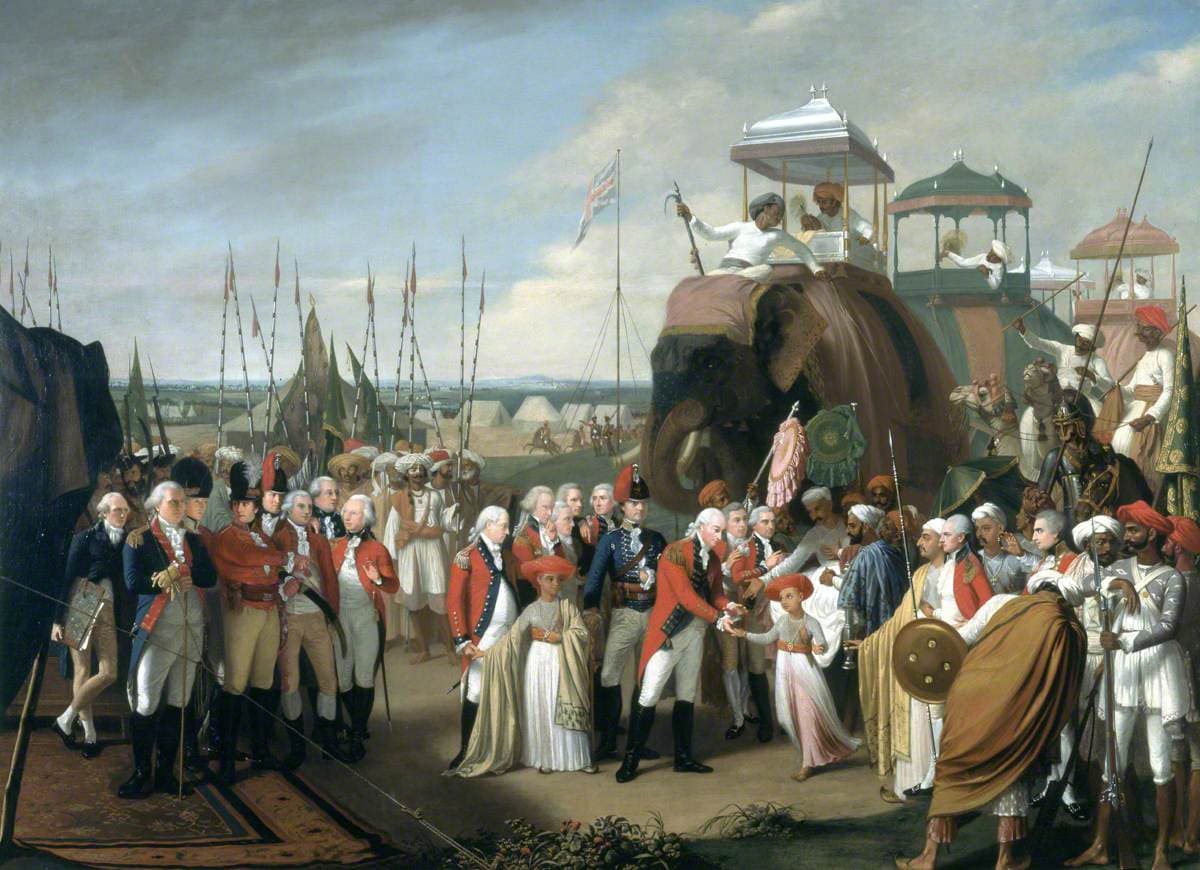
The Treaty of Seringapatam of 18 March 1792 took roughly half of Mysore, imposed an indemnity of 3.3 crore rupees, and required two of Tipu Sultan's young sons as hostages for payment. The delivery of the boys became one of the most reproduced images of the British empire — painted repeatedly, engraved, and hung as a scene of paternal conquest.
The reformer
Cornwallis was not only a soldier in India. He rebuilt the Company's administration, attacked the private trading and gift-taking that had made earlier Company servants rich, and gave Bengal the Permanent Settlement of 1793 — fixing the land revenue in perpetuity and confirming the zamindars as proprietors. It is instructive to set that against what Tipu Sultan was doing at the same moment: Cornwallis entrenched a class of hereditary intermediaries in Bengal while Mysore was busy abolishing the equivalent.
Afterwards
He left India in 1793, served as Lord Lieutenant of Ireland through the rising of 1798, negotiated the Peace of Amiens, and was sent back to India as Governor-General a second time in 1805. He died at Ghazipur in October of that year, a few weeks after arriving, and is buried there.
The symmetry is hard to miss. The man remembered in America for losing an empire is remembered in India for taking one, and the two reputations belong to the same person, six years apart. See also The American Connection.
Sources for this page
- Mohibbul Hasan, History of Tipu Sultan — the Third Anglo-Mysore War.
- Major Dirom, A Narrative of the Campaign in India, which Terminated the War with Tipoo Sultan in 1792 (1794).
- Treaty of Seringapatam (1792), in Aitchison's Treaties, Engagements and Sanads.
- James Gillray, 'The Coming-on of the Monsoons — or, the Retreat from Seringapatam' (1791).
- Standard biographies of Charles, 1st Marquess Cornwallis, on Yorktown, the Governor-Generalship, and the Permanent Settlement.
Full bibliography and how we weigh sources: Sources & Method