Innovation · Plants
Lalbagh
Every embassy Tipu Sultan sent abroad came home with seeds. Paris, Mauritius, Kabul, the Cape — the garden at Bangalore was where a state that could not buy what it needed tried to grow it instead.
- Founded
- 1760, by Haidar Ali
- Name
- Lal Bagh — the red garden
- Sources of stock
- Kabul, Kandahar, Persia, Turkey, France, Mauritius, the Cape
- Today
- 240 acres, still a garden
A garden begun by a soldier
In 1760 Nawab Haidar Ali Khan ordered a garden laid out at Bangalore — some thirty-odd acres of square parterres cut by paths of fruit trees, cypresses framing the rose beds, a tank to water it. The model was the Mughal charbagh crossed with the French gardens at Pondicherry — and, more immediately, the Mughal gardens at Sira, ninety miles north, laid out by the subedar Dilawar Khan and the nearest thing to a precedent in Haidar Ali's own country.
It is worth registering the date. The East India Company did not establish its own botanic garden at Calcutta until 1787, twenty-seven years later. The first serious botanical garden in the subcontinent was built by a man the British would spend four wars trying to destroy, and by the son who inherited it.
It was not called Lalbagh
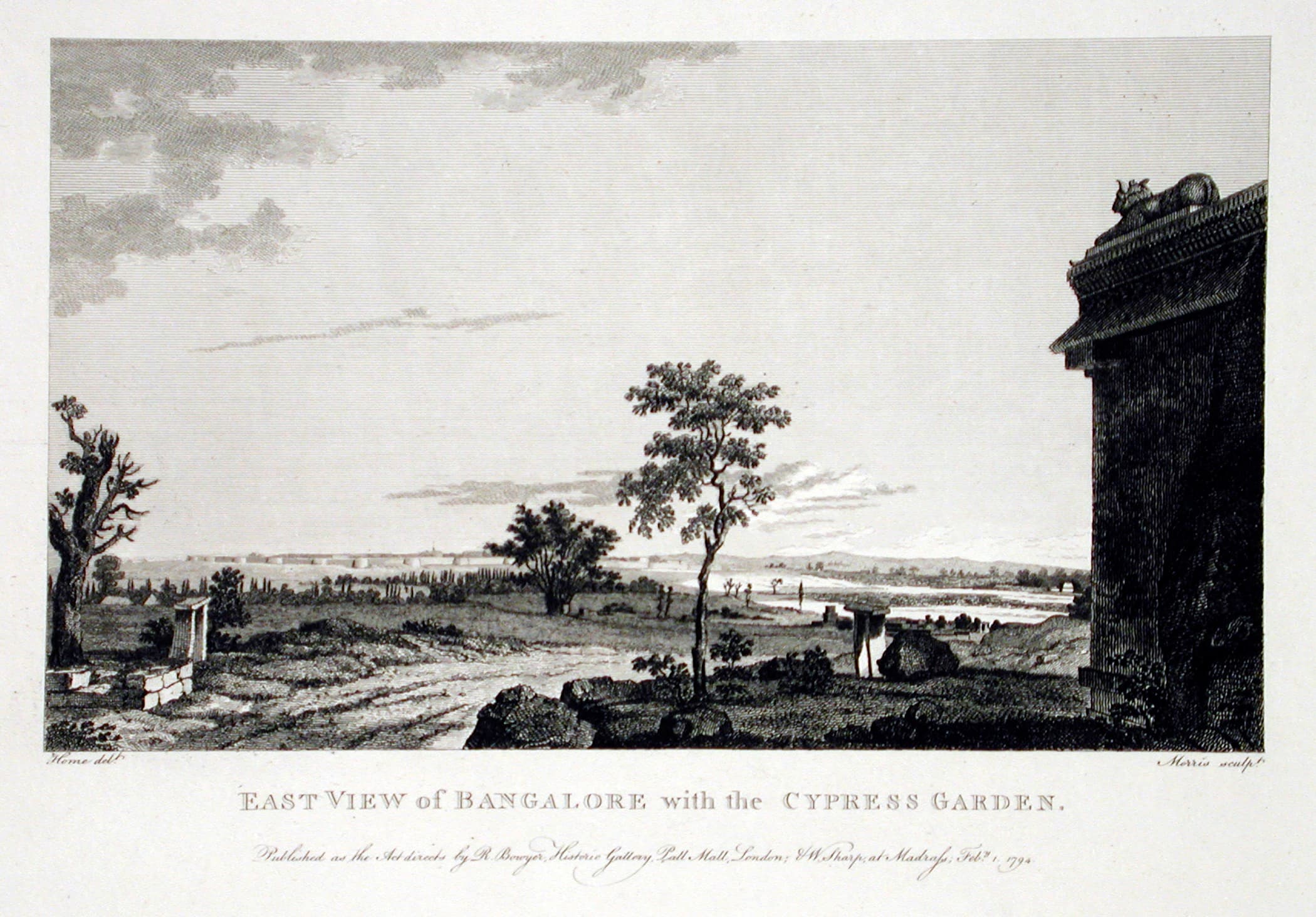
The name is later than the garden, and the name it had first was the Cypress Garden. That is not a folk etymology: it is what the English called it while Tipu Sultan was still on the throne. Robert Home's etched view, published at Madras on 1 February 1794, is captioned East View of Bangalore with the Cypress Garden. James Hunter, who drew Mysore as an artillery officer in the Third Anglo-Mysore War, produced a view of the same ground engraved for Picturesque Scenery in the Kingdom of Mysore in 1804 under much the same title.
The trees were the reason. Francis Buchanan found the walks lined with cypress, and in both prints it is the cypresses — tall, narrow, utterly unlike anything native to the Deccan plateau — that identify the garden from a distance. They were themselves imported stock, and they were the first thing anyone approaching Bangalore noticed.
Other English names followed as the garden changed hands: the Sultan's Garden, the Mussalman's Garden, the Garden of Waugh after the officer who took charge in 1799, the Garden of Bangalore. Lal Bagh — the red garden, usually explained by the roses, though lal also carries the sense of beloved — is generally dated to 1856, when it was made a government botanical garden and acquired an official name for the first time.
What Tipu Sultan turned it into
Haidar Ali built a pleasure garden and stocked it largely from India. Tipu Sultan extended the ground and changed its purpose. Under him Lalbagh became something closer to an experimental station, organised in three kinds of nursery: one for agriculture, one for garden crops, one for aromatic and ornamental plants. The object was not display. It was to find out what would grow in Mysore.
That fits everything else known about how he ran the state. The same reign that established twenty-one silkworm stations with their mulberry plantations, that pushed higher-yielding rice, that put state capital behind manufacture — that state treated a garden as infrastructure. Sandalwood, pepper, cardamom and silk were the commodities Mysore sold to the world. Anything that widened that list was worth the freight.
The embassies came home carrying plants
This is the part that connects the garden to everything else on this site. Tipu Sultan's embassies are usually read as a search for alliances, and they were. They were also procurement missions, and the shopping list was explicit.
The instructions for the 1788 embassy to Louis XVI asked the French king for engineers, artisans, makers of glass, clocks and porcelain — and for gardeners. The envoys came back with gardeners, an engineer, a clockmaker, and seeds and bulbs from the Jardin du Roi in Paris, the royal botanical garden that would shortly be renamed the Jardin des Plantes.
A later embassy to the French colony at Mauritius produced the detail that says most about how seriously this was taken: twenty chests of plants and seeds, together with clove and nutmeg trees that took eighty men to carry up from the port at Mangalore and over the Western Ghats. Clove and nutmeg were then a Dutch monopoly of the Spice Islands, among the most jealously guarded plants on earth. Getting living trees to Bangalore was not gardening. It was an attempt to break somebody else's monopoly by growing the plant at home.
Stock came from further afield still. Contemporary accounts of the garden's sources name Persia, Kabul and Kandahar, Lahore and Multan, Turkey, Mauritius, France, and the Cape of Good Hope — pine and oak from the Cape among them. Agents were sent out to buy saplings; Constance Parsons wrote of Tipu Sultan stocking the garden with fruit and ornamental trees from far Kabul and Kandahar. The gardeners who kept it were drawn from the Thigala community, whose descendants were still working Bangalore's market gardens generations later, and the garden was run by a daroga — the office held in the last years by Mohammed Ali and then by his son Abdul Khader, who was still in charge when the British arrived.
What was actually growing there is better recorded than the shipping manifests. Early accounts of the garden name peaches from Persia in such quantity that they went unpicked, along with mangoes, oranges, limes, pomegranates, apples, mulberries, custard apples, rose apples, loquat and pomelo. It is a fruit list before it is a flower list — which is the point. This was a garden for finding out what would bear.
One plot for each kind of plant
The clearest description of the garden as Tipu Sultan left it comes from the man the Company sent to inventory his kingdom. Francis Buchanan, surveying Mysore immediately after 1799, found the gardens of Haidar Ali and Tipu Sultan extensive, and divided into square plots separated by walks, the walks lined with cypress. He noted the convention that governed them: a separate piece of ground allotted to each kind of plant.
That detail is easy to read past and worth stopping on. A garden arranged by species, one bed to a kind, is not a garden arranged for the look of it. It is a garden arranged so that you can tell what is thriving and what is failing, and compare — which is what a botanical garden is for, and what distinguishes Lalbagh from the pleasure gardens it is usually grouped with.
Buchanan also recorded the waterworks, and the difference between father and son: Haidar Ali's ground was watered from a reservoir, Tipu Sultan's from three wells worked by bullocks hauling leather bags. He preferred the father's taste, whose walks were wider and whose cypresses stood less thickly — a judgement that tells you more about Buchanan than about the garden.
Why a garden was a weapon
Set beside the rest of the reign, the logic is consistent. Mysore was a state trying to hold off a commercial empire, and the empire's instrument was control of what moved and what it cost. Tipu Sultan answered that everywhere he could: state factories, state trading houses, embassies hunting for artisans and technique, his own workshops building what he was not permitted to buy.
A botanical garden is that same policy in slower form. If the spice you need is a monopoly, grow it. If the crop yields badly, find a better strain. If the technique lives in someone's hands, ask for the gardener as well as the seed — which is exactly what the letter to Louis XVI did. The British, who understood this thinking perfectly well because it was also their own, built Kew and Calcutta on the same principle and moved rubber, tea and cinchona around the world with it.
What happened to it
The army took the garden in 1799 along with everything else, and it then passed through a long chain of hands. Major Gilbert Waugh, the Company paymaster, took charge first; in 1814 it went to the government of Mysore; in 1819 Nathaniel Wallich — superintendent of the Company's own botanic garden at Calcutta — was put over it, so that for a time Tipu Sultan's garden was supervised from Fort William. In 1831 it fell to the Commissioner of Mysore, and in 1856 it was made a government botanical garden outright.
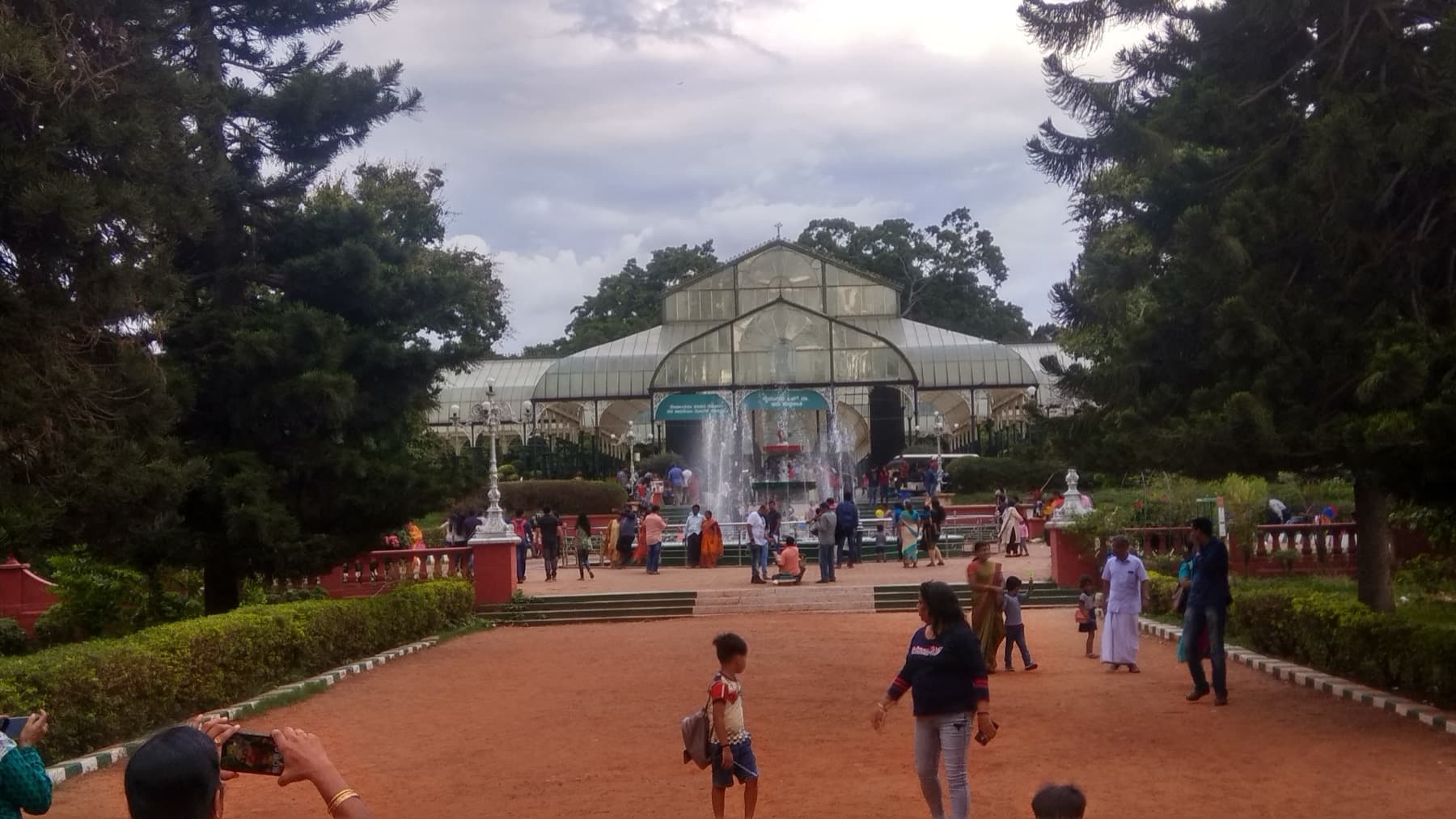
The revival dates from that moment. William New, recruited from Kew, arrived in April 1858 and laid the avenues, bringing in plantings from China, South Africa and the Indian Ocean; his 1861 catalogue lists cinchona, coffee, tea, macadamia, pecan, rhododendrons and camellias — a working economic-botany collection, in the same spirit as the one it replaced. John Cameron, also from Kew, succeeded him in 1873 and added the baobab and the araucarias; Gustav Hermann Krumbiegel followed in 1908. The Glass House, modelled on the Crystal Palace, went up in 1889. The ground grew with them: about forty-five acres in 1874, then additions in 1889, 1891 and 1894 — one of them the rock carrying Kempegowda's watchtower — and 240 acres today.
The result is an odd kind of survival. Almost nothing else Tipu Sultan built is still doing the job he built it for: the forts are monuments, the arsenals are ruins, the state was dismantled inside a year. Lalbagh is still a botanical garden, still collecting, and still open to the city — as it goes on being, on ground chosen by his father, for a purpose he set.
What is being argued about now
The survival is not settled. Through 2026 Lalbagh has been at the centre of a fight over Bengaluru's proposed twin tunnel road, a 16.7-kilometre north–south route from Hebbal to Central Silk Board whose alignment put a construction shaft and ramps on the garden's land.
In August 2026 the Karnataka assembly passed the Parks (Preservation) (Amendment) Bill, 2026, which would have allowed up to five per cent of a protected park to be alienated or leased for public works — about twelve of Lalbagh's 240 acres, and about ten of Cubbon Park's 192. Thousands marched in the garden against it, behind the retired forest officer A. N. Yellappa Reddy; a Union minister wrote to the Governor asking him to withhold assent. On 3 September 2026 the state cabinet withdrew the Bill before it was signed, while saying plainly that the proposal was not being given up and would be brought back after wider discussion.
The second front is geological. The Karnataka High Court, hearing challenges to the tunnel, called for the Geological Survey of India's report on the outcrop inside the garden — the Peninsular Gneiss, rock some three billion years old, declared a National Geological Monument in 1975, and carrying one of the four watchtowers with which Kempegowda marked the limits of Bangalore two centuries before the garden existed. The GSI warned that tunnelling could widen existing fractures in the rock mass, disturb groundwater and threaten the tower, and recommended that the design and the shaft position be reassessed. By mid-September the government said it was examining alignments that avoid Lalbagh altogether.
None of that is settled either, and this page does not pretend to know how it ends; the account above is where things stood in September 2026. It is worth noting only what the argument is about. The reason Lalbagh cannot simply be built through is that it is old, continuous and still doing its work — which is the same reason it is on this site.
Sources for this page
- Eugenia W. Herbert, Flora's Empire: British Gardens in India (2011) — on Lal Bagh under Haidar Ali and Tipu Sultan, the Jardin du Roi seeds and bulbs, the twenty chests from Mauritius, and the garden after 1799.
- Irfan Habib (ed.), State and Diplomacy under Tipu Sultan: Documents and Essays (2001) — the instructions to the embassy to France, including the request for gardeners and artisans.
- Mohibbul Hasan, History of Tipu Sultan — on the embassies and the economic policy the garden belongs to.
- Francis Buchanan, A Journey from Madras through the Countries of Mysore, Canara and Malabar (1807) — the Company's own survey of Mysorean agriculture immediately after the conquest.
- Horticultural histories of Lalbagh on its foundation in 1760, the Thigala gardeners, the darogas Mohammed Ali and Abdul Khader, the sources of imported stock, and the superintendencies of Gilbert Waugh, Nathaniel Wallich, William New, John Cameron and G. H. Krumbiegel.
- Constance E. Parsons, Seringapatam (1931) — on the fruit and ornamental trees brought from Kabul and Kandahar.
- Robert Home, 'East View of Bangalore with the Cypress Garden', etching published at Madras, 1 February 1794 (LACMA M.73.14.10), and James Hunter, 'East view of Bangalore, with the cypress garden, from a pagoda', aquatint in Picturesque Scenery in the Kingdom of Mysore (Edward Orme, 1804-05; British Library) — for the name in use before 1799.
- Yashaswini Sharma, Bangalore: The Early City, AD 1537-1799 — on the garden's plantings and management before 1799.
- Royal Botanic Garden, Calcutta, founded 1787 — for the comparison of dates.
- Geological Survey of India, report on the Peninsular Gneiss at Lalbagh placed before the Karnataka High Court, 2026; the outcrop was declared a National Geological Monument in 1975.
- Press reporting on the Karnataka Parks (Preservation) (Amendment) Bill, 2026, the protest at Lalbagh and the cabinet's withdrawal of the Bill on 3 September 2026 — Deccan Herald, ETV Bharat, The Week.
Full bibliography and how we weigh sources: Sources & Method