Pillar One
The Person
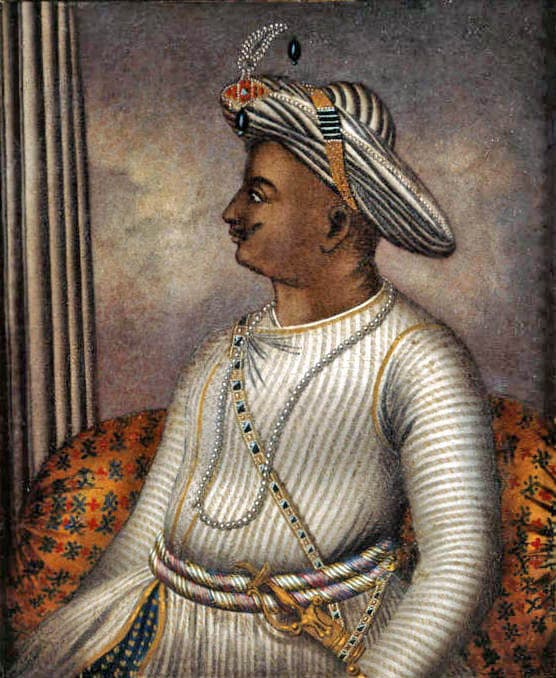
Before he became a political symbol, Tipu Sultan was a man of particular habits and appetites: a soldier's son educated like a prince, a compulsive reader and record-keeper, a devout Muslim who dreamed in ink and catalogued his dreams.
- Full name
- Sultan Fateh Ali Khan Tipu
- Father
- Nawab Haidar Ali Khan
- Mother
- Fatima Fakhr-un-Nisa
- Named after
- Saint Tipu Mastan Aulia
Early life
Tipu Sultan was born at Devanahalli, north of Bangalore, in November 1750 — some older accounts give 1751 — the eldest son of Haidar Ali, then a rising military officer in the service of the Wodeyar rajas of Mysore, and Fatima Fakhr-un-Nisa. He was named for the Sufi saint Tipu Mastan Aulia of Arcot, whose shrine his parents had visited.
His childhood tracked his father's extraordinary ascent. By the time Tipu Sultan was in his teens, Haidar Ali had made himself the de facto ruler of Mysore, and Tipu Sultan was being educated accordingly: Quran and Islamic law, Persian — the language of administration and diplomacy across much of India — along with Urdu, Kannada, and by most accounts some Arabic. Haidar, himself unlettered, was determined his son would not be, and paired the classroom with the camp: Tipu Sultan received his first independent military command while still a teenager, and rode with his father's cavalry in the First Anglo-Mysore War before he was twenty.
Personality and habits
The picture that survives — from his own letters, from the library and papers captured in 1799, and from the accounts of those who dealt with him — is of a ruler of unusual personal discipline and almost compulsive attention to detail. Tipu Sultan drafted and corrected state correspondence in his own hand, issued minutely detailed regulations to his revenue officers and factory managers, and maintained a personal library of some two thousand volumes spanning theology, law, history, medicine, mathematics, and military science.
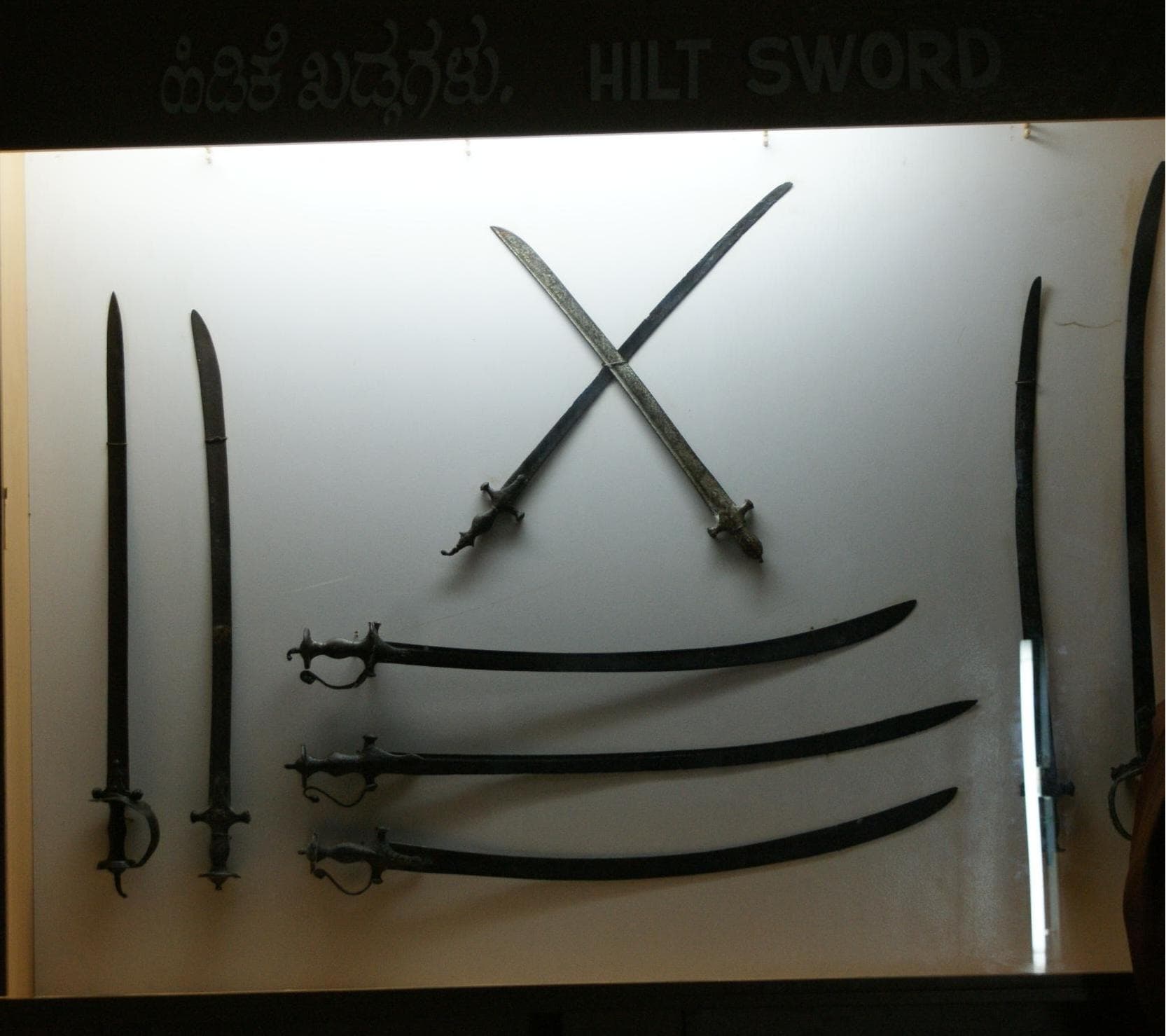
He kept a private register of his dreams, found in his bedchamber after the fall of Srirangapatna — thirty-seven of them, in his own hand, and one of the most intimate documents left by any Indian ruler of the period. He was personally abstemious, took a close interest in new technology of every kind, and adopted the tiger as a personal emblem with total commitment: tiger stripes (the bubri) on uniforms, cannon, coins, his throne, and the famous mechanical tiger organ now in the Victoria & Albert Museum.
Contemporaries found him demanding. He paid his soldiers regularly and well by the standards of the age — a key reason his army held together through four wars — but officials who failed him could be treated harshly, and he trusted few people fully after the betrayals of the 1790s.
Family and household
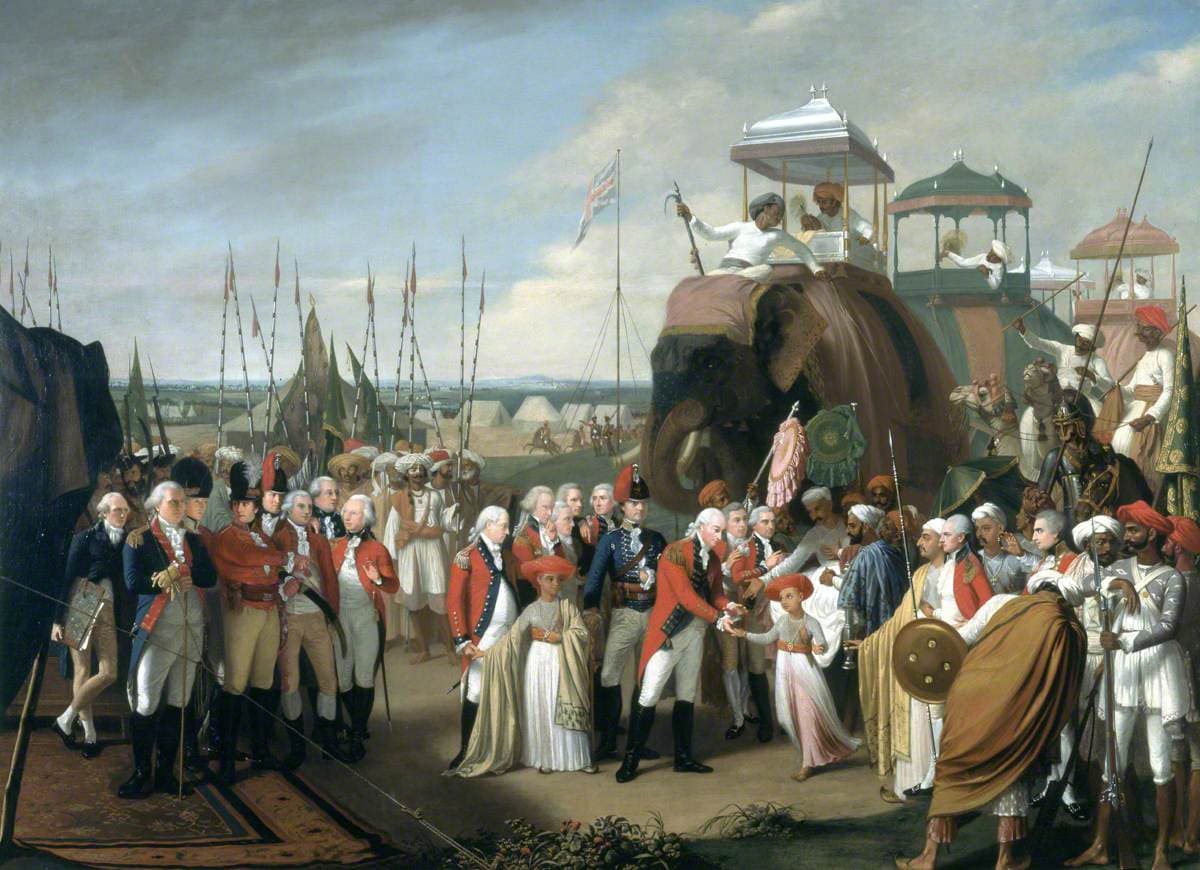
Tipu Sultan married in 1774; his household eventually included several wives and a large number of children — twelve sons survived him. The most politically significant were Fateh Haidar, his eldest, and Abdul Khaliq and Muiz-ud-din, the two boys surrendered to Lord Cornwallis as hostages in 1792 under the Treaty of Seringapatam, an episode British painters turned into one of the most reproduced images of colonial India.
After the fall of Srirangapatna in 1799 the family was pensioned and removed first to Vellore; after the Vellore uprising of 1806, in which the Company saw the princes' household as a rallying point, they were transferred to Calcutta. Tipu Sultan's descendants live today mainly in Kolkata.
Faith and worldview
Tipu Sultan was a devout, practising Sunni Muslim. His personal piety is not in dispute: it pervades his letters, his library, his dream register, and the religious vocabulary of his state — which he called the Sarkar-i-Khudadad, the “God-given government.”
His religious policy is a different question from his personal faith, and the documented record is clear enough about it.
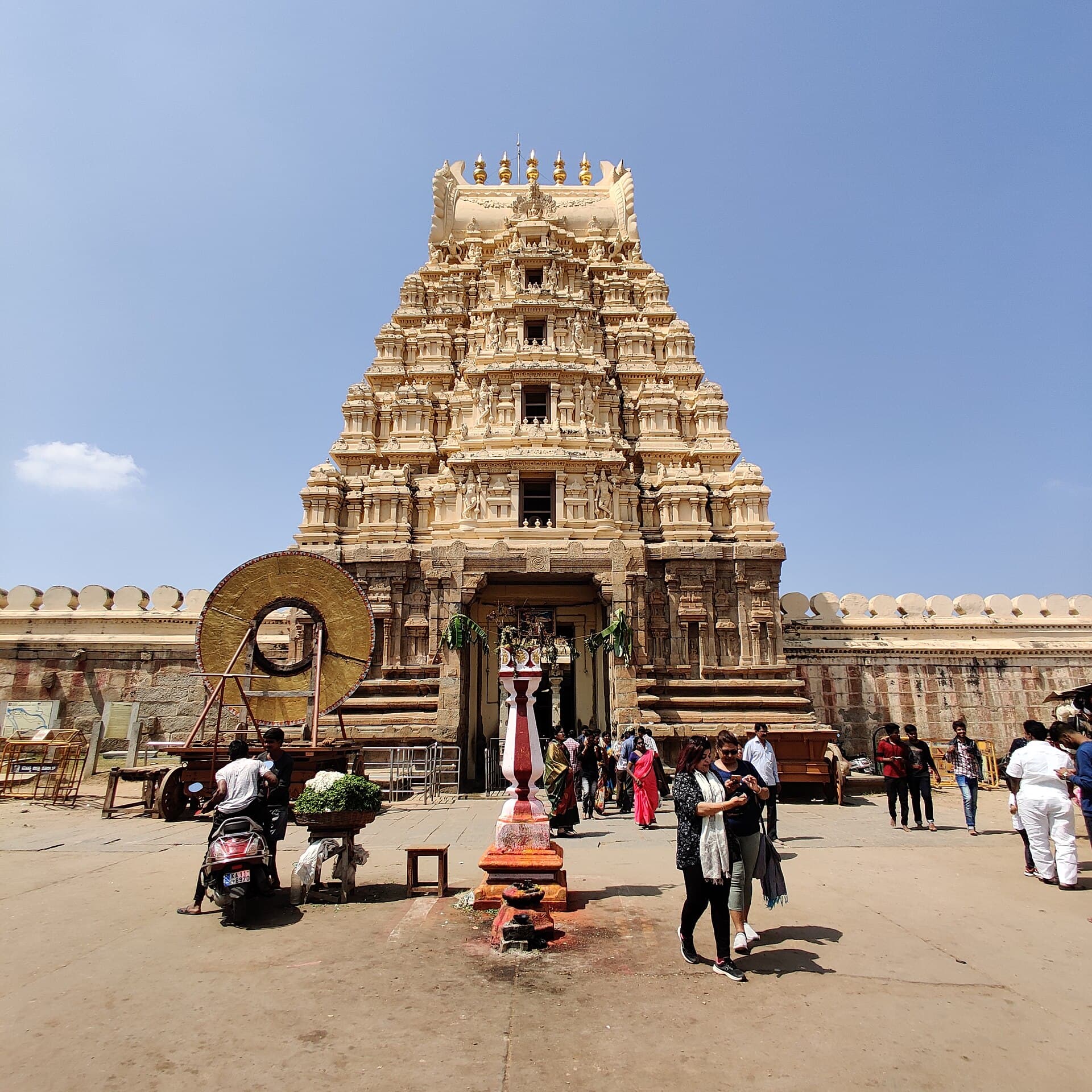
Patronage across communities. Tipu Sultan maintained and endowed Hindu institutions throughout his reign. The Ranganathaswamy temple functioned inside his capital's fort walls, within earshot of his palace, until the day he died. After Maratha cavalry sacked the Sringeri math in 1791, he wrote a series of surviving letters to its Shankaracharya expressing outrage and funded the restoration of the deity's image — among the best-documented episodes of the reign. His chief finance minister, Purnaiya, was a Brahmin; Hindus served throughout his revenue administration, his court, and his army, and the state he built made no religious test of service.
War in conquered territories. His campaigns in Coorg and Malabar, and the deportation of the Catholic community of Canara in 1784, were harsh, and involved mass captivity, the destruction of communities, and conversions among the captives. Following Mohibbul Hasan and the contributors to Irfan Habib's Confronting Colonialism, this site reads those episodes as fundamentally political — the ordinary brutality of eighteenth-century counter-insurgency, directed at populations in revolt or in alliance with his enemies rather than at religions as such. He broke Muslim opponents with the same severity, among them the Mappilas of Malabar, whom he had to massacre in thousands before the province was subdued. The figures in circulation are unreliable in both directions: British wartime writing needed him to be a fanatic, and the Persian court chronicles written by his own admirers inflated conversion totals to make him a champion of Islam. Religious Policy sets out each episode with its evidence, and says who asserts which number.
What the evidence does not support is either popular caricature: the secular saint who never harmed anyone, or the fanatic who ruled by forced conversion. The documented Tipu Sultan prayed daily, endowed temples, employed Hindus at the head of his government, and dealt with rebellion — of whatever faith — as eighteenth-century rulers did.
What became of his memory
The man is one thing; what was made of him afterwards is another, and the second story is nearly as long as the first. His throne was broken up for prize money, his tiger automaton became a London attraction, the Royal Navy named a frigate after the storming, and within a few years he was a stage villain in Britain and America. In India he became a symbol of resistance, and more recently a subject of political argument.
Sources for this page
- Mohibbul Hasan, History of Tipu Sultan (Calcutta, 1951; rev. 1971) — chs. on early life and religious policy.
- Irfan Habib (ed.), Confronting Colonialism: Resistance and Modernization under Haidar Ali and Tipu Sultan (2002).
- Kate Brittlebank, Tipu Sultan's Search for Legitimacy (1997) — on the tiger emblem and Sarkar-i-Khudadad.
- Mahmud Husain (trans.), The Dreams of Tipu Sultan — the dream register.
- Sringeri letters: A. K. Shastry, The Records of the Sringeri Dharmasamsthana (2009).
- William Kirkpatrick, Select Letters of Tippoo Sultan (1811) — colonial translation, used critically.
Full bibliography and how we weigh sources: Sources & Method