The Administrator
Religious Policy
This is the most argued-over question about Tipu Sultan, and the one where the sources are worst. Both the accounts that condemn him and the accounts that glorify him had reasons to exaggerate the same events — and they exaggerated them in the same direction.
Two propaganda machines, not one
Most subjects on this site require the reader to allow for British wartime writing. This one requires allowing for two distortions pulling the same way.
The British case for the wars needed a fanatic, and Wilks and Kirkpatrick supplied one. But the Persian court chronicles composed in Tipu Sultan's own circle — the Sultan-ut-Tawarikh and the Tarikh-i-Khudadadi — needed a champion of Islam, and they inflated conversion figures to produce one. When a hostile British source and a devoted Mysorean source agree that tens of thousands were converted, that agreement is not corroboration. Both had an interest in the same large number.
Mohibbul Hasan, whose 1951 History of Tipu Sultan remains the standard scholarly biography and is this site's anchor, states the problem exactly: the non-Muslim versions were designed to malign Tipu Sultan, and no reliance should be placed on the Muslim accounts either, which distort and exaggerate out of anxiety to represent him as the champion of Islam.
What is not in dispute
He was a devout Sunni Muslim and his state said so. He called it the Sarkar-i-Khudadad, the God-given government. His coinage, calendar and military code all carried Islamic vocabulary. None of this is contested by anyone.
Hindus ran much of his government. Purnaiya was mir asaf; Krishna Rao was Treasurer; Shama Iyengar held post and police, with his brother Ranga Iyengar and Narsinga Rao in high positions at Srirangapatna. Srinivas Rao and Appaji Ram were sent on important diplomatic missions. Suba Rao was chief peshkar. Nagappaya, a Brahmin, was made faujdar of Coorg — of the province whose treatment is most often cited as proof of religious persecution.
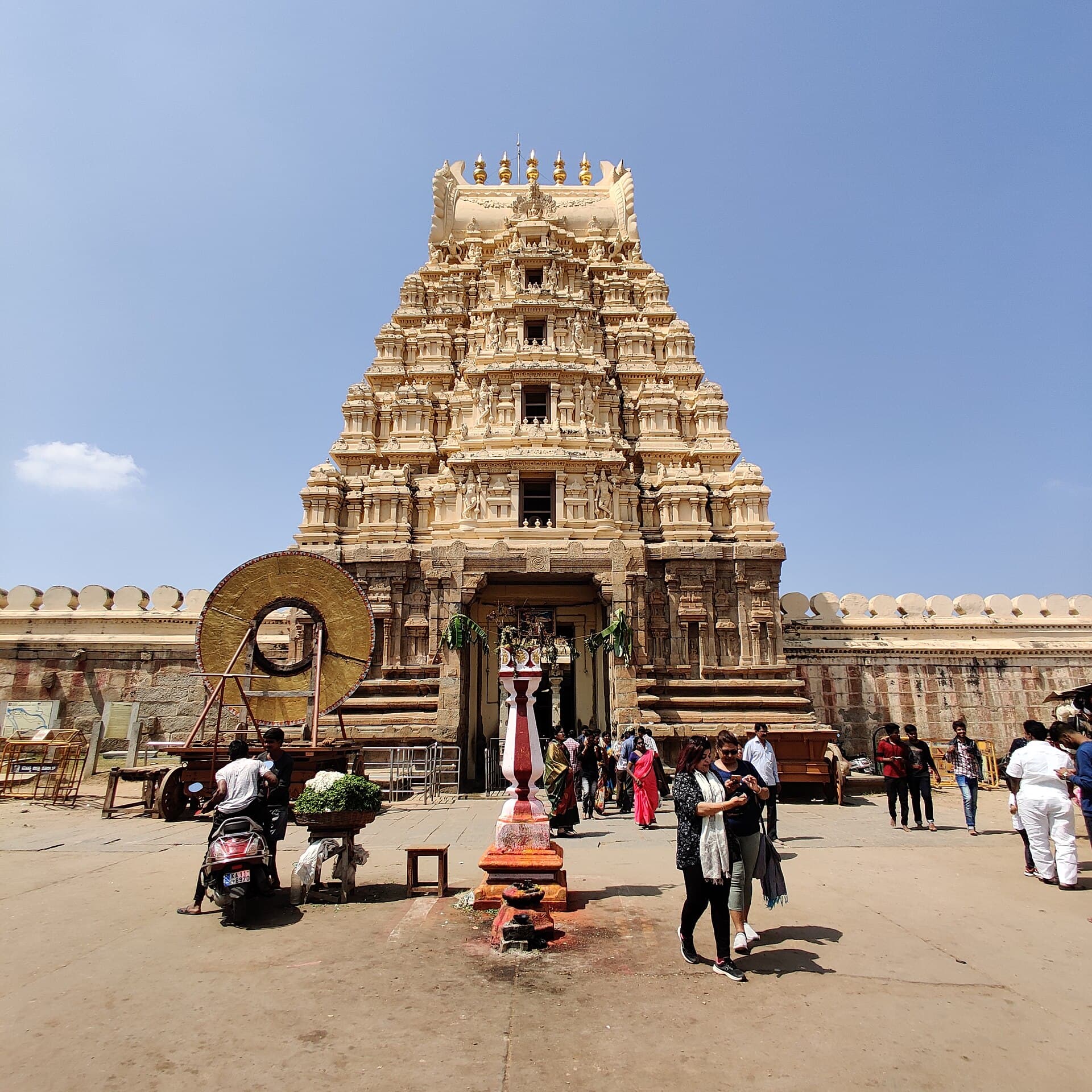
He endowed Hindu institutions throughout his reign. He conferred grants on temples and Brahmins, gave money for the consecration of images, and on at least one occasion ordered a temple built. The Ranganathaswamy temple operated inside his capital's fort walls, beside his palace, until the day he died.
Being Muslim bought no protection. The Mappilas of Malabar were Muslims and rose against him; he put the rising down with the same severity he used on anyone else. Faith did not determine who was punished. Loyalty did.
Sringeri: the best-documented episode of the reign
In 1791, during the Third Anglo-Mysore War, Maratha horsemen under Raghunath Rao Patwardhan raided the Sringeri math — the chief of the monasteries founded by Shankaracharya, and one of the most venerated institutions in southern India. They killed and wounded many people including Brahmins, plundered the monastery, and displaced the image of the goddess Sharada. The Swami left for Karkala.
The Jagadguru informed Tipu Sultan and asked for help in consecrating the image. Tipu Sultan's reply survives, along with the rest of the correspondence: people who sin against such a holy place, he wrote, will soon suffer the consequences of their misdeeds. He funded the restoration of the temple and the re-consecration of Sharada.
The correspondence was found in the temple at Sringeri by Rao Bahadur K. Narsimhachar, then Director of Archaeology in Mysore, and published in the Mysore Archaeological Report for 1916. The letters run from 1791 to 1798, dated in the mauludi era with Hindu dates given alongside. The math's own record counts twenty-nine letters written to the Acharya between those years.
They are not only condolences. He asked the Acharya to perform Satachandi and Sahasrachandi rites, wrote afterwards that the ceremonies had brought rain and success, and said he depended on three things: God's grace, the Jagadguru's blessing, and the strength of his own arm. He asked the Acharya to bless his gifts to the temples at Kanchi and the repair of temples damaged during his father's campaigns. He wanted to make the pilgrimage to Sringeri himself, and never did.
This is a large body of dated, institutionally held evidence, and it is held by the Hindu institution concerned rather than by anyone with a case to make about Tipu Sultan.
The hard cases
None of the above disposes of the other half of the record. Three episodes involved mass deportation, the destruction of communities, and conversions — and no honest account of the reign can treat them as footnotes. They have their own pages, because each has a different evidentiary problem.
The Canara Christians, 1784–99
The deportation of the Catholic community of Canara to Srirangapatna, held for fifteen years — the best attested of the three, and the one where the numbers vary most wildly.
Read →
Coorg
Repeated risings, repeated reprisals, and a conversion figure that appears in a chronicle written to praise him — and that exceeds the likely population of the province.
Read →
Malabar
The longest and bloodiest of the three, where Mysore fought Nairs and Mappilas alike, and where the social order it attacked was itself violent.
Read →
Where this site stands
Following Hasan, and the contributors to Irfan Habib's Confronting Colonialism, this site holds that Tipu Sultan did not persecute Hindus as Hindus, did not pursue a policy of converting his Hindu subjects, and treated disloyalty — Hindu, Muslim or Christian — with the same eighteenth-century severity. The appointments, the endowments and the Sringeri correspondence are not decoration on a record of persecution; they run continuously through the same years as the campaigns.
It also holds that the deportations were real, that they destroyed communities, that conversions took place within them, and that no amount of context makes that a small thing. A ruler can endow a math in one province and empty a district in another. Tipu Sultan did.
Reading about this subject elsewhere
More is written about Tipu Sultan's religious policy than about anything else he did, and most of it is unusable. A large web literature exists on both sides which quotes the eighteenth-century chronicles selectively, treats the panegyric conversion figures as confessions, or answers them by denying that the deportations happened at all. Sites of that kind are not cited here in either direction.
The scholarship worth reading is named at the foot of this page, and the primary material is on the Documents page, where each source carries a note on what it was written to do. The general rules this site follows are set out in Sources & Method.
Sources for this page
- Mohibbul Hasan, History of Tipu Sultan (Calcutta, 1951; rev. 1971), ch. XXI 'Religious Policy' — for the Hindu officers of the state, the Sringeri letters, and his assessment of the conversion figures.
- Mysore Archaeological Report, 1916 — first publication of the Sringeri correspondence, found by Rao Bahadur K. Narsimhachar.
- Sringeri Sharada Peetham, the math's own account of Sri Sacchidananda Bharati III (1770–1814) and the twenty-nine letters.
- Irfan Habib (ed.), Confronting Colonialism: Resistance and Modernization under Haidar Ali and Tipu Sultan (2002).
- Kate Brittlebank, Tipu Sultan's Search for Legitimacy (1997) — on the religious idiom of the state, and on using Wilks and Kirkpatrick with care.
- Susan Bayly, Saints, Goddesses and Kings: Muslims and Christians in South Indian Society, 1700–1900 (Cambridge, 1989).
- Sultan-ut-Tawarikh and Tarikh-i-Khudadadi — Mysorean court chronicles, used here as evidence of how his own circle wished him portrayed.
- Mark Wilks, Historical Sketches of the South of India (1810–17), and William Kirkpatrick, Select Letters of Tippoo Sultan (1811) — hostile and contemporary; used with that bias stated.
Full bibliography and how we weigh sources: Sources & Method