The Military Genius
The Hostage Princes
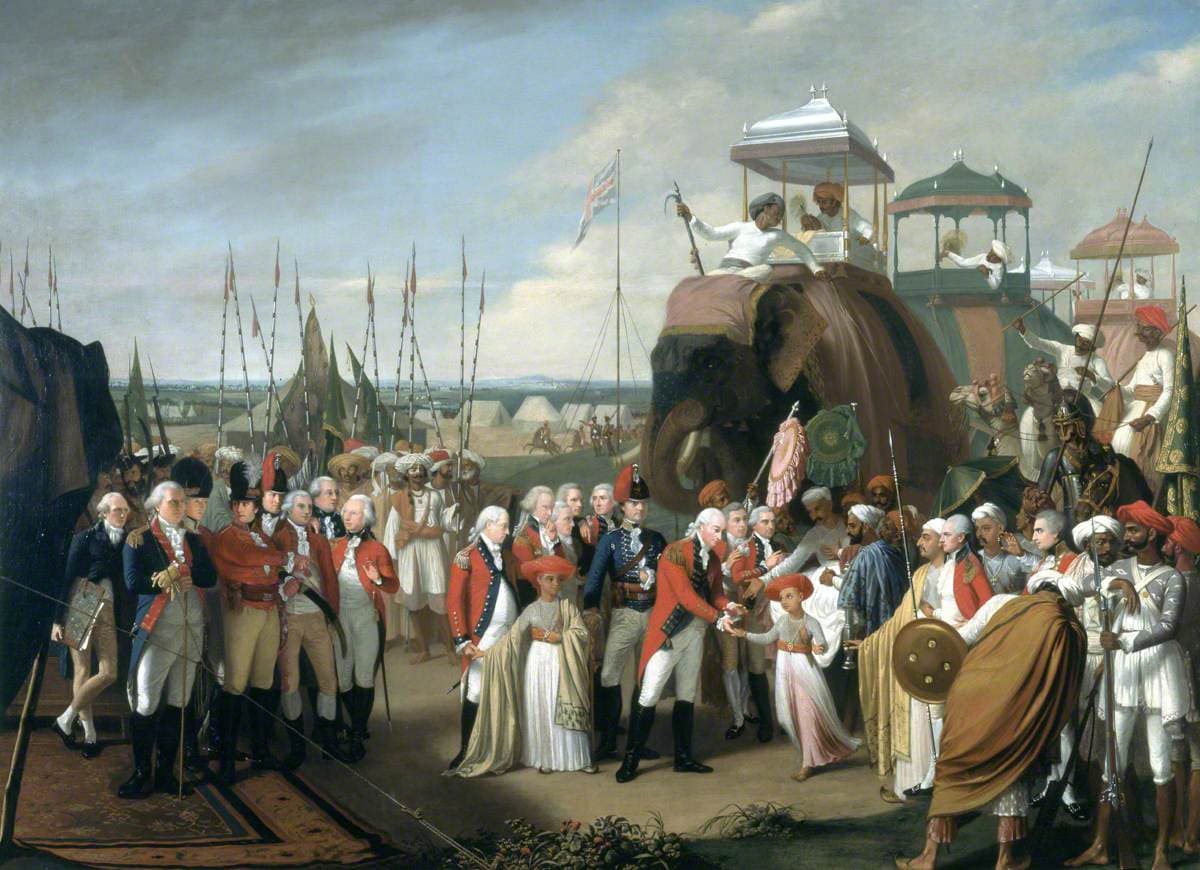
On 26 February 1792 two small boys were handed over to the British army outside their father's capital as security for a debt. They were returned two years later. In between, the scene was engraved, painted, staged and sold in London until it became one of the defining images of the British in India.
The terms
The Treaty of Seringapatam ended the Third Anglo-Mysore War on terms that took half of Tipu Sultan's territory and imposed an indemnity of three crores and thirty lakhs of rupees, half payable immediately. Until the remainder was paid, two of his sons were to remain in British hands.
The boys delivered to Lord Cornwallis were Abdul Khaliq, aged ten, and Muiz-ud-din, aged eight. Hostage-taking of this kind was a normal instrument of eighteenth-century Indian diplomacy and would not have struck either side as barbarous. What was unusual was the publicity.
What the two years were actually like
The princes were not imprisoned in any ordinary sense. They were lodged in a house at Fort St George in Madras, kept in some state, and taken to concerts, plays and dances — the social round of the Presidency. Cornwallis appears to have understood that their treatment was itself a diplomatic instrument, and that any harm to them would be both a political failure and a personal disgrace.
The best physical trace of those years is a portrait. On 8 August 1792 Abdul Khaliq sat for the miniaturist John Smart, and the result — now in the Victoria and Albert Museum — is a likeness of a ten-year-old taken from life, rather than an artist's idea of an oriental prince.
In February 1794, the treaty terms having been met, both boys were returned to Srirangapatna.
Why the scene was painted so often
The handover became one of the most reproduced subjects in British art about India. Mather Brown's composition of Cornwallis receiving the princes was engraved and sold widely; Robert Home and others produced their own versions; prints of the departure of the sons from the zenana circulated alongside them. The National Army Museum, the Royal Collection, the British Museum and the National Portrait Gallery all hold examples.
The appeal is not hard to reconstruct. The image let a British public see conquest as guardianship: a grave English nobleman receiving children with kindness, the humiliation of a defeated enemy rendered as a scene of paternal care. It is propaganda of an unusually effective kind, because nothing in it is invented — the handover happened, the boys were well treated — and the framing does all the work.
It is worth setting the paintings beside what the same settlement did on paper: half a kingdom transferred, an indemnity that forced the reduction of the Mysore army, and a state left too weak to survive the next war. The tender scene and the dismemberment are the same event.
Afterwards
Abdul Khaliq died in 1806, aged twenty-four, in the year the sepoys at Vellore rose and proclaimed his half-brother king. By then the family had been prisoners of the Company for seven years, and the boy in Smart's miniature had spent most of his life either as a hostage or as a pensioner of the people who had taken him.
Sources for this page
- Alexander Dirom, A Narrative of the Campaign in India which Terminated the War with Tippoo Sultan in 1792 (1793) — eyewitness account of the negotiation and the handover.
- National Army Museum, collection records for 'The Marquis Cornwallis receiving the Hostage princes' and related prints, and for the delivery of the sons to the vakeel.
- Victoria and Albert Museum, John Smart's miniature of Abdul Khaliq Sultan, sat 8 August 1792.
- Royal Collection Trust and National Portrait Gallery, prints after Mather Brown of the same subject.
- Mohibbul Hasan, History of Tipu Sultan (Calcutta, 1951; rev. 1971), on the terms of the Treaty of Seringapatam and the indemnity.
- Anne Buddle, The Tiger and the Thistle (1999) — on British representation of Mysore.
Full bibliography and how we weigh sources: Sources & Method