The Wars · 1780–1784
The Second Anglo-Mysore War
Mysore's high-water mark. It opened with the worst defeat British arms had yet suffered in India, continued through the death of one ruler and the accession of another in the middle of the campaign, and ended with the last treaty an Indian power dictated to the East India Company as an equal.
- Years
- 1780 – 1784
- Mysore
- Haidar Ali, then Tipu Sultan
- Allies
- France
- Ended
- Treaty of Mangalore
Origins
Haidar Ali entered this war with a grievance and an opportunity. The grievance was the Company's refusal to honour the mutual defence clause of the Treaty of Madras when the Marathas invaded Mysore in 1771. The opportunity was the American War of Independence: Britain was fighting France, Spain, and the Dutch simultaneously, and its Indian garrisons were stretched. The immediate trigger was the British seizure of French Mahé, a port under Haidar's protection, in 1779.
This time Haidar built the coalition. He brought in the Marathas and the Nizam — turning the Company's own instrument against it — and in July 1780 swept into the Carnatic with an army of perhaps 80,000, burning the countryside up to the outskirts of Madras.
Pollilur, 10 September 1780
The Madras government, slow to react and worse at coordinating, allowed its forces to move in separate columns. Colonel William Baillie's detachment of around 3,800 was caught before it could join Sir Hector Munro's main army near Pollilur, north-east of Kanchipuram.
Tipu Sultan commanded the enveloping attack. Mysorean cavalry pinned the column; artillery and rocket fire tore into the squares; and at the decisive moment rocket fire is credited by accounts from both sides with detonating Baillie's ammunition tumbrils. The explosion broke the formation. Baillie's force was destroyed — a few hundred survivors, several hundred prisoners including Baillie himself and the young David Baird, who would return nineteen years later to storm Srirangapatna.
It was the heaviest defeat the Company had suffered in India. Tipu Sultan had it painted in mural across a wall of his summer palace at Srirangapatna, where it still is.
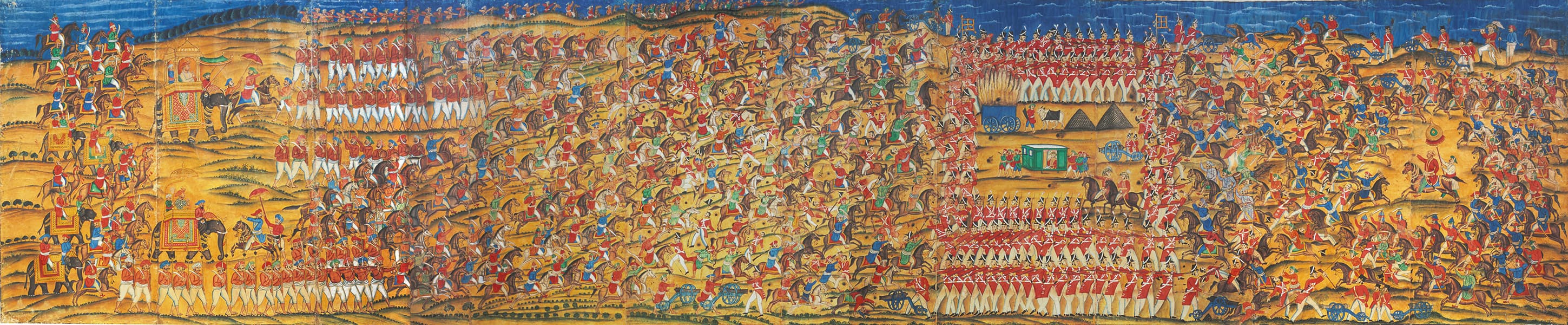
The mural, the finger-biting Baillie and the wall opposite are covered in detail on Daria Daulat Bagh and the Pollilur murals.
Coote's counter-offensive, 1781
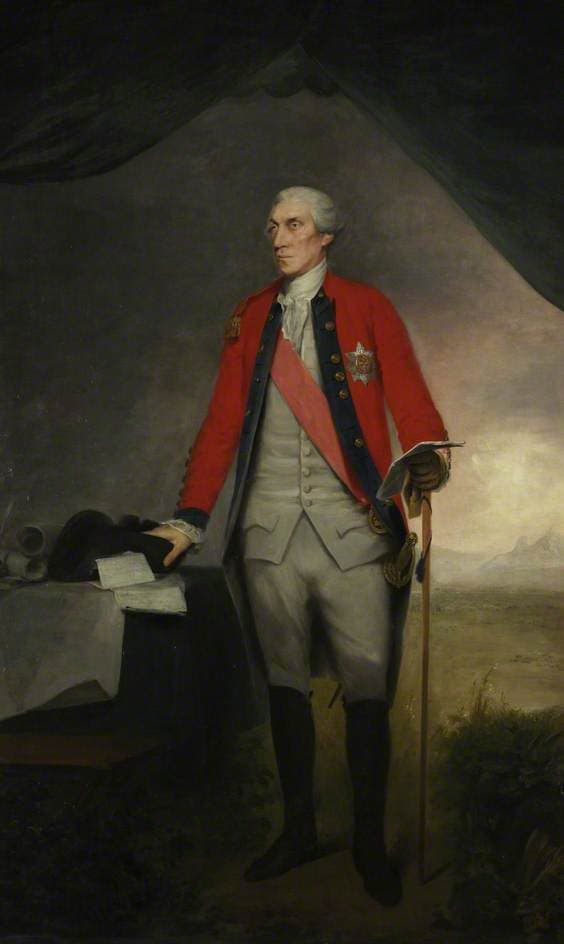
Warren Hastings responded from Calcutta by sending Sir Eyre Coote, the most capable British commander in India, with reinforcements. Coote could not match Mysore's mobility, but he could win set-piece battles, and he won three.
At Porto Novo on 1 July 1781, roughly 8,000 Company troops defeated a Mysorean army several times their size. A second action at Pollilur on 27 August and a third at Sholinghur on 27 September pushed Haidar out of the central Carnatic with heavy losses. The Marathas and the Nizam, as usual, withdrew from the alliance once the tide turned.
A succession in mid-war
The French fleet under Admiral Suffren arrived in 1782 and fought a series of hard-drawn naval actions along the Coromandel coast, restoring Mysore's hopes. Then, on 7 December 1782, Haidar Ali died of a carbuncle in camp — while his son was campaigning on the Malabar coast, hundreds of miles away.
This was the moment the war should have ended. A first-generation dynasty losing its founder mid-campaign, with an army in the field and enemies on three sides, was the classic recipe for collapse. The death was concealed until Tipu Sultan could return; he took control of the treasury and the army and continued the war without a break. It is among the strongest pieces of evidence for how thoroughly the Mysorean state had been institutionalized.
Tipu Sultan's campaign, 1783–84
As sultan, he recovered Bednore, pressed the British on the west coast, and in 1783 laid siege to Mangalore. The French, having made peace in Europe, withdrew their support in July 1783 — abandoning him mid-campaign, a foretaste of 1799. He continued alone. The starved-out garrison capitulated in January 1784 and was allowed to march away.
The Treaty of Mangalore, 11 March 1784
The terms were mutual restitution of all conquests and an exchange of prisoners. No territory lost, no indemnity, no hostages. Both sides simply returned to where they had started.
For an Indian power negotiating with the East India Company in the 1780s, that was a triumph — and it is remembered as the last treaty the Company signed with an Indian state on terms of equality, and the last it signed under duress. In London and Calcutta it was received as a humiliation requiring reversal. Within six years, Cornwallis was building the alliance to reverse it.
Sources for this page
- Mohibbul Hasan, History of Tipu Sultan — chapters on the Second War and the accession.
- Irfan Habib (ed.), Confronting Colonialism (2002).
- Kirmani (trans. Miles), Nishan-i-Haidari — the Mysorean account of Pollilur and Haidar's death.
- Treaty of Mangalore (1784), in Aitchison's Treaties, Engagements and Sanads.
- Roddam Narasimha, 'Rockets in Mysore and Britain' (1985) — on the rockets at Pollilur.
Full bibliography and how we weigh sources: Sources & Method