The Military Genius · The Adversaries
The Maratha Assessment
In the secret pages of his dream register, Tipu Sultan delivered a verdict on the finest light cavalry in India: they had put on the clothes of men, and would prove to be women. It has recently been argued that this was penetrating strategic insight. It deserves a fair trial — his case, the record's answer, and what the line actually was.
- The verdict
- Dream 13 · Oct 1786
- Panipat
- January 1761
- His tribute to Pune
- 12 lakhs a year
- Marathas fell
- 1818
The verdict, in his own hand
The line comes from the Shahnur dream of October 1786: a stranger who proved to be a woman in men's clothes, interpreted by the dreamer — and, unusually, announced to his officers — as a sign about the enemy across the river. Two days later he cut through Haripant Phadke's camp with a few hundred men and wrote that the Marathas had fled like women, omen and fulfilment in a single entry.
It would be easy to file the line as a taunt and move on. But a recent strain of popular commentary asks that it be taken seriously as military analysis — the claim being that Maratha reputation rested on raiding, that the confederacy repeatedly failed against organised opposition, and that Tipu Sultan saw through the legend. Since the claim exists, the site's method applies: state it fairly, and test it against the record.
The case for his contempt
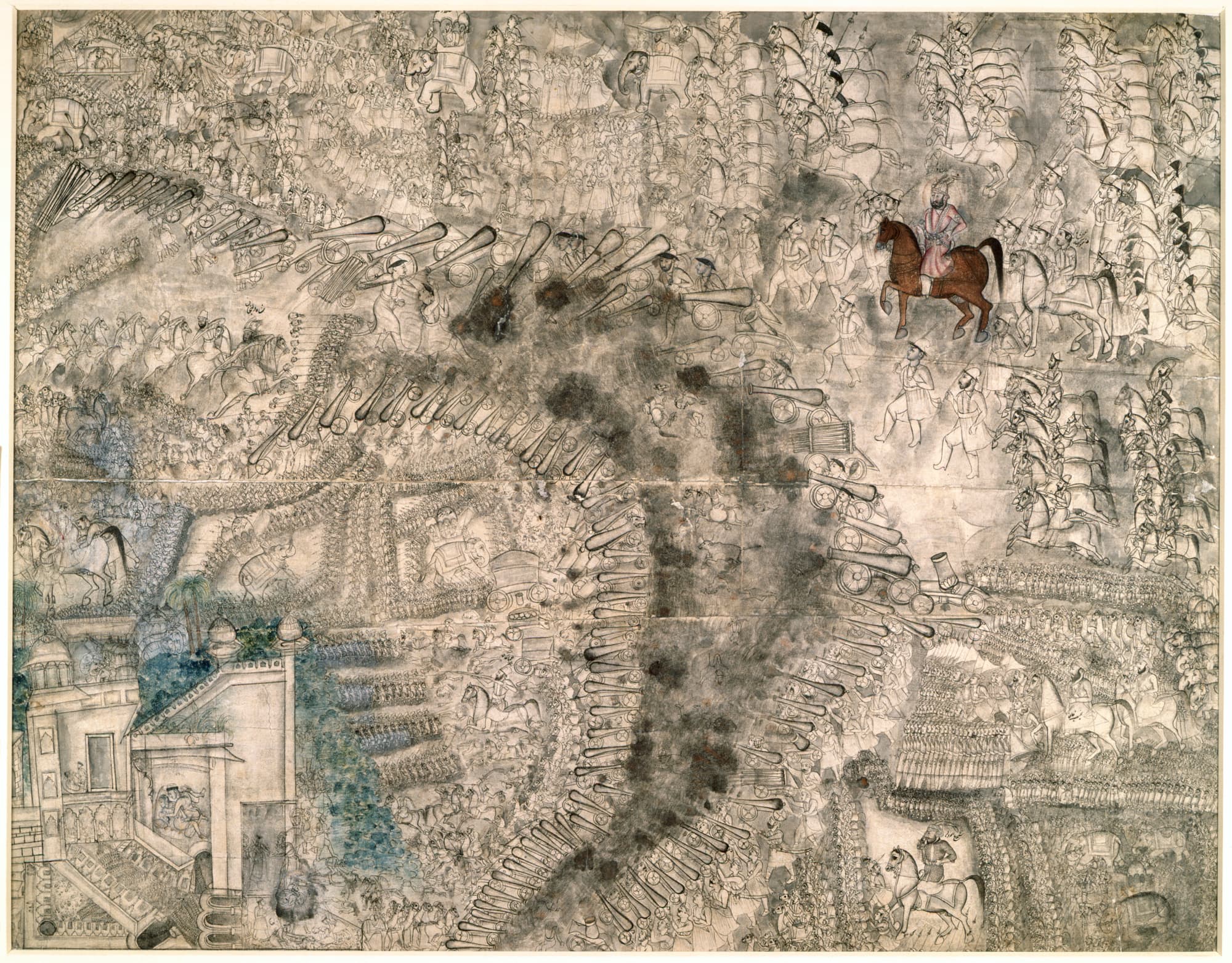
The steelman begins at Panipat. In January 1761 the largest army the confederacy ever fielded was destroyed in a single day by Ahmad Shah Abdali — the commander-in-chief Sadashiv Rao Bhau and the Peshwa's heir dead on the field, losses reckoned in the tens of thousands, a generation of leadership gone. No other Indian power suffered a comparable one-day catastrophe in that century.
The structural argument follows. Maratha warfare was built for the raid and the tribute claim — chauth extracted by mobility and threat — and it could struggle against disciplined infantry standing its ground. Mysore's European-drilled battalions beat Maratha armies in the field in 1786–87, Shahnur among the proofs; and when the Company finally turned on Pune in 1803, Assaye and Delhi were won by exactly the kind of army the raid could not break. On this reading, Tipu Sultan's line was a soldier's shorthand for a real doctrinal weakness.
The record's answer
The trouble starts with the family ledger. Under Madhavrao I, Maratha armies beat Nawab Haidar Ali Khan in 1764, 1766 and 1771, and made him pay for peace each time — the dreamer's own father could not hold his northern frontier against them until a Maratha succession crisis, not a Mysorean victory, changed the balance. Panipat itself is double-edged: within a decade of the catastrophe, Maratha armies were back in Delhi installing an emperor. A power that absorbs Panipat and recovers inside ten years is many things; fragile is not one of them.
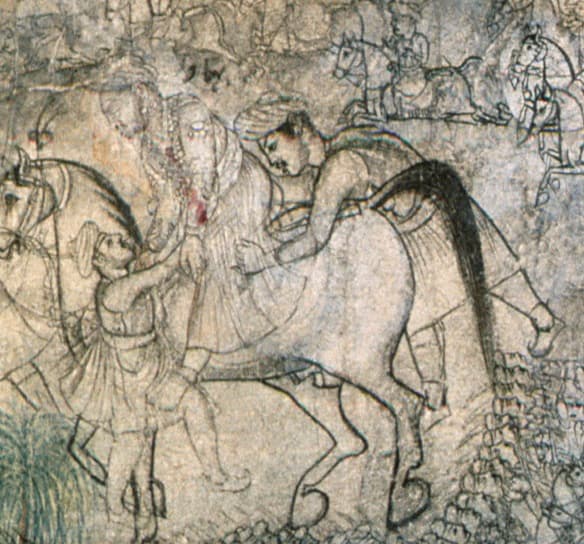
Then there is the witness of Tipu Sultan's own statecraft. At Gajendragad in 1787 — months after Shahnur, with the better of the fighting — he conceded territory and agreed to pay Pune twelve lakhs a year. Rulers do not pay annual tribute to armies of women in men's clothing. And in 1790–92 the deficiencies ran the other way: Maratha cavalry ravaged Mysore at will as part of Cornwallis's coalition and shared in the partition that took half the kingdom. Whatever the dream had promised, the raid-army hurt him exactly as raid-armies are designed to.
Reading the line honestly
Calling a beaten enemy women was the standard martial idiom of the eighteenth century, on every side of every war — British officers said it of the French, the Afghans said it of the Marathas, and chroniclers of every court said it of whoever ran. The dream entry speaks that language in the one document where Tipu Sultan performed for nobody but himself and his God: it is morale, omen and self-encouragement on the eve of a raid at long odds — not a staff appreciation.
His considered assessment is written elsewhere, in treaties and embassies rather than dreams. He paid the Marathas tribute he had not lost, courted Pune for a decade as the ally he needed against the English, and named their neutrality the condition of his survival. A man does not spend twelve lakhs a year and ten years of diplomacy on an enemy he genuinely believes will run.
There is a last irony the record insists on. The power he dreamed into women outlived him by nineteen years — the confederacy was the final major Indian power to fall to the Company, in 1818 — and it took the general trained in the Mysore war to break them. The fuller story of the relationship — the wars, the treaty, the failed courtship — is on the Marathas page.
Sources for this page
- Mohibbul Hasan, History of Tipu Sultan — the Maratha wars of 1785–87, Shahnur, and the Treaty of Gajendragad.
- Mahmud Husain (trans.), The Dreams of Tipu Sultan (1957), pp. 63–64 — dream thirteen.
- C. Hayavadana Rao, History of Mysore 1766–1799 (1946) — the Haidar Ali–Maratha wars and their settlements.
- Jadunath Sarkar, Fall of the Mughal Empire — Panipat and the Maratha recovery of the north.
- Irfan Habib (ed.), State and Diplomacy under Tipu Sultan (2001) — the Pune diplomacy.
- India News Week, 'Deconstructing the Maratha Military Reputation' (December 2024) — the popular argument examined on this page; unsigned and without named sources, cited here as the claim under test, not as evidence.
Full bibliography and how we weigh sources: Sources & Method