The Diplomat · The Ottoman Empire
Constantinople
Nine hundred people, four ships, and nearly two years on the road to ask the caliph for four things: a crown, a port, the right to repair the shrines of Islam, and an army. He got the first.
- Departed
- Tadri, 1785–86
- Arrived
- Constantinople, Sept 1787
- Led by
- Ghulam Ali Khan
- Sultan
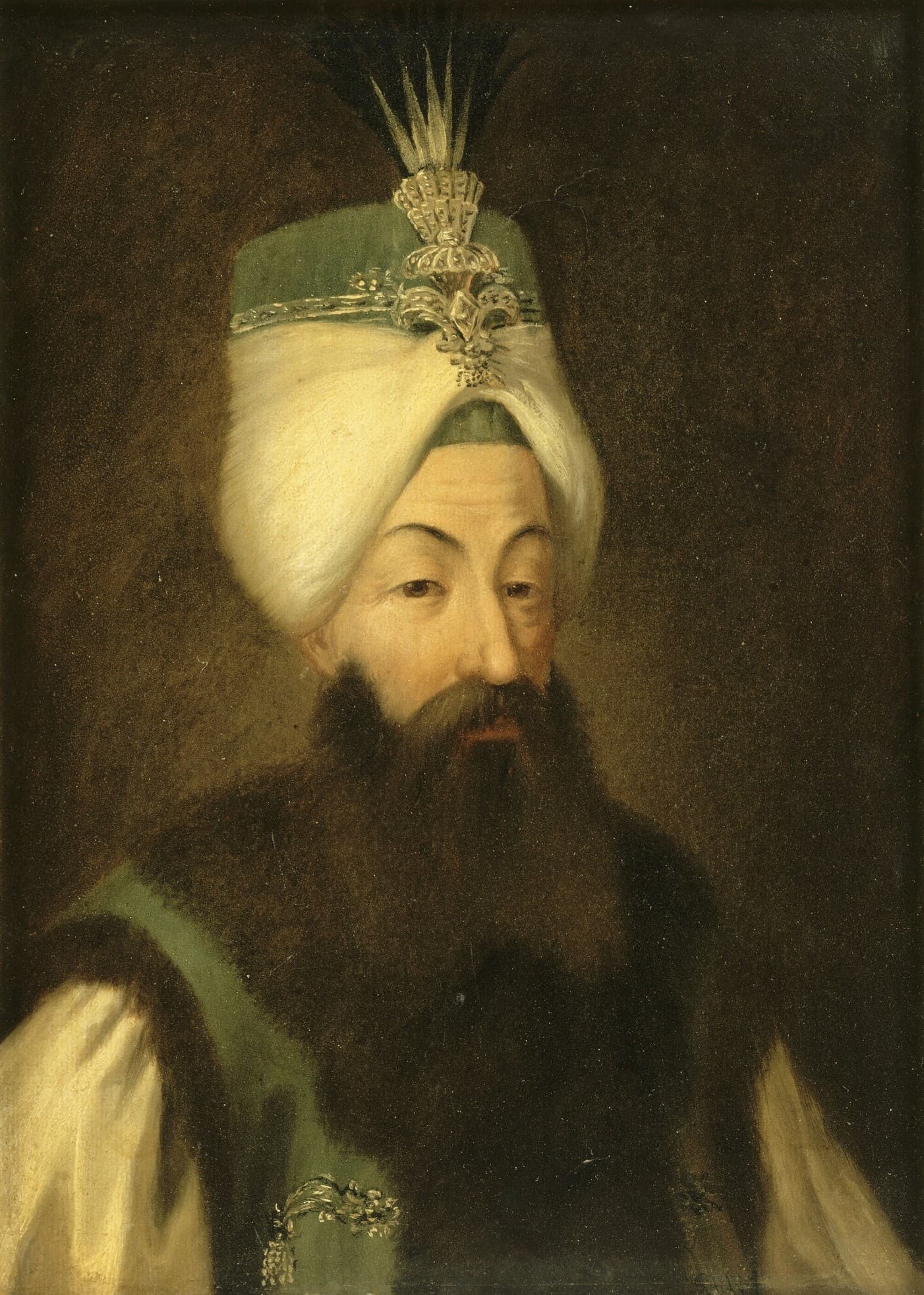
- Abdul Hamid I
Why the Ottomans mattered
Tipu Sultan had a legitimacy problem. His father had ruled Mysore in the name of a Wodeyar raja; he himself had dropped that fiction and declared his own sovereignty, dropping the Mughal emperor's name from his coinage. But by whose authority was a soldier's son a king? The answer he chose was the highest one available in the Islamic world: the Ottoman Sultan, still recognized as caliph, still the foremost political power of Islam despite the decay of his empire.
Recognition from Constantinople would place Tipu Sultan above the Nizam of Hyderabad, whose own standing rested on a Mughal viceroyalty. It would also, he hoped, unlock troops, trade, and a port.
The journey
An exploratory mission went out in 1784 under Usman Khan. The great embassy followed: roughly 900 people in four ships, leaving the Malabar port of Tadri near Mangalore in 1785–86 under Ghulam Ali Khan, with a full suite of secretaries, merchants, servants, and pilgrims, and cargo to trade along the way.
They reached Basra in the summer of 1786, and then went overland — Bushire, Baghdad, and north — arriving at Constantinople in September 1787, close to two years after setting out. Many died on the journey. Tipu Sultan's written brief to his ambassadors survives among the documents Irfan Habib collected: it instructs them to work in consultation with one another and to address Ottoman notables with complete respect, as supplicants and solicitors. He was under no illusion about who was asking whom.
What he asked for
1. Recognition as an independent sovereign. The right to have the khutba read and coin struck in his own name. Granted. The embassy returned with letters, robes of honour (khilats), and a jewelled sword and shield from the caliph and his Grand Vizier. It was a real diplomatic victory, won against active British lobbying at the Porte.
2. Basra, in exchange for Mangalore. The most audacious proposal of his reign: give Mysore the port of Basra at the head of the Gulf, and take Mangalore on the Malabar coast in return, with reciprocal trading privileges — and Mysorean troops to help garrison Basra. Tipu Sultan wanted what the European companies had: an overseas settlement of his own, a base in the Gulf beyond the reach of the East India Company's network. Refused. The Grand Vizier is reported to have taken offence at being offered soldiers by a prince who had come to beg for them.
3. The shrines. He sought permission to contribute to the upkeep of the holy places — Mecca and Medina, and the shrine cities of Najaf and Karbala — including an offer to fund completion of the canal works bringing Euphrates water to Najaf, a project the Nawab of Awadh had begun. An Ottoman rescript of May 1787 records the provincial government being ordered to arrange a pilgrimage caravan into south-central Iraq for the Mysorean envoys, who were preparing to visit the tombs of Imam Ali at Najaf and Imam Husayn at Karbala.
4. An alliance. Troops, military experts, and an Ottoman expeditionary force against the British — and, in a later mission, the suggestion that Constantinople and Mysore might divide Britain's Indian possessions between them. Refused completely.
A crown from the caliph is not a suzerain
The investiture is sometimes read backwards — as if a farman from Constantinople made Mysore a province of the Caliphate. The grant itself says the opposite. In Islamic political practice, sovereignty is declared by two things: whose name the Friday khutba is read in, and whose name the coin carries. A territory of the Caliphate reads the khutba in the Caliph's name. What Tipu Sultan asked Istanbul to sanction — and got — was the khutba and the coin in his own name. From 1787 the khutba at Srirangapatna was recited for Tipu Sultan Padshah: the Caliph had certified Mysore's independence, not absorbed it. No tribute went to Istanbul, and no Ottoman writ ever ran in Mysore.
Nor was the request an innovation. Sultans of Delhi had sought investiture from the Abbasid caliphs for centuries on the same understanding — a blessing on sovereignty already held, not a transfer of it. What was new was the address. Into the mid-1780s Tipu Sultan still observed the Mughal forms, sending ceremonial tribute to Shah Alam II in Delhi; by 1787 the Mughal emperor was a Maratha instrument, and the House of Haidar stopped pretending otherwise. Legitimacy was re-anchored — formally on the Caliph's letter, and in the state's own vocabulary on God directly: the Sarkar-i-Khudadad, the God-given government, owing its crown to no earthly overlord at all. The test of all this came in 1798, at the end of this page: when the Caliph finally issued Mysore an instruction, Tipu Sultan did not obey it.
Piety, or statecraft?
The shrine proposals are often read as simple devotion, and the piety was real. But paying for the sacred infrastructure of Islam was also the oldest legitimacy claim in the Muslim world. Awadh and Persia were already patrons of the shrine cities; a Mysorean canal at Najaf would place the Sarkar-i-Khudadad in that company, and would be seen doing so by pilgrims from across the Islamic world. The embassy carried devotion and diplomacy in the same baggage — as it carried merchants' goods alongside the ambassadors' briefs.
Why it failed
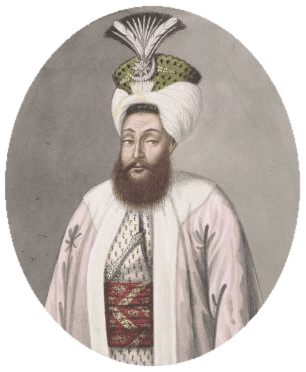
Timing and geopolitics. The Ottomans were sliding toward another war with Russia and could not afford to alienate Britain, whose goodwill they needed far more than a friendship in South India. British diplomats at the Porte worked hard against the mission and were largely successful. Abdul Hamid I died in 1789 and was succeeded by Selim III while Mysorean envoys were still abroad; the change brought no change of policy.
The last exchange is almost a parody of the whole effort. In 1798, with Napoleon in Ottoman Egypt, the Sultan wrote to Tipu Sultan urging him to regard the French as enemies of Islam — asking Mysore, on religious grounds, to abandon the only ally it had left.
Sources for this page
- Irfan Habib (ed.), State and Diplomacy under Tipu Sultan: Documents and Essays (2001) — the ambassadors' briefs, 1785–86.
- I. H. Qureshi, 'The Purpose of Tipu Sultan's Embassy to Constantinople', Journal of Indian History 24 (1945).
- A. K. Pasha, 'Tipu Sultan's Relations with the Ottoman Empire', Détente X (1992).
- M. Choudhury, 'Tipu and the Turks: An Islamicate Embassy in the Age of British Expansion', Itinerario (2023) — on the Ottoman archival rescripts.
- Mohibbul Hasan, History of Tipu Sultan — chapter on relations with Turkey.
Full bibliography and how we weigh sources: Sources & Method