Legacy & Memory · Objects & Relics
The Huma Bird
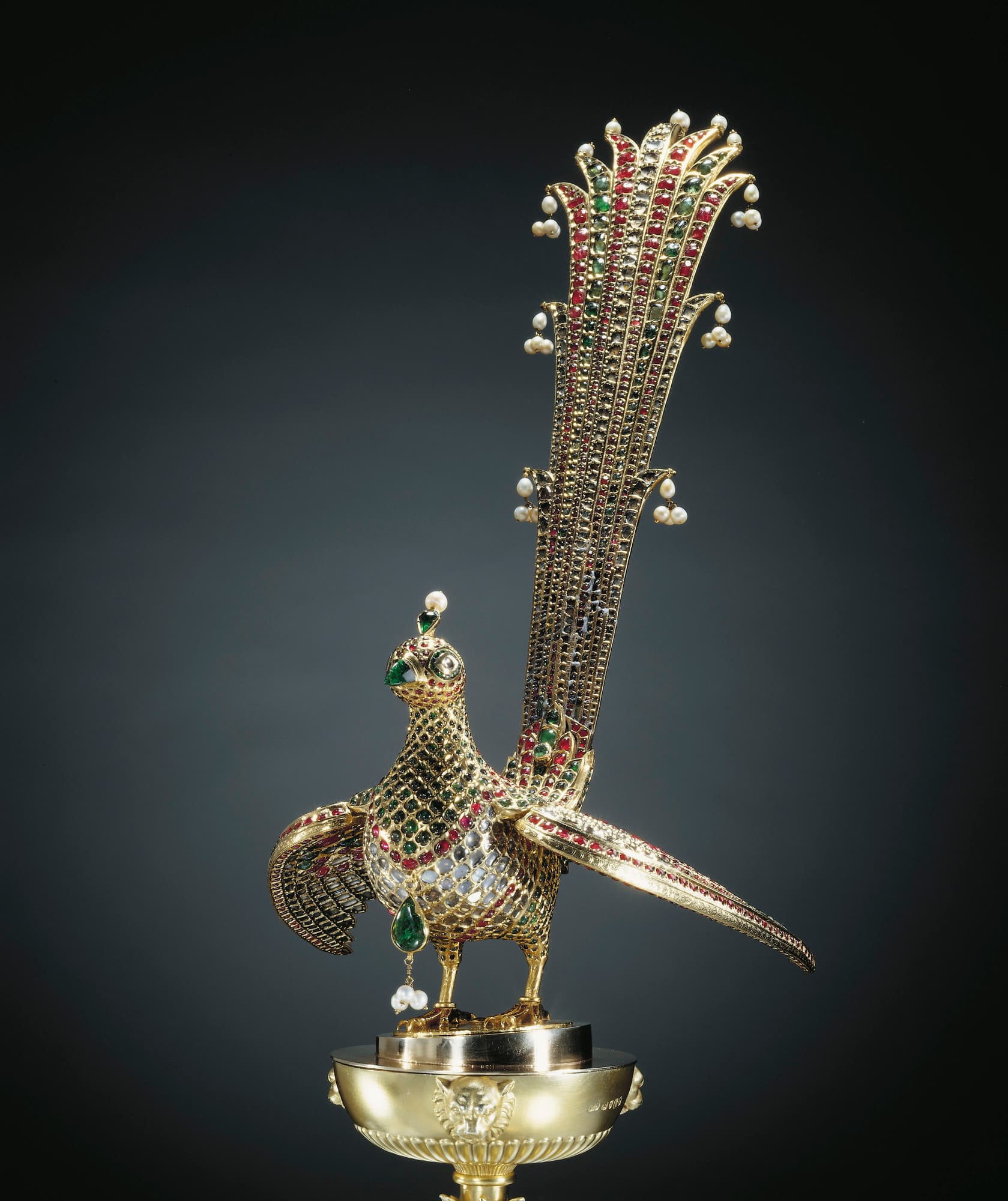
On the canopy of Tipu Sultan's golden throne, directly above the ruler's head, stood a bird of gold set with hundreds of rubies, emeralds and diamonds — the huma, the Persian bird that never lands, whose shadow falling on a man marks him out for kingship. The throne was broken up for prize money. The bird survived, and stands at Windsor Castle.
- Made at Srirangapatna
- c. 1787–91
- Height
- 42 cm
- Presented to George III
- 1800
- Now at
- Windsor · RCIN 48482
The bird whose shadow makes kings
The huma comes out of ancient Persian tradition: a bird in eternal flight that never touches the earth, and whose shadow, passing over a man, confers fortune and sovereignty. The idea travelled with Persian courtly culture into South Asia, where the huma became a standing emblem of kingship — and it lived on in Sufi poetry. In Attar's Conference of the Birds, the huma is the bird that refuses to join the pilgrimage at all: why should the bird that bestows kingship go seeking anything? Persian and Mughal courts even said the plumes in a king's turban were huma feathers — a claim worth remembering when you look at the plume-holder on Tipu Sultan's war turban.
Set on the canopy of a throne, the emblem becomes an argument. A bird that never lands, fixed in gold directly over the sovereign's seat, casts its shadow on one man permanently: the kingship it confers can never pass to anyone else. For a ruler like Tipu Sultan — a usurper's son with a documented interest in Sufism, who named his state the God-given government — it was the right bird in exactly the right place.
The bird itself
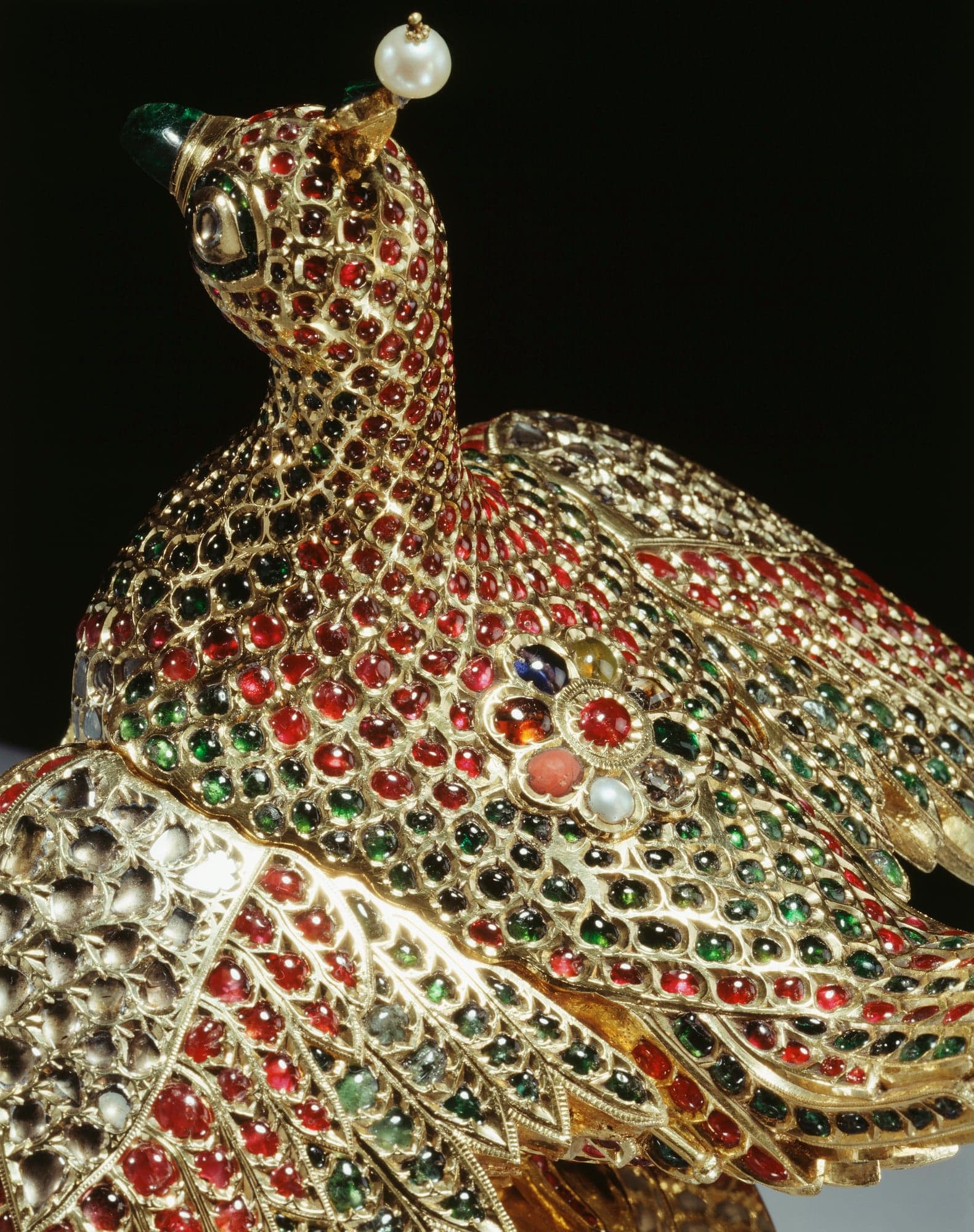
The figure is gold, about 42 centimetres tall with the fanned tail, made at Srirangapatna around 1787–91, when the throne itself was built. The body is covered in chased gold feathers, each set with its own stone — rubies and emeralds by the hundred, with diamonds for the eyes and a pointed emerald for the beak. The crest is an emerald drop under a pearl; a larger matching pendant hangs at the chest; the tail plumes end in pearls.
On the bird's shoulder sits a detail that is easy to miss in photographs and impossible to miss in person: a flower of nine different gems — ruby at the centre, ringed by pearl, coral, emerald, diamond, sapphire, topaz, hessonite and tiger's eye. That is the set Indian tradition groups as the nine auspicious stones, the navaratna — a Hindu astrological scheme, worked into the imperial bird of a Muslim court's throne. Like the coinage named for both saints and stars, the object is less doctrinaire than the arguments fought over its owner.
The throne it crowned
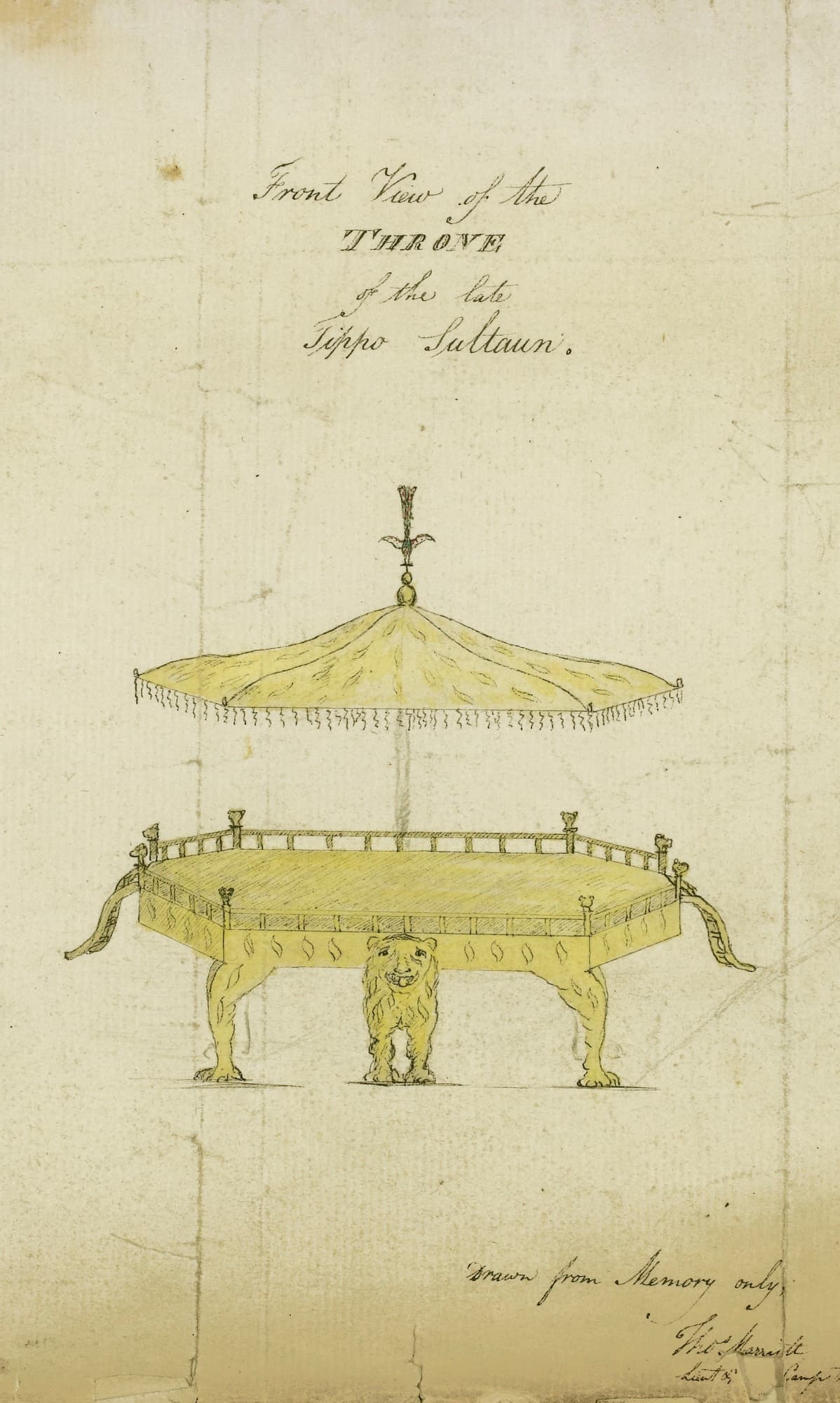
The throne was an octagonal platform of gold-covered wood carried on the back of a life-size gilded tiger, with a railing of small tiger heads around its edge and a fringed canopy above, the huma on the canopy's finial. Tipu Sultan is recorded to have sworn not to mount it until he had driven the English from India, and the scholarship takes him at his word: there is no account of him ever sitting on it.
No reliable painting of the assembled throne was made while it existed. The best visual record is by Lieutenant Thomas Marriott, who drew the front view at Srirangapatna in 1799 with Benjamin Sydenham supplying the description — and who wrote across the sheet, honestly, “Drawn from Memory only”. By the time anyone thought to document the throne, it no longer existed to be drawn.
Broken up in weeks
The prize committee at Srirangapatna valued the throne as bullion and had it cut apart for division — the act that scattered the tiger's head, the railing finials and the huma bird into separate hands at auction. Governor-General Richard Wellesley, realising what had been destroyed, tried to buy the pieces back, hoping to reassemble the throne as a gift for the Crown. He was too late for the throne. He got the bird.
The Royal Collection's own provenance runs: acquired by Marquess Wellesley for the Directors of the East India Company in 1799; presented by them to George III in 1800; given by the King to Queen Charlotte; bequeathed at her death in 1818 to four of her daughters; and given by them to George IV in the same year. In the 1820s the royal goldsmiths Rundell's mounted it on the gilt stand it still occupies — into which, in a small act of historical tact, they worked a ring of tiger heads. It stands today in the Grand Vestibule at Windsor Castle, as RCIN 48482.
The bird and the argument
The huma bird is regularly cited in the repatriation debate, and for good reason: it is the single most concentrated piece of the throne to survive, and the throne is the sharpest case of the 1799 prize system destroying what it valued. In 2019 the Indian government formally objected to the continued auctioning of Srirangapatna material in Britain; British export review committees have, in individual cases, barred pieces from leaving the country on the ground of their significance to British history — an irony the objects themselves are indifferent to.
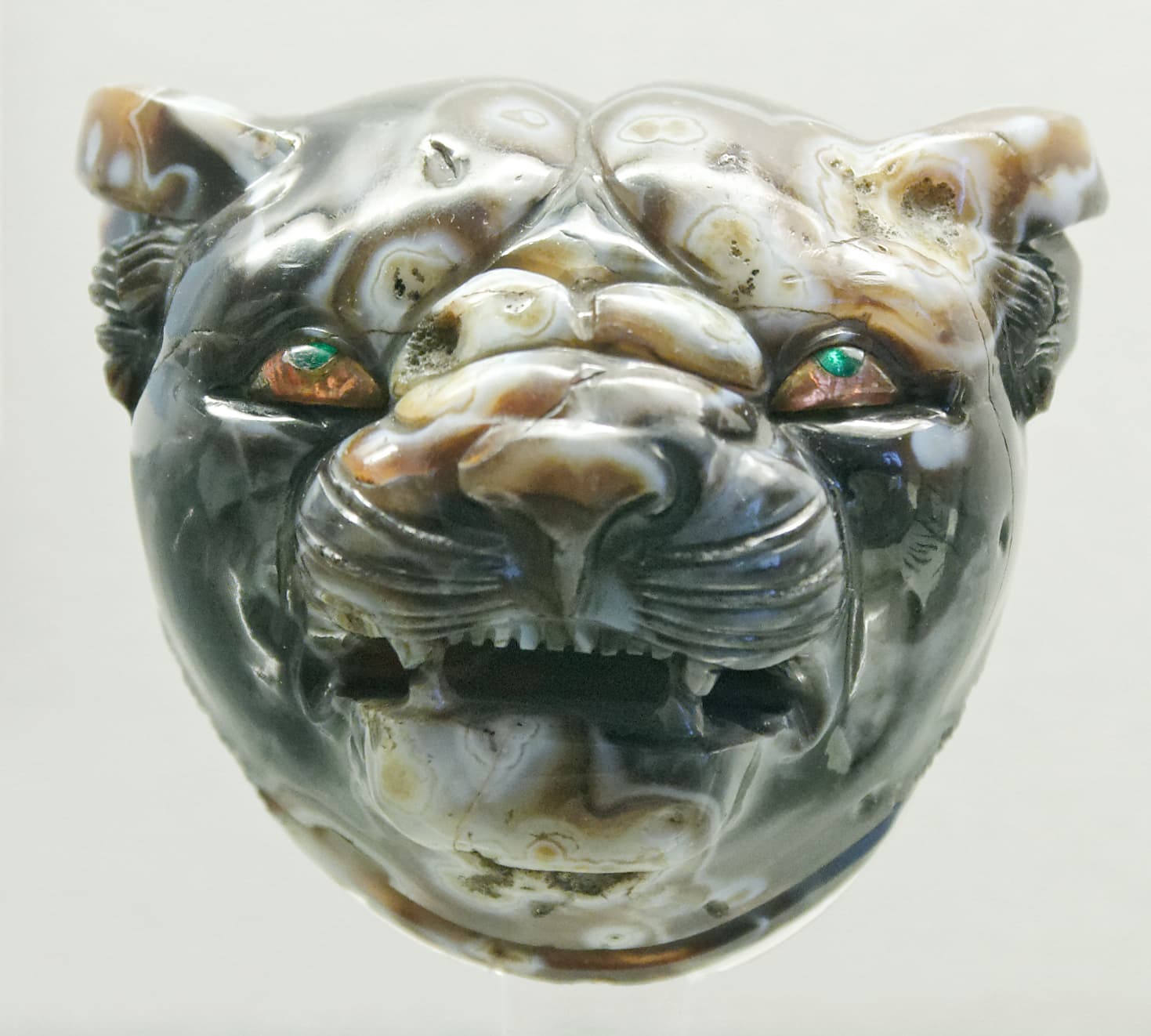
The wider argument, and this site's position of stating the taking plainly while resolving nothing, is set out on Objects & Relics. The other surviving throne fragments — the great gold tiger's head with its rock-crystal teeth, and the small railing finials — are catalogued there too.
Sources for this page
- Royal Collection Trust, object record RCIN 48482 (huma bird) — description, dating and the published provenance this page follows.
- Thomas Marriott and Benjamin Sydenham, 'Front View of the Throne of the late Tippo Sultaun', 1799 — the drawing inscribed 'Drawn from Memory only'.
- Imperial Art (imp-art.org), 'Tipu Sultan's Huma Bird Ornament' — on the object's construction, gem-setting and the huma in Zoroastrian and Sufi tradition.
- Attar of Nishapur, The Conference of the Birds — the huma's refusal; and the Persian tradition of the never-landing bird whose shadow confers kingship.
- Splainer, 'Blood Runs Cold' art section (2025) — on the dispersal of the throne and the repatriation debate.
- Mohibbul Hasan, History of Tipu Sultan — on the throne, the oath attached to it, and the fall of the capital.
- Anne Buddle, The Tiger and the Thistle (1999) — on the throne fragments and their British afterlife.
Full bibliography and how we weigh sources: Sources & Method