Tipu Sultan attracts confident claims from every direction. Here are the ones we're asked about most, each tested against the documents and the scholarship — with a verdict of exactly the strength the evidence allows.
“Tipu Sultan invented the rocket.”
Overstated
Gunpowder rockets existed for centuries before Mysore. What Haidar Ali and Tipu Sultan's workshops did was fit them with iron cases — greatly increasing range and lethality — and organize dedicated rocket corps with written doctrine. That is the first effective military rocket system, and it directly seeded Britain's Congreve rocket. Real achievement; wrong verb.
“The 'rockets' red glare' in the US anthem traces back to Mysore.”
Supported
Congreve's rockets, developed at Woolwich from captured Mysorean technology after 1799, were fired at Fort McHenry in 1814 — the rockets Francis Scott Key watched. The chain Srirangapatna → Woolwich → Baltimore is documented ordnance history.
“Tipu Sultan was a fanatic who ruled by forced conversion.”
Not supported as stated
Mass captivity, the destruction of communities and conversions among the captives are documented in specific conquered or rebellious territories — Coorg, Malabar, the Canara Catholics of 1784. There is no evidence of any such policy toward the Hindu majority of core Mysore, whose temples operated freely, whose revenue administration was heavily Hindu-staffed, and whose chief minister was a Brahmin. The totals usually quoted are unreliable in both directions: the largest conversion figures come from court chronicles written by his own admirers to prove his piety. See Religious Policy for each episode and its evidence.
“Tipu Sultan was a secular ruler who never harmed any community.”
Not supported either
The mirror-image myth. Tipu Sultan was a devout Muslim ruler of an explicitly Islamic state who endowed temples and also brutalized rebellious populations, some along lines his own letters framed religiously. Sanitizing the record is as unhistorical as demonizing it.
“Tipu Sultan protected the Sringeri math after the Marathas sacked it.”
Supported
The 1791 Maratha raid on Sringeri and Tipu Sultan's response — outraged letters to the Shankaracharya and funds for restoring the image of the goddess — survive in the math's own records. It is among the best-documented episodes of his reign.
“Tipu Sultan died fighting, refusing to flee or surrender.”
Supported
British and Mysorean accounts agree: offered escape by his attendants during the storming of 4 May 1799, he refused, fought at the ramparts and the Water Gate, and was killed at close quarters. His body was found under the dead that evening.
“He was betrayed by Mir Sadiq.”
Partly documented, partly legend
British-paid correspondence with figures inside the fort is documented, and the defence collapsed suspiciously fast. The theatrical details — troops marched off for pay as the assault began — rest on later chronicle and cannot be verified. Treachery: likely. The famous choreography: unproven.
“Tipu Sultan joined a Jacobin Club as 'Citizen Tipu'.”
Thinly sourced
The story of a Jacobin Club at Srirangapatna and Tipu Sultan planting a liberty tree comes from limited and partly hostile sources; historians differ on how much ceremony (or irony) to read into it. His substantive alliance-seeking with Revolutionary France, however, is fully documented.
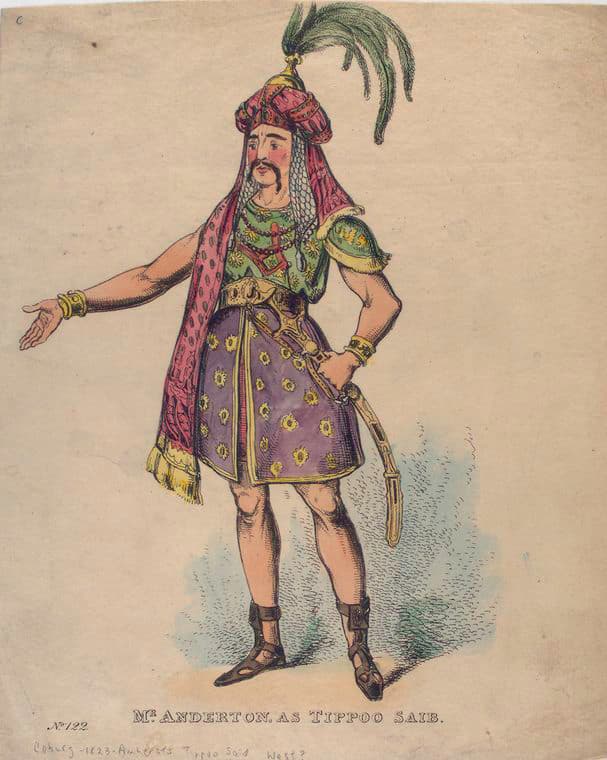
An actor billed as 'Tippo Saib'. Within a few years of his death he had become a stage character in Britain and America — proof of how quickly the man was replaced by a costume. New York Public Library. (Unknown etcher · Public domain)
Sources for this page
Mohibbul Hasan, History of Tipu Sultan — the base narrative against which claims are tested.
Irfan Habib (ed.), Confronting Colonialism — on propaganda and the religious-policy debate.
Roddam Narasimha, 'Rockets in Mysore and Britain' (1985).
A. K. Shastry, The Records of the Sringeri Dharmasamsthana (2009).
Kate Brittlebank, Tipu Sultan's Search for Legitimacy (1997).