Innovation · Flagship
Mysorean Rockets
Not 'Tipu Sultan invented the rocket' — rockets were centuries old. What Mysore did was harder and more consequential: it industrialized them, cased them in iron, organized them into a corps, and used them so effectively that its enemy reverse-engineered the weapon and carried it around the world.
- Casing
- Hammered soft iron
- Range
- ~1–2 km reported
- Corps
- Dedicated rocket units
- Successor
- Congreve rocket, 1805
What existed before Mysore
Gunpowder rockets had been used in Asian warfare since medieval China, and were familiar in India for centuries — bamboo- or pasteboard-cased, short-ranged, erratic, and mostly good for frightening horses. European armies had largely abandoned them as toys. This is the baseline against which Mysore's contribution has to be measured.
What Mysore changed
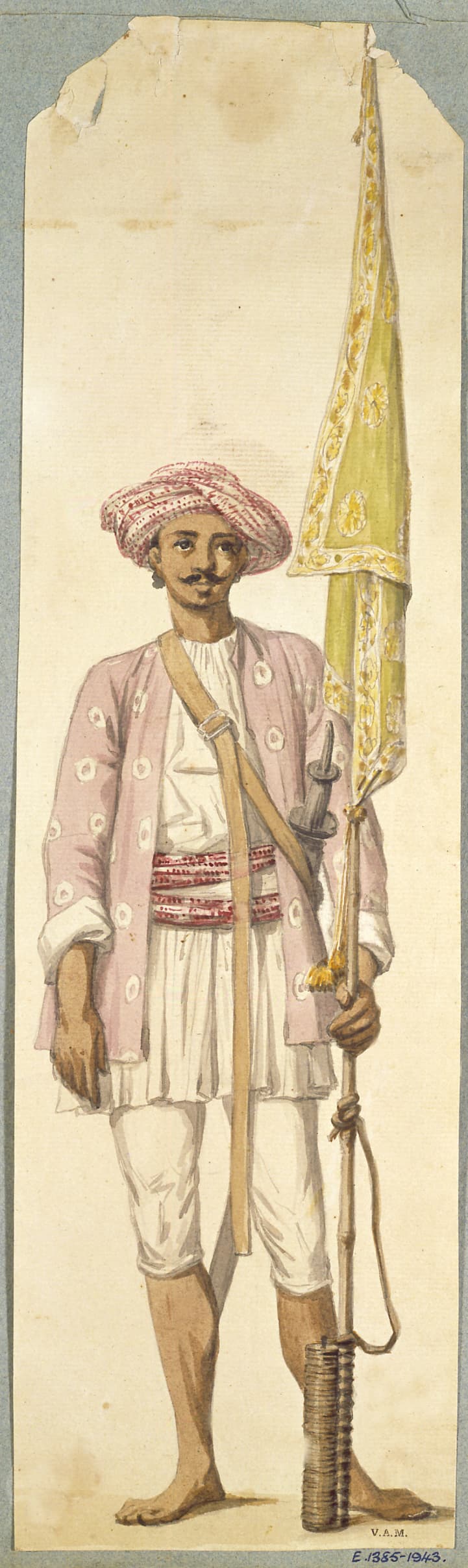
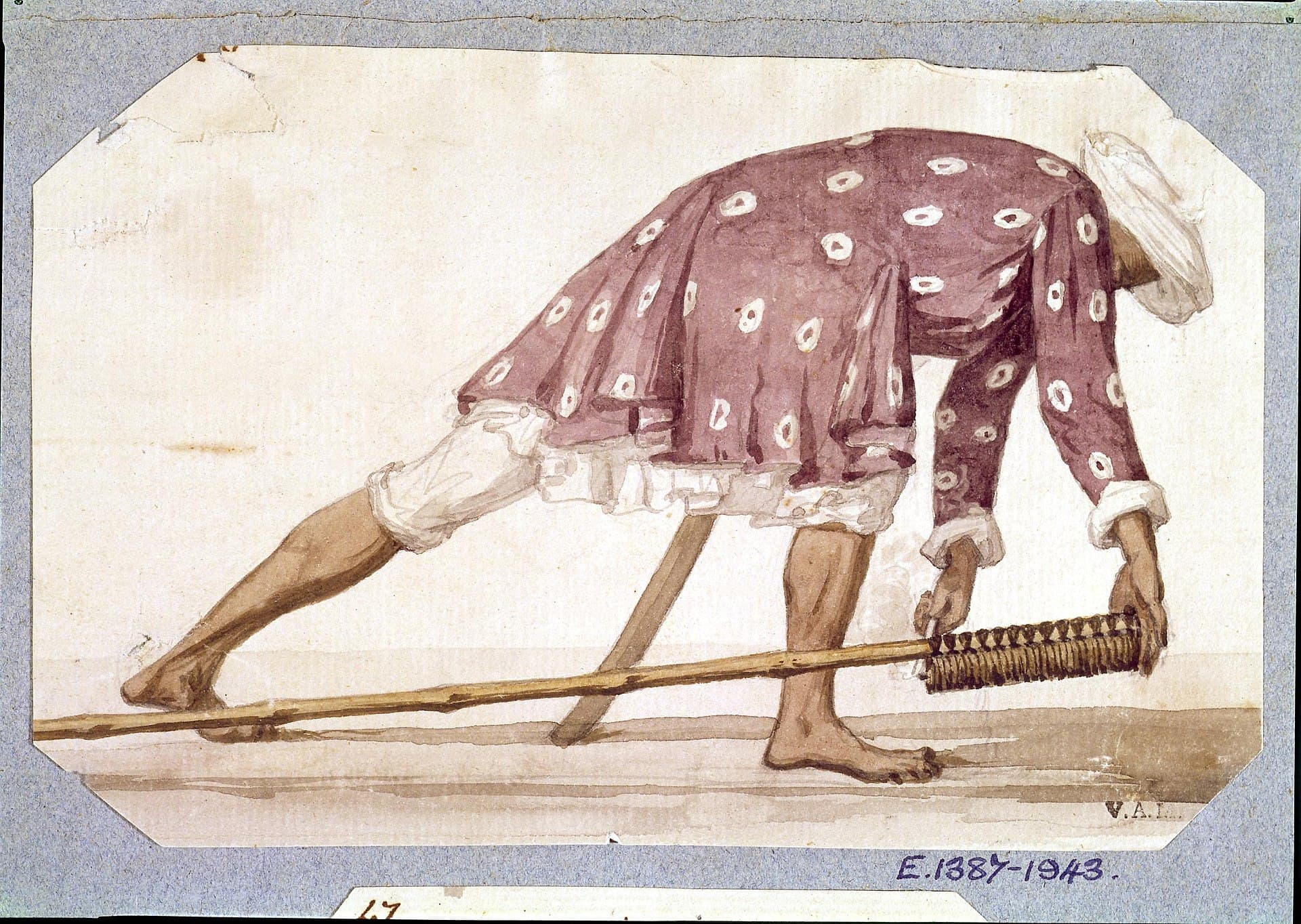
The iron case. Under Haidar Ali and then Tipu Sultan, Mysore's workshops replaced combustible casings with hammered soft-iron tubes — typically around 20–25 cm long and 4–8 cm in diameter, lashed to a bamboo guide-stick up to three metres long. Iron withstood far higher combustion pressure than pasteboard, which meant more propellant burned faster: greater thrust, greater range — contemporary British accounts report ranges approaching a kilometre or more — and a casing that arrived as shrapnel. Some rockets were fitted with blades; others carried explosive heads.
The organization. The real innovation was institutional. Tipu Sultan's army included dedicated rocket units within its regular brigades — British observers estimated the corps in the thousands — with standardized manufacture, wheeled launchers capable of firing several rockets together, and written doctrine: the Fathul Mujahidin prescribed rocket tactics alongside musketry and artillery drill. Mysore did to the rocket what European states had done to the musket: made it boring, repeatable, and massed.
Taramandalpet — the rocket towns
Mass production needed dedicated places, and Mysore built them. The rocket manufactories were known as taramandalpet — literally “star-cluster quarter,” the name earned by the constellation of sparks a rocket threw as it burst. Four are recorded: at the capital Srirangapatna, at Bangalore, at Chitradurga, and at Bidanur (present-day Nagara). Each combined workshops, powder mills, and storage — closer to an ordnance research district than a single factory, with iron-casing manufacture, propellant mixing, and assembly concentrated in one quarter.
Bangalore's survives as a place name. Taramandalpet is still a locality of narrow lanes near the City Market and Jama Masjid, carrying — unmarked and largely unnoticed — the name of what was once the rocket works of the Mysore state.
The rocket corps that these towns armed was substantial: a regular formation of roughly 1,200 rocketmen under Haidar Ali, expanded considerably under Tipu Sultan, with rocketmen attached to the regular infantry brigades rather than kept as a curiosity.
Rediscovered, 2018
For two centuries the Mysorean rocket was known mainly from British descriptions and a handful of museum specimens. Then in July 2018, archaeologists excavating an abandoned open well inside the fort at Nagara — the old Bidanur, one of the four taramandalpets — brought up more than a thousand corroded iron rockets, 23–26 cm long, some still charged with their propellant mix of potassium nitrate, charcoal, and magnesium. A smaller cache of about 160 had been found nearby in 2002 and identified only after years of study.
The find is the largest physical body of evidence for the technology in existence, and it confirmed the written record: iron cases, standardized sizes, stored in bulk at a manufacturing centre. The rockets are being conserved for display at the Shivappa Nayaka Museum in Shivamogga.
On the battlefield
Rockets were terror weapons against cavalry and packed formations, and genuinely destructive against ammunition trains. At Pollilur in 1780 — the Company's worst defeat in India to that date — rocket fire is credited by both sides' accounts with detonating Colonel Baillie's ammunition wagons at the decisive moment. They were used throughout the later wars, including against the British camps and trenches at Srirangapatna in 1792 and 1799. A young officer on the receiving end in 1799, later famous as the Duke of Wellington, was among many who recorded their effect on morale.
Woolwich: the technology transfer
After the fall of Srirangapatna in 1799, the British inventoried hundreds of launchers and thousands of rockets and sub-assemblies in Tipu Sultan's arsenals. Specimens were shipped to the Royal Arsenal at Woolwich for analysis. William Congreve — son of the Arsenal's comptroller — began systematic development shortly afterwards, and by 1805 demonstrated the Congreve rocket: iron-cased, stick-guided, produced in standard calibres. He acknowledged the Indian precedent in his own publications, while claiming (and delivering) substantial improvements in propellant, manufacture, and scale.
Congreve rockets went into action at Boulogne (1806), the devastating bombardment of Copenhagen (1807), and Leipzig (1813). Every army in Europe soon fielded derivatives.
Britain copied the unit, not just the rocket. The organisational idea — rocketmen as a standing branch of the army with their own doctrine, rather than a novelty wheeled out occasionally — crossed with the technology. Rocket troops were raised in 1813 and fought at Leipzig that October as the Rocket Brigade under Captain Richard Bogue, who was killed there after breaking five French and Saxon battalions at Paunsdorf; in 1814 they were formalised as troops of the Royal Horse Artillery. The United States raised a rocket battery of its own for the Mexican–American War.
That formation never entirely disappeared. The British Army still fields O Battery (The Rocket Troop), Royal Horse Artillery, a unit descended from the troops raised to use a weapon the British first encountered when it was fired at them by Tipu Sultan's army.
America: the rockets' red glare
The technology reached North America in the War of 1812, in British hands. Congreve rockets were fired at Bladensburg in August 1814 — where their noise and erratic flight helped break the American line on the road to Washington — and then, most famously, at Fort McHenry.
Through the night of 13–14 September 1814, the rocket vessel HMS Erebus fired a barrage of roughly 30-pound incendiary Congreve rockets into the Baltimore harbour defences across some twenty-five hours. Watching from a truce ship offshore was a lawyer named Francis Scott Key, who wrote what he saw into a poem that became “The Star-Spangled Banner.” The rockets' red glare of the American national anthem is, by a direct and documented chain of custody, the descendant of the weapon perfected in the taramandalpets of Mysore.
The United States then adopted the weapon itself. In the Mexican–American War of 1846–48 the US Army raised a rocket and howitzer battery equipped with Hale rockets — the improved, stick-less design that spun for stability — and used them at Veracruz and Chapultepec. Rockets also saw service on both sides of the American Civil War, though by then rifled artillery was rapidly making them obsolete.
The long afterlife: from Srirangapatna to the space age
The Mysorean design set the basic pattern of the military rocket for well over a century: a metal case packed with solid propellant, stabilized first by a stick and later by spin. Congreve refined it; William Hale removed the stick in the 1840s; rocket troops appeared in the British, American, Austrian, and Russian armies. Then rifled breech-loading artillery arrived in the second half of the 19th century, out-ranging and out-shooting the rocket, and the weapon faded to signal flares and lifesaving lines.
Its return in the Second World War transformed it. Solid-fuel rockets came back as the Soviet Katyusha, the American bazooka, and aircraft rocket projectiles — all recognizably in the old lineage. But the decisive break came from Germany: the liquid-fuelled, gyroscopically guided A-4, better known as the V-2, the first ballistic missile and the first object to reach space. Its designers went on to build the rockets of the American and Soviet space programmes. That is the line that runs from an iron tube in a Mysore workshop to the Moon.
Found again, on a wall in Virginia
There is a coda. Two centuries after Srirangapatna, a young Indian rocket engineer visiting NASA's sounding-rocket base in Virginia noticed a painting in the reception area: a battle, a rocket in flight, and rocketmen who were plainly South Asian. It was Tipu Sultan's army firing on British troops, displayed by Americans as part of the ancestry of rocketry. The engineer was A. P. J. Abdul Kalam, later the Missile Man of India and President of the republic.
Keeping the claim honest
Sources for this page
- Roddam Narasimha, 'Rockets in Mysore and Britain, 1750–1850' (National Aeronautical Laboratory, 1985) — the standard technical study.
- Fathul Mujahidin — Tipu Sultan's military code, on rocket tactics and organization.
- William Congreve, A Concise Account of the Origin and Progress of the Rocket System (1810).
- Irfan Habib (ed.), Confronting Colonialism — on Mysore's ordnance industry.
- Alexander Beatson, A View of the Origin and Conduct of the War with Tippoo Sultaun (1800) — inventory of the captured arsenals.
- Archaeological Survey / Karnataka Dept. of Archaeology excavation at Nagara fort, July 2018 — the cache of 1,000+ rockets.
- Smithsonian National Air and Space Museum, on Congreve rockets at Fort McHenry, 1814.
- Frank H. Winter, The First Golden Age of Rocketry: Congreve and Hale Rockets of the Nineteenth Century (1990).
- Regimental histories of O Battery (The Rocket Troop), Royal Horse Artillery — raised 1813, Leipzig under Bogue, formalised 1814.
Full bibliography and how we weigh sources: Sources & Method