Srirangapatna · The Painted Palace
Daria Daulat Bagh and the Pollilur Murals
He built a summer palace of teak and had his greatest victory painted the length of one wall, so that he could walk past the destruction of a British army every day. After 1799 the British officer who would go on to beat Napoleon moved in and lived inside it.
- Built
- 1784
- Material
- Teak, on a raised plinth
- West wall
- The Battle of Pollilur, 1780
- East wall
- The courts of his contemporaries
A palace of wood and paint
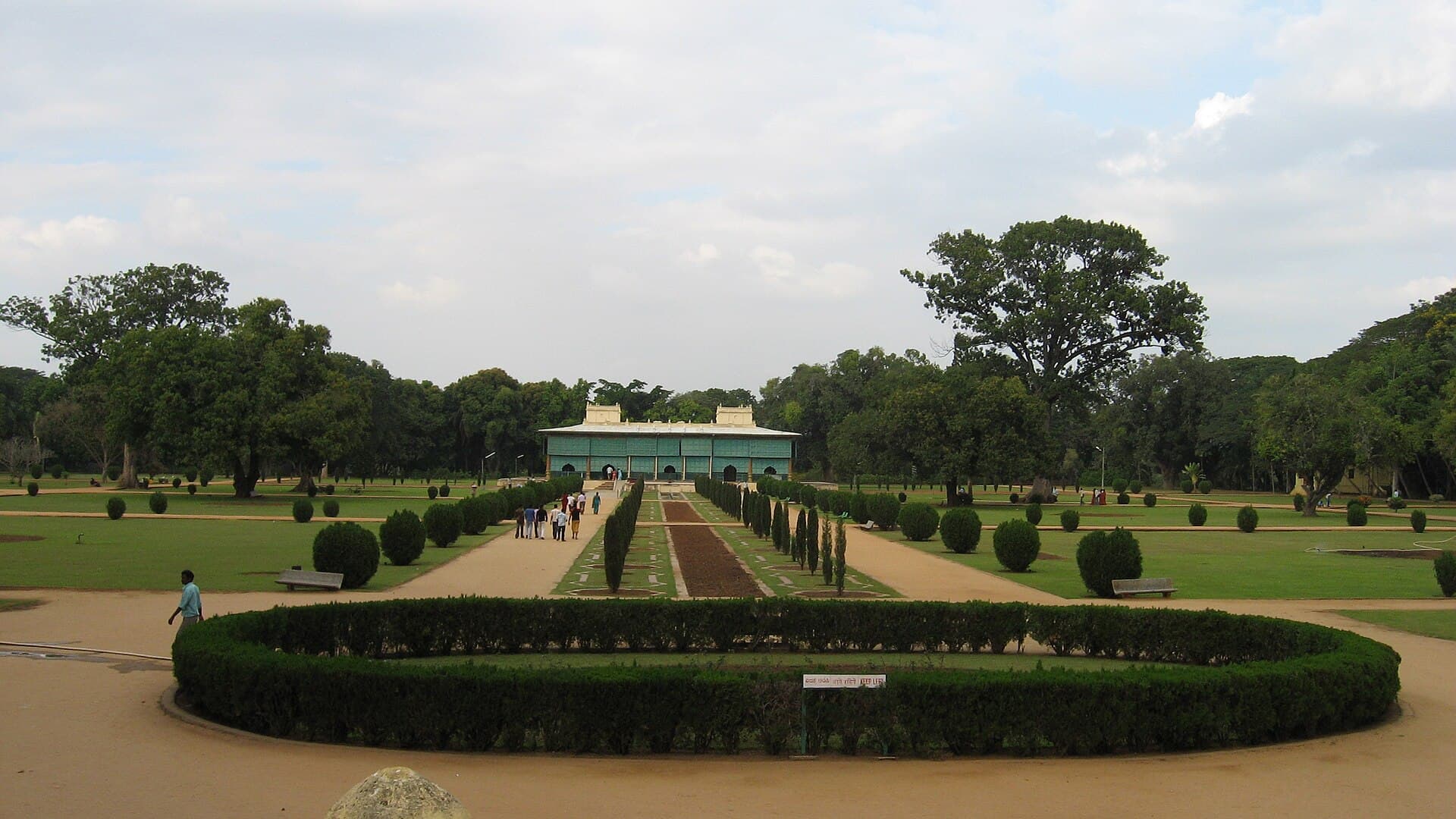
Daria Daulat Bagh — the garden of the wealth of the sea — was finished in 1784, in the year Tipu Sultan closed the second war with the Treaty of Mangalore. It stands in a garden east of the fort at Srirangapatna: a low rectangular building on a raised plinth, open verandahs on all four sides, and built largely of teak — the same preference for a light painted pavilion over a mass of masonry that produced the summer palace at Bangalore.
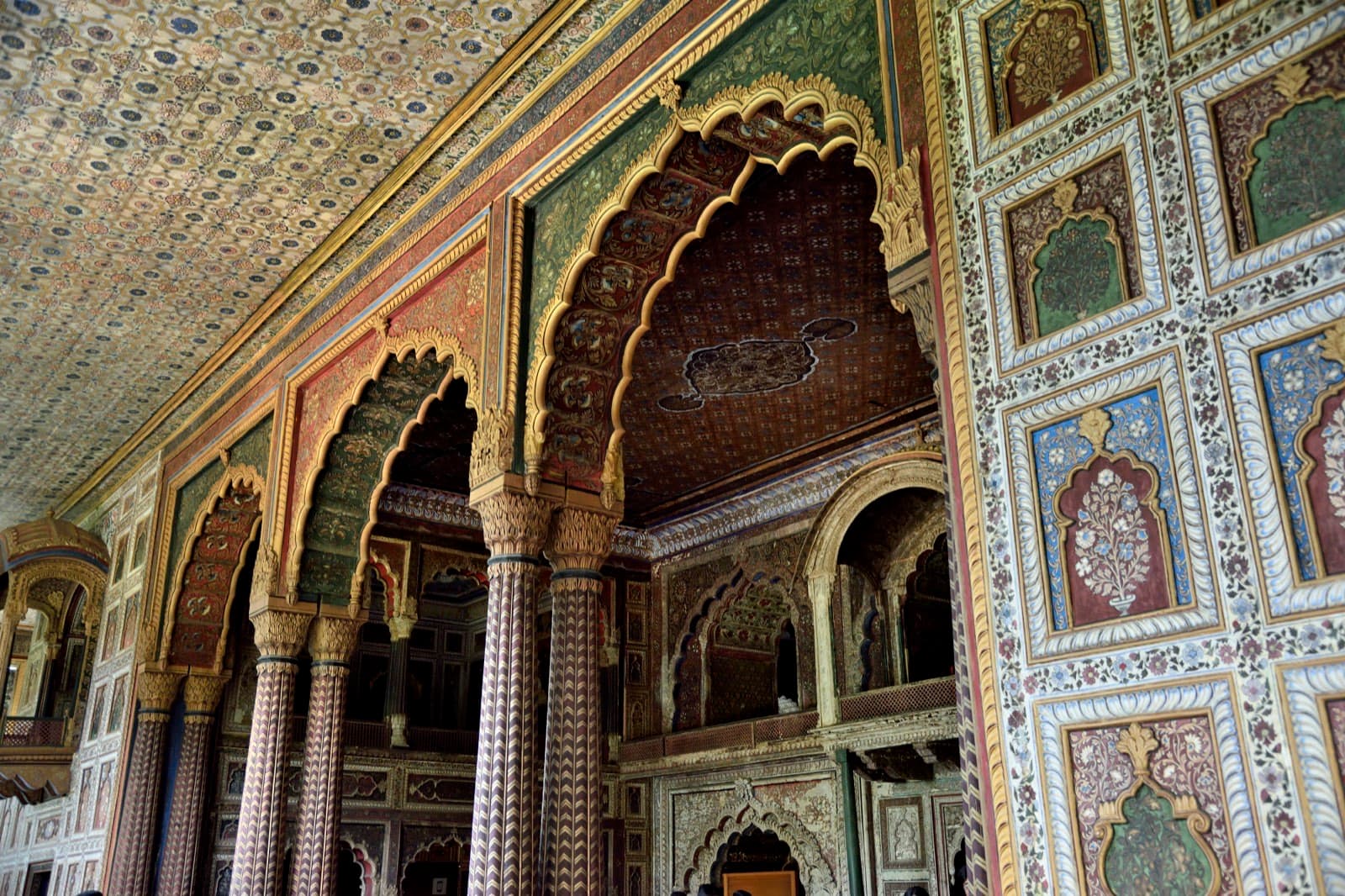
What makes it extraordinary is that almost nothing was left plain. Walls, piers, arches and canopies are covered in painting in the Mysore manner. The division is deliberate: the outer walls carry battles and portraits — public matter, seen from the verandah — while the inner walls dissolve into thin foliage and floral scrollwork.
The west wall: Pollilur
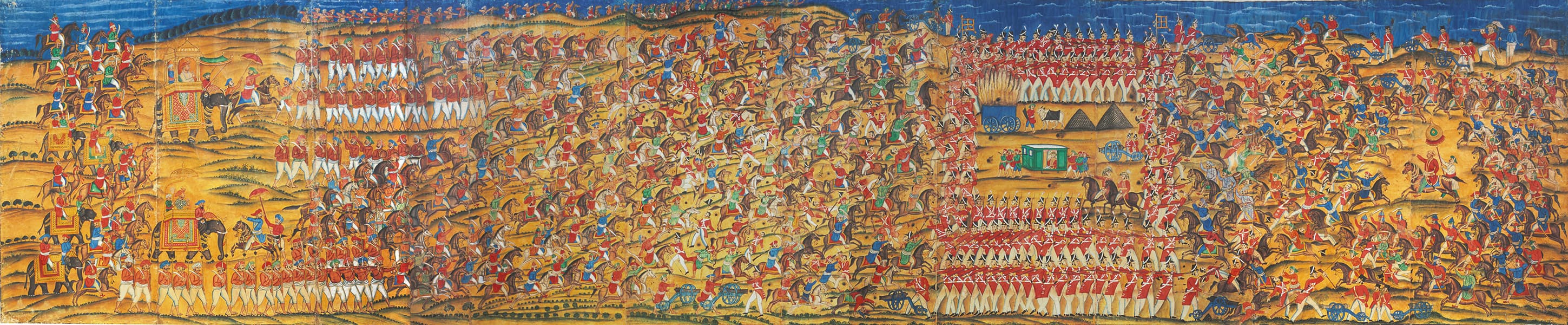
On 10 September 1780, at Pollilur near Kanchipuram, a British detachment under Colonel William Baillie was surrounded and destroyed by the Mysorean army under Haidar Ali and Tipu Sultan. It was the worst defeat the East India Company had yet suffered in India. The full account is on the second war page.
Four years later he had it painted across the west wall of his summer house, at length and in detail: the Mysorean cavalry closing around the red-coated squares, the French officers serving alongside them, and — the detail everyone remembers — the moment Baillie's ammunition tumbrils go up, the explosion that broke the British formation.
Baillie himself is in the picture, carried in a palanquin by six men, and he is biting his finger. That is not incidental. In Indian painting the finger raised to the mouth is a fixed convention for astonishment and chagrin — a gesture of a man watching a disaster he cannot stop. The Mysorean artist did not need to caption the defeat. He gave the defeated commander a gesture every viewer could read.
Why it matters as a document
Set against everything else on this site, the mural is unusual in a specific way. The visual record of the Anglo-Mysore Wars is overwhelmingly British: Robert Home's campaign views, the battle canvases of the storming of Bangalore and Srirangapatna, the prints sold in London. Those are the images that shaped how the wars were remembered, and they were made by the winners.
The Pollilur mural is the other thing entirely: a large-scale picture of an Indian victory over the Company, painted in India, for the Indian ruler who won it, on the wall of his own house. It is propaganda — nobody should pretend otherwise — but it is his propaganda, and there is very little of that left.
The east wall: his neighbours' courts
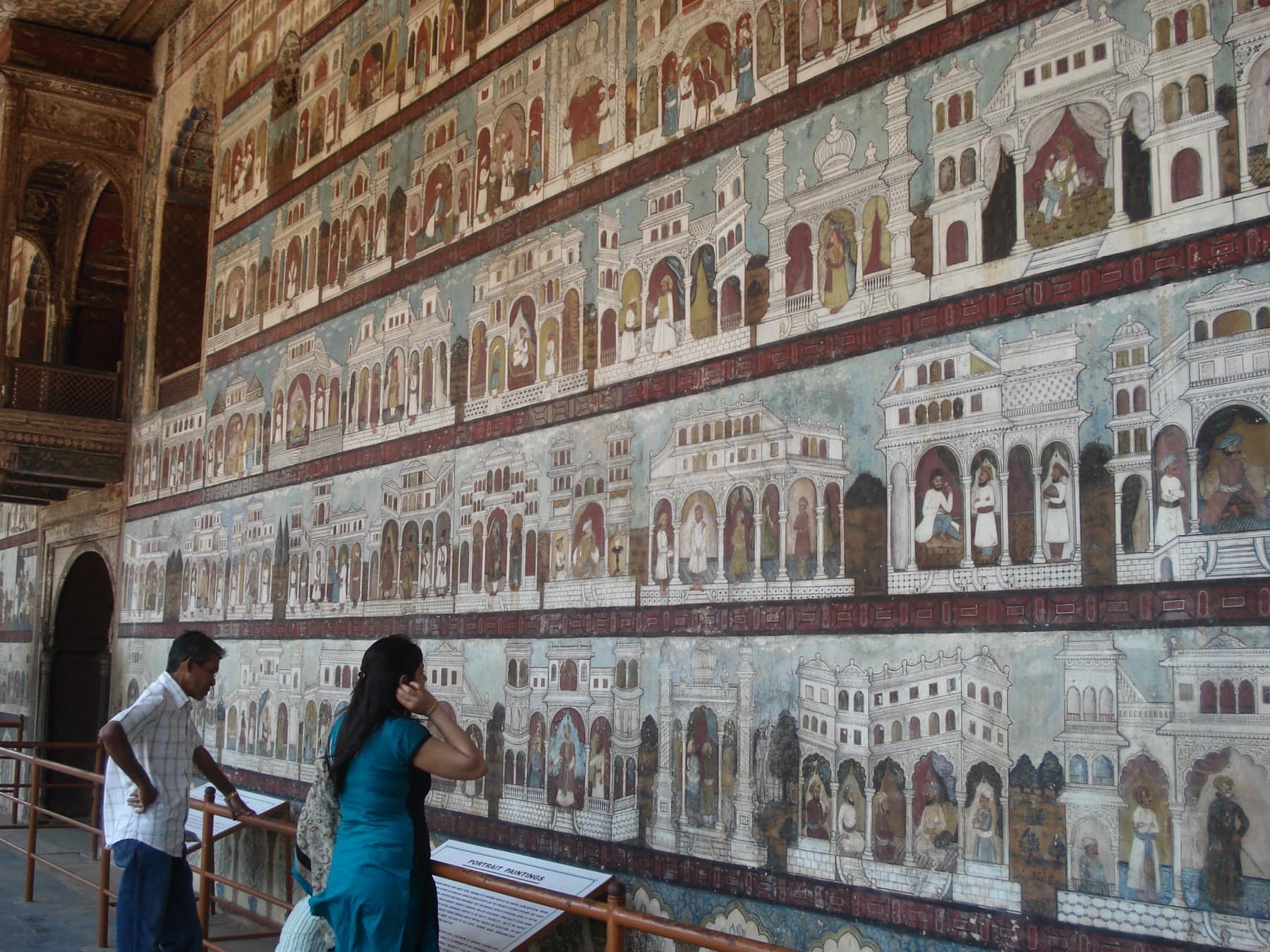
Opposite the battle, the east wall does something stranger and, read carefully, more revealing. In five stacked registers it paints the courts of other Indian rulers — palace after palace, each with its sovereign seated in darbar. Among them are the Rani of Chitor, the Raja of Tanjore, the Raja of Benares, the Peshwa Balaji Rao, Kempegowda of Magadi, Madakari Nayaka of Chitradurga, and Krishnaraja Wodeyar II.
Consider that company. The Peshwa headed the Maratha confederacy Mysore repeatedly fought. Madakari Nayaka ruled the Chitradurga that Haidar Ali took by force in 1779. The Wodeyar was the head of the dynasty Tipu Sultan's own family had displaced in all but name. These are not allies being flattered. They are the sovereigns of the subcontinent, and by painting them on his wall he places himself among them — a claim about standing rather than about friendship.
Wellesley moved in
After the fall of the city on 4 May 1799, Colonel Arthur Wellesley — later the Duke of Wellington — was made responsible for Srirangapatna, and chose to live in Daria Daulat Bagh.
The result is one of the better ironies in this history. For the best part of a year, the officer who would eventually defeat Napoleon at Waterloo ate and slept and wrote his orders in a room whose west wall is a fifty-foot celebration of a British army being annihilated. He did not have it painted over. Because he lived there and the building was maintained rather than stripped, the murals came through the conquest at all — which means the most important surviving image of a Mysorean victory owes its survival to the man who ended Mysore.
Going there
The palace is a protected monument and holds a museum of Tipu Sultan material. It sits a short distance from the Gumbaz, where he is buried, and from the fort and water gate where he was killed on the final day. The three together are the whole arc of the reign inside a couple of square miles: the victory he painted, the death he did not foresee, and the tomb he had already built for his father.
Sources for this page
- Archaeological Survey of India records for Daria Daulat Bagh, Srirangapatna — construction in 1784, fabric, mural programme and conservation history.
- Mohibbul Hasan, History of Tipu Sultan — on Pollilur (10 September 1780) and the destruction of Baillie's detachment.
- Published descriptions of the mural programme: the Pollilur battle on the west wall with Colonel Baillie in a palanquin biting his finger, and the five registers of contemporary darbars on the east wall.
- Anne Buddle, The Tiger and the Thistle (1999) — on Mysorean and British visual representation of the wars.
- Kate Brittlebank, Tipu Sultan's Search for Legitimacy (1997) — on display, kingship, and claims to standing among Indian sovereigns.
- Accounts of Arthur Wellesley's residence at Daria Daulat Bagh following the fall of Srirangapatna in 1799.
Full bibliography and how we weigh sources: Sources & Method