The Wars · 1799
The Fourth Anglo-Mysore War
A war of eleven weeks, decided in an afternoon. Wellesley had the pretext, the alliances, the money, and two armies converging from opposite coasts. Tipu Sultan had a truncated kingdom, no allies, and a choice about how to end.
- Declared
- February 1799
- Commanders
- Harris, Stuart, Wellesley
- Siege
- 5 April – 4 May
- Ended
- 4 May 1799
Origins — a decision taken in Calcutta
This war was decided before it was justified. Richard Wellesley arrived as Governor-General in 1798 with an explicit doctrine: no Indian state should keep French advisers or conduct its own foreign policy. Mysore did both.
The evidence came conveniently to hand. The Malartic Proclamation — the French governor of Mauritius publishing Tipu Sultan's secret request for troops as a recruitment advertisement — and Napoleon's letter from Egypt, intercepted at Mocha, together made the case that Mysore was conspiring with Revolutionary France. Wellesley demanded a subsidiary alliance: British troops in Mysore at Mysorean expense, a resident at the court, foreign relations surrendered. Tipu Sultan temporized. The armies marched before his final answer arrived.
Meanwhile Hyderabad had been bound into its own subsidiary alliance in 1798 and the Marathas stayed out. Mysore fought this war alone.
Forces
Two armies converged. General George Harris advanced from Madras with the main force — some 26,000 Company and King's troops, with a Hyderabad contingent of about 16,000 in which a young colonel named Arthur Wellesley, the Governor-General's brother and the future Duke of Wellington, commanded. Lieutenant-General James Stuart brought the Bombay army of roughly 6,500 from the west coast. Against perhaps 30,000 defenders, the allies fielded a combined force in the region of 50,000 fighting men, with an enormous siege train and — for once — solved logistics.
The campaign
Sedaseer, 6 March 1799. Tipu Sultan's best chance was to destroy the two armies separately. He struck west first, attacking Stuart's Bombay force in the passes at Sedaseer, about forty miles from his capital. The attack was pressed hard and held; Stuart's force survived intact and continued its advance.
Mallavelly, 27 March 1799. He then turned east to meet Harris, thirty miles from Srirangapatna. In a stand-up engagement against the main allied army — including a bayonet charge by Wellesley's troops — the Mysoreans were defeated and fell back on the capital. The field campaign was over in three weeks.
The investment, 5 April. Harris reached Srirangapatna and closed on the island from the west, the direction Cornwallis had probed in 1792 and the sector where the walls were weakest. The Kaveri was at its dry-season low and fordable.
The siege. For four weeks the batteries worked on the north-west angle. Sorties and rocket fire from the fort harassed the trenches; the outlying groves and villages were cleared in sharp local actions. Attempts at negotiation went nowhere — the terms offered would have ended Mysore as a state. By 3 May the breach was judged practicable.
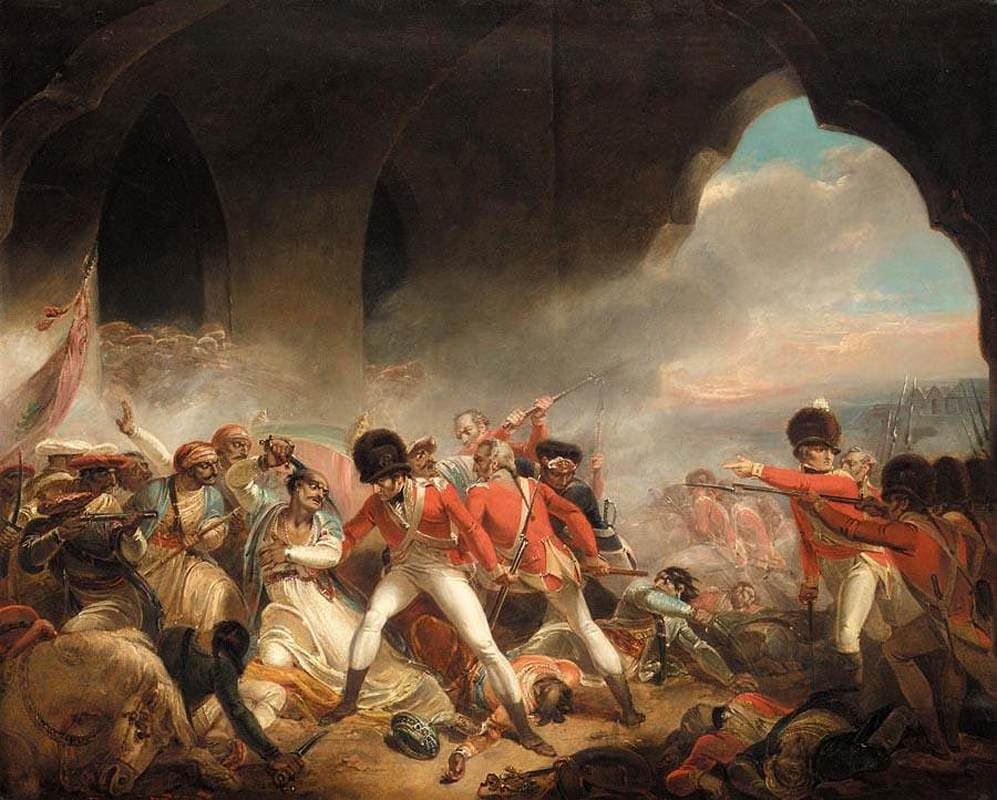
4 May. At about one in the afternoon, the hour of the garrison's midday rest, General David Baird — who had spent more than three years a prisoner in that fort after Pollilur — led some 4,000 men across the shallow river and up the breach. It was carried in minutes. Tipu Sultan died fighting near the Water Gate.
The reckoning
Mysore was partitioned. The Company took Kanara, Coimbatore, and Seringapatam itself; the Nizam received territory; and the rump of the kingdom was handed to a five-year-old Wodeyar prince under a subsidiary alliance, with Purnaiya — Tipu Sultan's own finance minister — as regent. Mysore survived on the map and ceased to exist as a power.
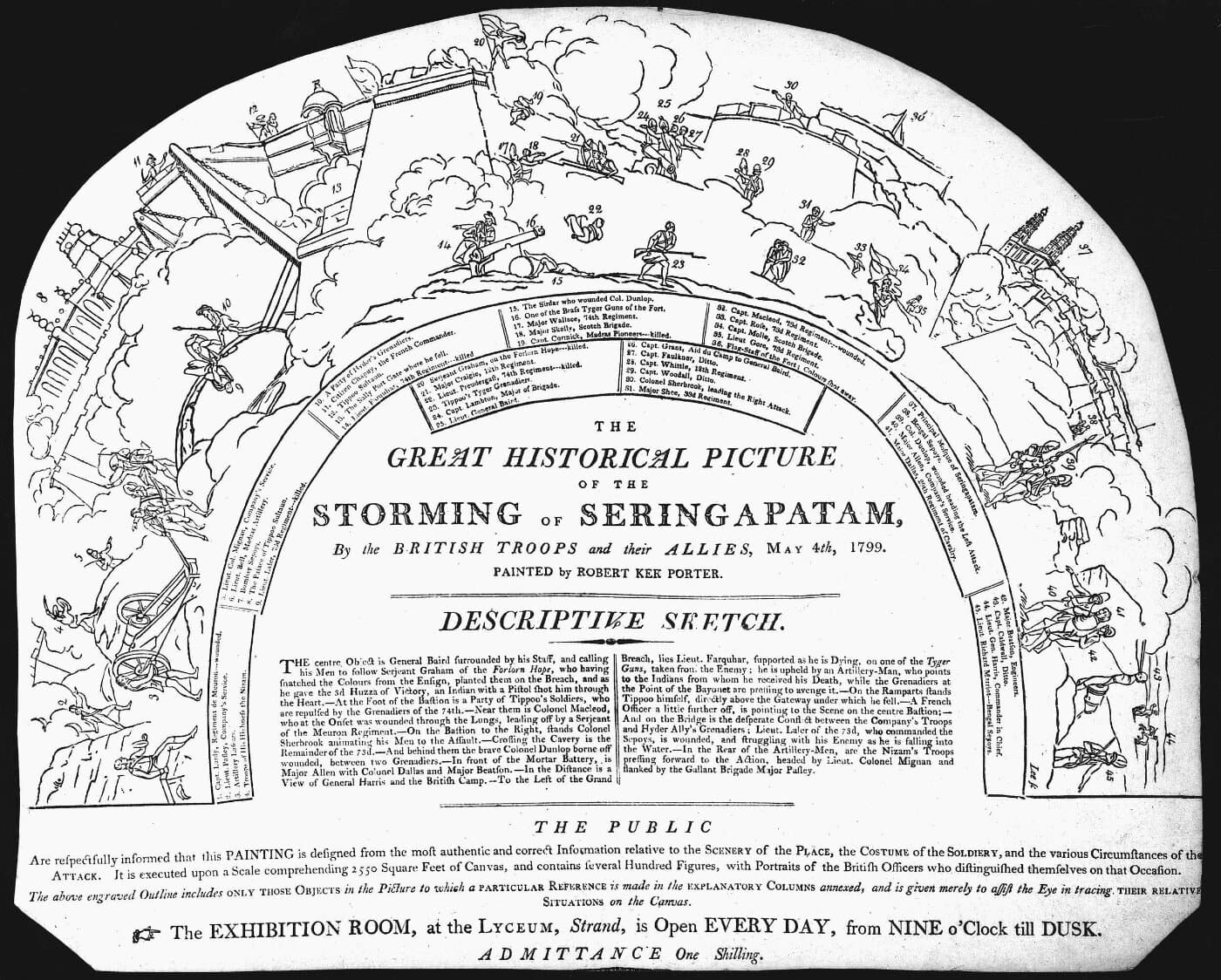
The plunder of Srirangapatna funded prize money for the army, sent the tiger throne to be broken up, and shipped Tipu Sultan's library, arsenal, and rockets to Britain. Within a year the storming was a paying attraction in London.
Could it have gone differently?
Sources for this page
- Alexander Beatson, A View of the Origin and Conduct of the War with Tippoo Sultaun (1800) — the official siege narrative and plans.
- Mohibbul Hasan, History of Tipu Sultan — final chapters.
- Kirmani (trans. Miles), Nishan-i-Haidari — the Mysorean account.
- James Salmond, A Review of the Origin, Progress and Result of the War with Tippoo Sultaun (1800).
- Irfan Habib (ed.), Confronting Colonialism (2002) — on Wellesley's case for war.
Full bibliography and how we weigh sources: Sources & Method