The Sultan · Economy
The Economic State
The most original part of the reign. Mysore did not merely tax commerce — it went into business: monopolies on its best exports, government trading houses from Srirangapatna to the Gulf, a treasury that took deposits, and its own money, weights, and calendar.
- Trading houses
- c. 30, home & abroad
- Silk centres
- 21 kar-khanas
- Gold coin
- Ahmadi = 4 pagodas
- Era
- Mauludi
Monopolies
The state reserved to itself trade in Mysore's most valuable exports: sandalwood, pepper, cardamom, areca nut, silk, and timber, along with elephants. These were the commodities that made the Malabar and Coromandel trade worth having, and every one of them had previously enriched private merchants — many of them agents of European companies.
The logic was strategic before it was fiscal. Company power in India rested on commerce; taking the most profitable commodities out of Company-linked hands and into a state monopoly attacked the Company's base directly while funding Mysore's army.
The state as merchant
Monopoly needs machinery, and Mysore built it. Government commercial houses — kothis — were established across the kingdom and overseas, some thirty trading outposts in all, staffed by state servants working under written commercial regulations. Abroad they reached Muscat and the Gulf ports; the Gulf trade network was the foreign-policy arm of the same design.
The commercial code went further than trade. It provided for subjects to deposit capital with the state against interest-bearing receipts, funding the enterprise out of domestic savings — something close to a state trading corporation with a public investment bank attached, in the 1780s. Whatever one concludes about its results, there is no other Indian document quite like it in the period.
Silk — the reform that outlived him
Mysore had no silk industry before Tipu Sultan. He created one: importing silkworm stock and expertise, assigning the raising of mulberry to designated land-holders, and establishing twenty-one rearing centres (kar-khanas) with monthly production quotas and the proceeds paid into the treasury. Accounts differ on where the worms came from — Bengal, Muscat, and China are all named in the sources.
It worked, and it survived the state that founded it. Mysore silk remains Karnataka's signature luxury product and employs thousands today. Of everything in this section, it is the one reform whose descendants you can still buy.
Manufacturing
State works produced muskets with domestically made flintlocks, cannon, and edged weapons; paper; glass; sugar, with attempts at Chinese refining methods; cutlery and scissors; and gunpowder. Shipyards on the west coast were building to French designs when the last war came. Embassies abroad carried standing instructions to recruit craftsmen — founders, clockmakers, weavers, glassblowers — and bring them to Mysore. The aim in each case was substitution: to stop buying from Europeans what Mysore could learn to make.
A town given over to toys
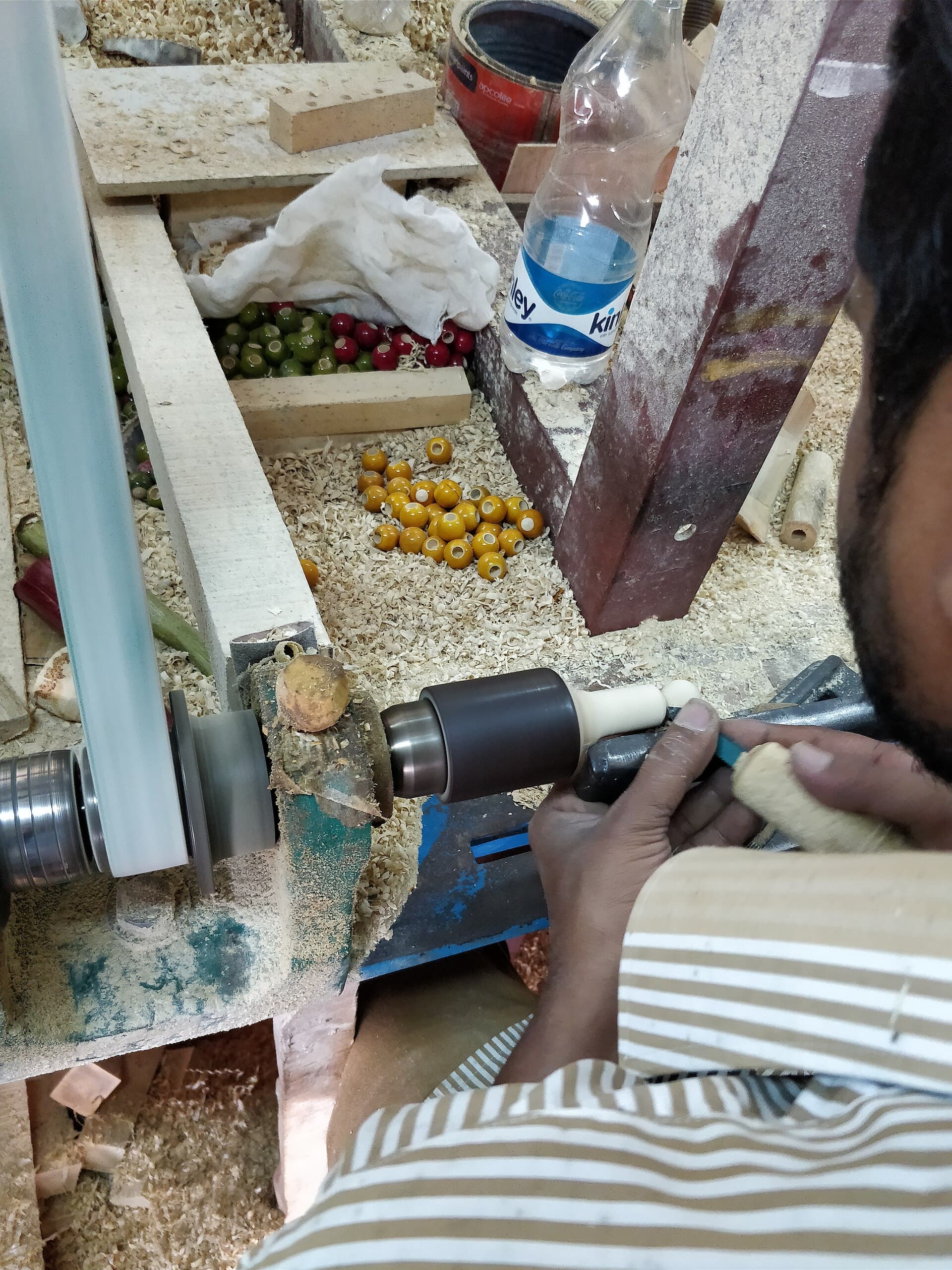
The clearest measure of how far this policy reached is that it did not stop at silk, cannon and sugar. Tipu Sultan was sent a lacquered Persian toy, liked it enough to want the craft, and did what he did with every other technology he wanted: he sent for artisans from Persia and had them train his own people in it.
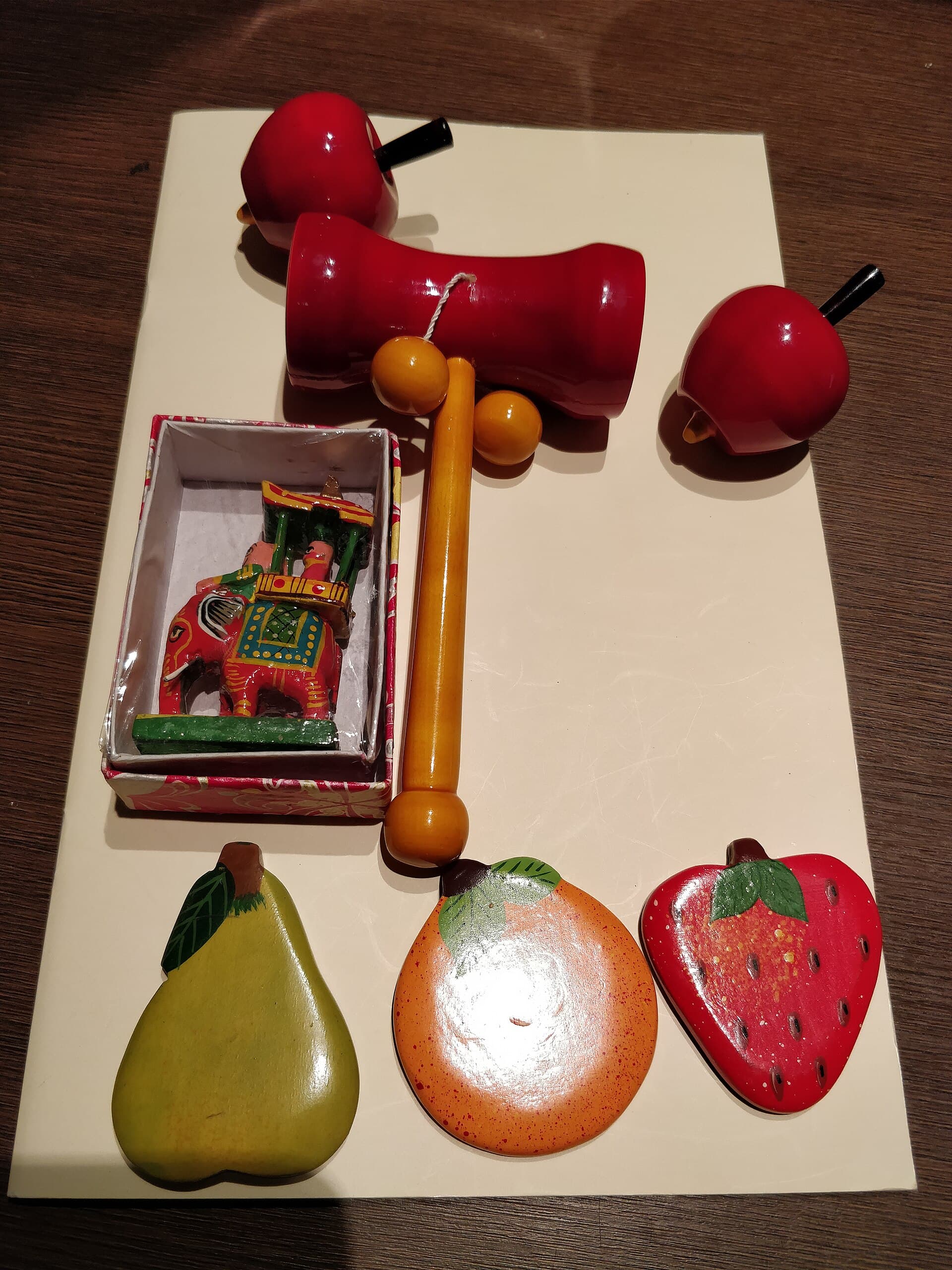
The place they were settled was Channapatna, on the road between Bangalore and Srirangapatna. Two centuries later it is still doing the same work, and is known across Karnataka as Gombegala Ooru — the town of toys. The craft is unchanged in essentials: figures turned on a lathe from the soft local aale mara wood, coloured with vegetable dyes from turmeric and indigo, and finished with a shellac lacquer burnished to a gloss against the spinning piece. Because the dyes and the lacquer are plant-based, the toys are safe for children to chew — which is precisely why they still sell. Channapatna toys now carry a Geographical Indication, the legal recognition that they can only be made where they have always been made.
It is a small story that says something large about the priority given to the economy. An eighteenth-century ruler at war for most of his reign, importing foreign craftsmen so that one town could learn to make wooden dolls, is a ruler treating manufacturing capability itself as the thing worth acquiring — the same instinct that produced the sericulture programme and the arms foundries, applied to a luxury trade. Of everything on this page, it and the silk are what survive: two industries you can still buy from today.
Money, weights, calendar
Like revolutionary France in the same decade, Tipu Sultan understood that measurement is sovereignty — and he renamed everything.
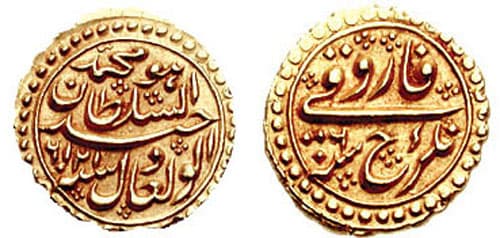
The coinage. Every denomination was individually named, and no name was repeated. Gold and silver coins took the names of saints and caliphs; the copper coins were named after stars. The gold Ahmadi — from Ahmad, “the most praised” — was worth four pagodas; the Sadiqi two, named for Abu Bakr; the Faruqi one, for Umar. In silver, the double rupee was the Haidari — for Ali, “the lion”, and unmistakably also for his own father — the rupee was the Imami, and the half-rupee the Abidi. A pocketful of Mysorean change was a statement of political theology.
Weights and measures were reissued on new standards tied to the coinage.
The calendar. He promulgated a new lunisolar calendar with renamed months and a new era — the Mauludi, dated from the birth of the Prophet rather than the Hijra — and dated his coins and documents by it. Every receipt in Mysore now declared that this was a new order, owing nothing to Mughal, Maratha, or Company precedent.
How rich was Mysore?
There is no separate national-accounts estimate for Mysore, and anyone who offers you one has invented it. What we do have is the picture for India as a whole, and an unusually good body of evidence for Mysore in particular.
India's share of world output. The standard long-run estimates — Angus Maddison's, and Paul Bairoch's before them — put India at roughly a quarter of world GDP around 1700–1750, against something like two or three per cent for Britain. India's share of world manufacturing output was of the same order, about a quarter in 1750. By 1900 that manufacturing share had fallen to around two per cent, and by 1950 India's share of world output was down to roughly four per cent, while Britain's had risen to nine per cent by 1870. These figures are reconstructions, not measurements — economists treat everything before 1820 as informed estimation — but the orders of magnitude are not seriously disputed.
Where Mysore sat inside that. Mysore was one of the more commercialised regions of a subcontinent that was, at the time, the workshop of the world for textiles. The European companies came to South India because it produced cottons and silks that Europe could not match on price or quality — the competitive problem that, on Prasannan Parthasarathi's account, pushed British manufacturers toward mechanisation in the first place.
The living-standards evidence is Mysore's own. This is the striking part. When Parthasarathi argues in Why Europe Grew Rich and Asia Did Not that the advanced regions of Europe and Asia were more alike than different in the eighteenth century, and that South Indian weavers may have earned incomes comparable with their British counterparts, the price and wage data he uses is largely Francis Buchanan's survey of Mysore — the same survey commissioned by the conquerors in 1800. The best evidence that Indian living standards stood comparison with Europe's comes from a walk through Tipu Sultan's former kingdom.
A caution worth keeping: “India was a quarter of world GDP” is a statement about a subcontinent of perhaps 150 million people, not a claim about output per head, and it should not be read as one. India was rich in aggregate because it was populous and productive; the interesting comparison is not the total but the wage, and there the evidence says South India was not obviously poorer than Britain before the divergence.
| Share of world manufacturing | 1750 | 1800 | 1830 | 1860 | 1880 | 1900 |
|---|---|---|---|---|---|---|
| India | 24.5% | 19.7% | 17.6% | 8.6% | 2.8% | 1.7% |
| United Kingdom | 1.9% | 4.3% | 9.5% | 19.9% | 22.9% | 18.5% |
The state as merchant, in comparison
The commercial programme also looks different set beside its contemporaries. Britain, France, and the Dutch conducted their Asian trade through chartered monopoly companies — private corporations granted exclusive rights, raising capital from shareholders and fielding their own armies. Tipu Sultan's answer was structurally the same idea with the ownership inverted: a monopoly trading organisation, but owned and staffed by the state itself, with the public invited to deposit capital in the treasury against interest-bearing receipts rather than to buy shares.
Set against his neighbours the contrast is sharper still. The Ottomans and Qajar Iran were devolving revenue and commerce outward to farmers and notables; Mysore was pulling both inward to the state. Whatever one concludes about the results, the design was an attempt to meet the East India Company with an instrument of the same kind — which is why it alarmed the Company far more than a conventional Indian kingdom ever did.
Sources for this page
- Irfan Habib (ed.), Confronting Colonialism (2002) — essays on trade, monopolies, and manufacture.
- Mohibbul Hasan, History of Tipu Sultan — chapters on commerce, industry, and coinage.
- Tipu Sultan's Commercial Regulations — on the kothis and the deposit scheme.
- Francis Buchanan, A Journey from Madras through Mysore, Canara and Malabar (1807) — on Mysore's industries just after 1799.
- Numismatic surveys of Tipu Sultan's coinage (denomination names and standards).
- On Channapatna: Sahapedia, 'Channapatna Toys and Tipu Sultan's Persian Connection'; and the GI registration for Channapatna toys.
- Prasannan Parthasarathi, Why Europe Grew Rich and Asia Did Not: Global Economic Divergence, 1600–1850 (2011) — the living-standards comparison, drawing on Buchanan's Mysore data.
- Angus Maddison, The World Economy: Historical Statistics; Paul Bairoch on shares of world manufacturing output — long-run estimates, treated as reconstructions rather than measurements.
Full bibliography and how we weigh sources: Sources & Method