Pillar Three
The Military Genius
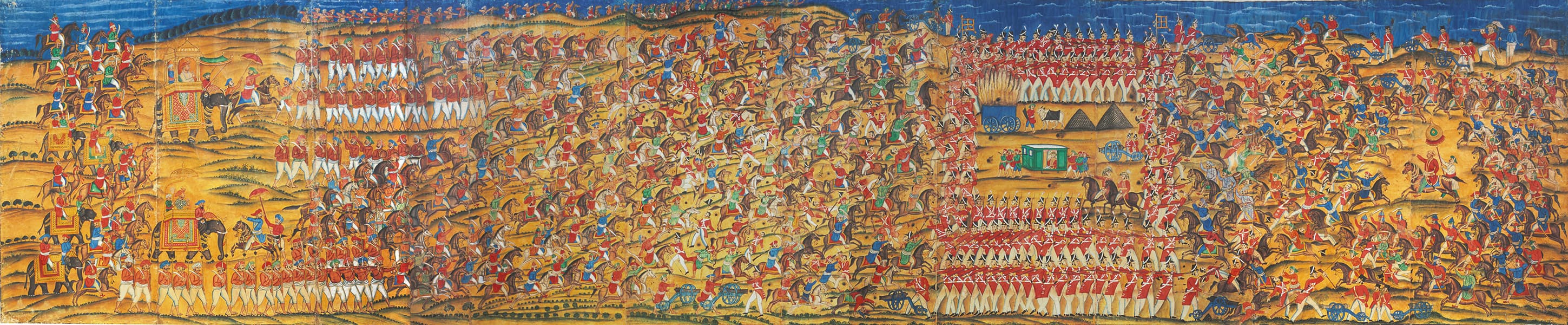
Four wars against the East India Company define Tipu Sultan's place in history. He won the second outright, survived the third, and chose death over surrender in the fourth. Behind the battles stood one of the most professional armies any Indian state had yet fielded.
The commander's education
Tipu Sultan learned war as a working profession. Trained by French officers in Haidar Ali's service and blooded in the First Anglo-Mysore War as a teenaged cavalry commander, he understood both the European infantry system and the Mysorean tradition of fast-moving light cavalry — and built an army that combined them: regular infantry (cushoons) drilled to European standards, an artillery park largely cast in Mysore's own foundries, an elite rocket corps, and cavalry used for deep raids on enemy supply lines rather than parade-ground charges.
His governing insight was logistical: the Company's armies were strongest in pitched battle and weakest in supply. Mysore's strategy — scorched earth ahead of invaders, cavalry on their convoys, fortresses forcing slow sieges — twice brought British armies to the edge of starvation, and defeated Cornwallis's first thrust at the capital in 1791 without a general action. It stopped working when the Company acquired allies who could keep it supplied.
The Four Anglo-Mysore Wars
Each war has its own page: objectives, forces, commanders, the campaign, the turning points, and what the peace cost.
1767 – 1769
First Anglo-Mysore War
Haidar Ali's war and Tipu Sultan's apprenticeship. Beaten at Chengam and Tiruvannamalai, Haidar broke the coalition by diplomacy, then appeared outside Madras and dictated peace — including a mutual-defence clause the Company later refused to honour.
Treaty of Madras — Mysore dictates terms
Read the full page →
1780 – 1784
Second Anglo-Mysore War
The high-water mark. Baillie's column annihilated at Pollilur; Eyre Coote's counter-offensive; Haidar Ali dead mid-war and Tipu Sultan succeeding without a break; the siege of Mangalore pressed alone after the French withdrew.
Treaty of Mangalore — status quo, as equals
Read the full page →
1790 – 1792
Third Anglo-Mysore War
The Travancore attack gave Cornwallis his war and his triple alliance. Bangalore stormed, a first advance on the capital defeated by logistics, the hill forts reduced — and a peace costing half the kingdom, a vast indemnity, and two royal hostages.
Treaty of Seringapatam — half of Mysore lost
Read the full page →
1799
Fourth Anglo-Mysore War
Eleven weeks. Wellesley's ultimatum, two armies converging from Madras and Bombay, defeats at Sedaseer and Mallavelly, a month-long siege, and the breach carried on the afternoon of 4 May.
Srirangapatna stormed — Tipu Sultan killed
Read the full page →
The last day of the last war has its own hour-by-hour reconstruction: 4 May 1799 — The Final Day.
The military system
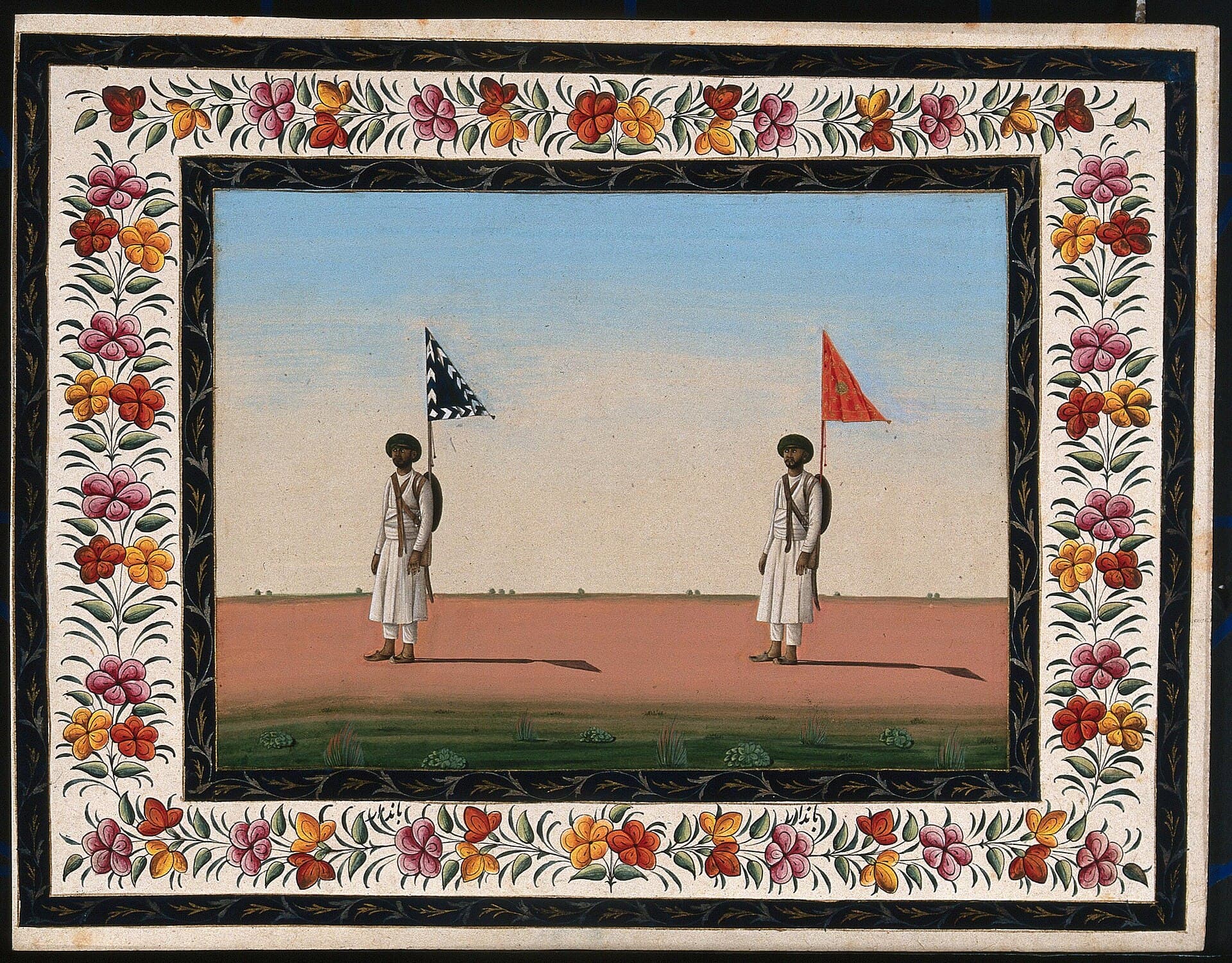
Infantry and organization. The army was reorganized on written regulations — Tipu Sultan's military code, the Fathul Mujahidin, standardized drill, ranks, pay, and even rocket tactics down to the launch angle. Units were paid in cash from the treasury, a discipline most Indian armies of the age could not match, which is why Mysore's army did not dissolve between campaigns.
Artillery and ordnance. Brass foundries at Srirangapatna and Bangalore cast guns finished with snarling tiger heads at muzzle and breech; of the 927 cannon the British inventoried in 1799, more than half had been cast in Mysore's own foundries. Muskets were manufactured domestically with flintlocks — Tipu Sultan personally tested and critiqued patterns. See Artillery & Ordnance.
Fortification. Mysore's key forts — Bangalore, Chitradurga, Savandurga, and Srirangapatna itself — were rebuilt with French-influenced traces, wide ditches, and layered batteries, and new works were raised: the Vauban-style star fort at Manjarabad above Sakleshpur, and the coastal battery guarding the river mouth at Mangalore. It took Cornwallis most of 1791 to reduce them. See Fortifications.
Naval ambitions. In 1796 Tipu Sultan established a Board of Admiralty and ordered a fleet of frigates and ships of the line built at Mangalore, Wajidabad, and Molidabad — cut short by the 1799 war, but evidence of how completely he understood that the Company's power was ultimately seaborne.
Rockets. The iron-cased rocket was Mysore's signature weapon and gets a full treatment on the Mysorean Rockets page.
The adversaries
The British careers that run through Mysore are worth following in their own right. Lord Cornwallis arrived having surrendered to Washington at Yorktown and left having taken half of Mysore. Arthur Wellesley was a thirty-year-old colonel here, suffered the first real failure of his career in a grove outside Srirangapatna, and beat Napoleon sixteen years later. And the Clives built the fiscal machine that made these wars winnable — and took the Sultan's tent home to Wales.
The capital, and the last day
Every one of these wars ends at the same place: the island fortress in the Kaveri that was arsenal, mint, court and capital at once, and the stage for the siege that finished the state. The fort, the palaces, the mosque and temple inside the walls, the dungeons, the Water Gate, and the hour-by-hour reconstruction of 4 May 1799 are all there.
How good was he?
Sources for this page
- Mohibbul Hasan, History of Tipu Sultan — campaign narratives for all four wars.
- Irfan Habib (ed.), Confronting Colonialism (2002) — essays on Mysore's army and the wars.
- Fathul Mujahidin (Tipu Sultan's military code, comp. Zainul Abedin Shustari).
- Kirmani (trans. W. Miles), History of Tipu Sultan (Nishan-i-Haidari) — Mysorean court chronicle.
- Alexander Beatson, A View of the Origin and Conduct of the War with Tippoo Sultaun (1800) — official British account, used critically.
- Denys Forrest, Tiger of Mysore (1970).
Full bibliography and how we weigh sources: Sources & Method