The Wars · Artillery & Ordnance
Guns, Foundries and Powder
An army can buy guns; a state casts its own. Mysore did both, and the inventory the British took after the fall of Srirangapatna is the clearest surviving measure of what its workshops had achieved — and of their limits.
- Foundries
- Srirangapatna & Bangalore
- Guns taken, 1799
- 927
- Cast in Mysore
- Over half
- Emblem
- The tiger, in bronze
The foundries
Mysore maintained two principal foundries for brass cannon, one at the capital, Srirangapatna, and one at Bangalore — each paired with an arsenal and powder magazines, so that casting, filling, and storage sat together under one administration. Ordnance was a department of state in its own right, under the Muluk-ut-Tujjar, alongside revenue and commerce.
Guns cast for the Sultan carried marks. Many bear a heart-shaped Haydar talisman identifying the royal foundry; some carry the founder's own name and the place of casting — one surviving bronze four-pounder is inscribed as cast at Patan, the court name for Srirangapatna, by Shams al-Din. Technical evidence on the surviving pieces, such as an offset bore and the marks of cast-on construction, tells us how they were made.
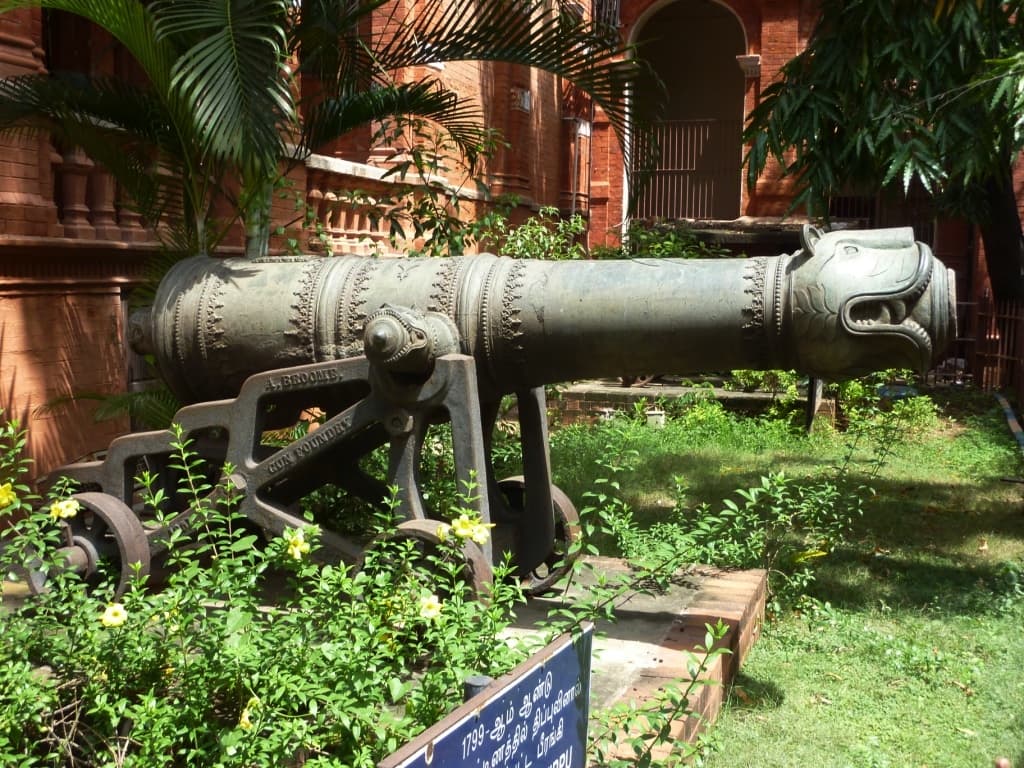
Tigers in bronze
Mysorean guns are among the most recognisable artillery of the eighteenth century, because Tipu Sultan carried his emblem into the metal itself. Snarling tiger heads form the muzzle at the front of the barrel, appear again on the trunnions at the sides, and finish the cascabel at the breech. The gun does not merely belong to the Sultan; it is decorated as the animal he had adopted as himself.
This was not ornament for its own sake. The same bubri stripe and tiger mask ran through uniforms, coins, the throne, and the mechanical tiger now in the V&A. An enemy gunner who captured a Mysorean piece was meant to know exactly whose it was — which is precisely why so many of them ended up as trophies in Britain.
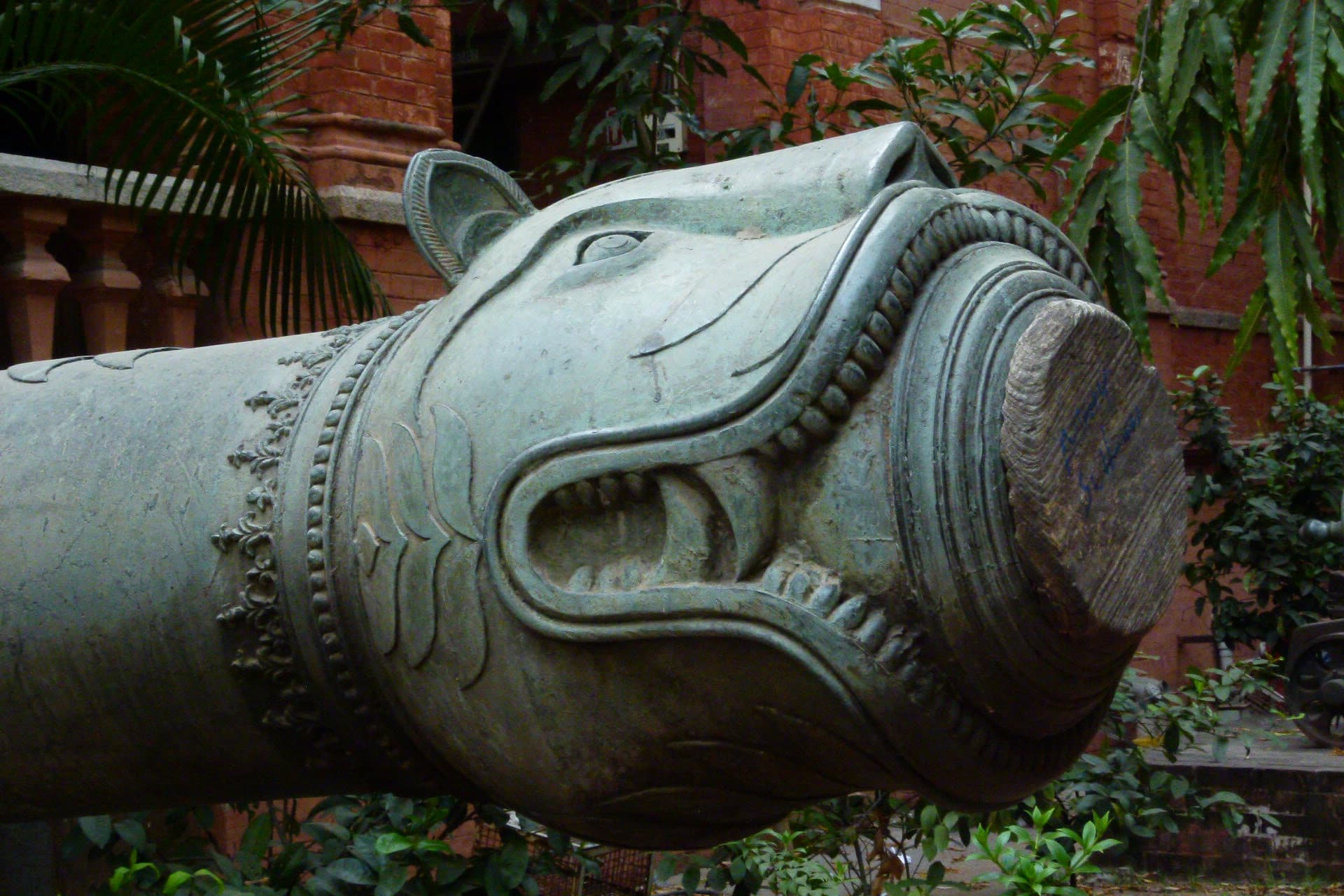
The inventory of 1799
The best measure of the ordnance programme is the count taken by the conquerors. At the fall of Srirangapatna the British inventoried 927 cannon — and recorded that over half of them had been cast in Tipu Sultan's own foundries.
That ratio is the achievement. A state of Mysore's size, permanently at war and cut off by its enemy from the European arms trade, had built the capacity to supply the majority of its own artillery domestically. The same programme produced muskets with locally made flintlocks, and the rocket manufactories of the taramandalpets.
Powder, and where it was kept
Guns are useless without propellant, and gunpowder is the most demanding thing a pre-industrial state can manufacture at scale: it needs saltpetre, charcoal, and sulphur in controlled proportions, milling that can destroy the mill, and storage that is dry, guarded, and — ideally — a long way from anything else worth keeping.
Mysore made its own, and the magazines were built into the fortification system. At Manjarabad, the star fort above Sakleshpur, two underground cellars were cut specifically to hold powder — cool, dark, and below the line of any bombardment. The capital and Bangalore each had magazines attached to their foundries and arsenals.
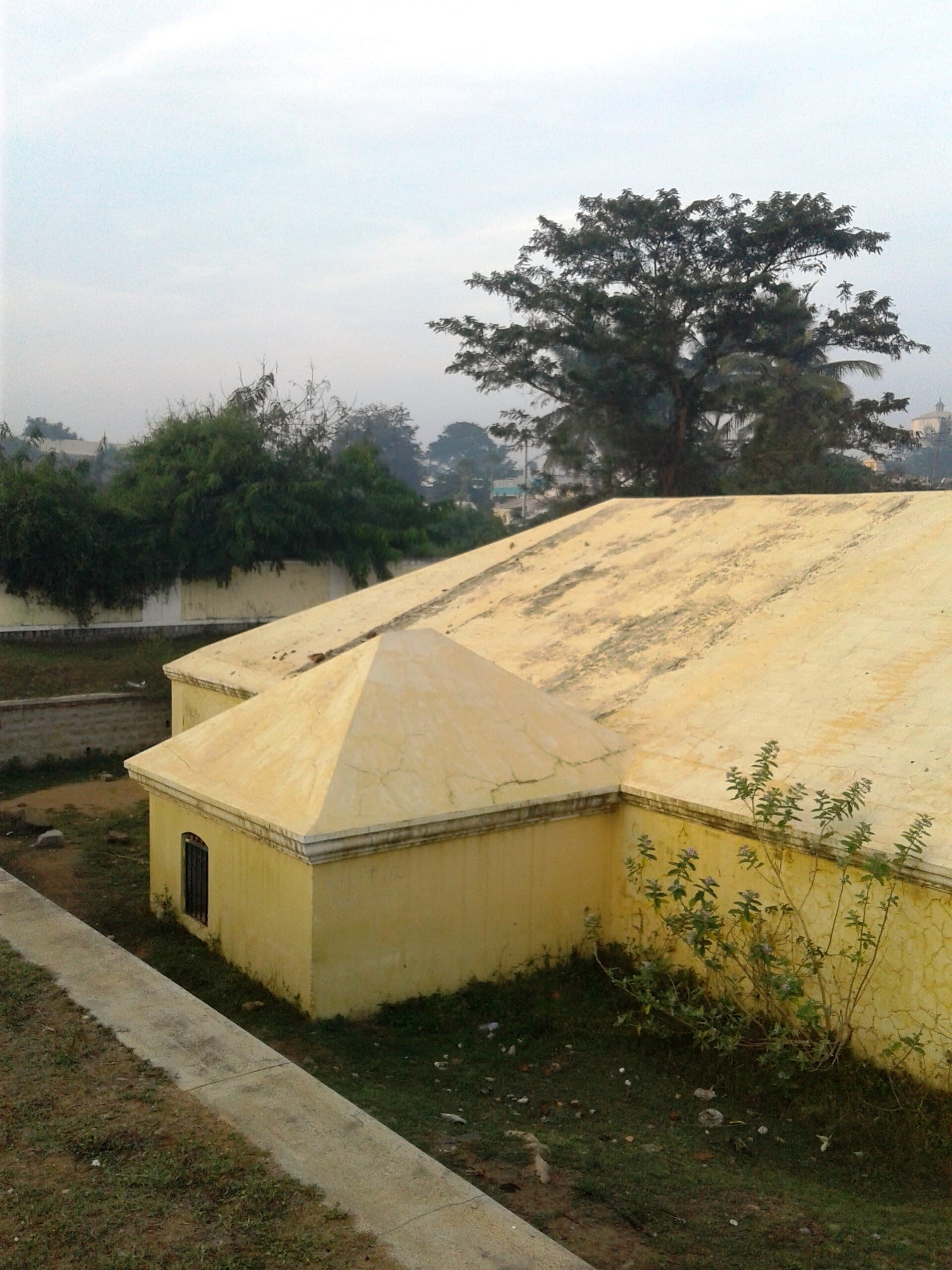
The armoury that was moved. One of those buildings had an unlikely second life. Tipu Sultan's armoury at Srirangapatna, a protected monument, stood squarely in the path of the second track being laid on the Bengaluru–Mysuru railway, and had held up roughly 1.7 kilometres of doubling work for years. Rather than demolish it, the Union government sanctioned some ₹13 crore to move the building itself. In an operation completed on 10 March 2017, South Western Railway's contractors, working under the archaeology department, jacked up the 228-year-old structure and translocated it roughly 100 metres to a safer site without breaking it — the first time a protected monument had been relocated in India. An eighteenth-century powder store was shifted so that trains could pass, which is a fair description of what has happened to most of this history.
Two towns named after a battery
The ordnance system left its mark on the map, in two places that still carry it.
Sulthan Bathery, Wayanad. A town in the Kerala hills was called Ganapathyvattom — “the fields of Ganapathi”, after its temple — until Tipu Sultan's campaigns in Malabar. He took over the town's thirteenth-century Jain temple, a Vijayanagara-influenced building, and used it as an ammunition store. The British recorded the place as Tipu Sultan's Battery, and the name stuck: Sultan's Battery, then Sulthan Bathery, which is what the town is called today. The Jain temple survives, and the renaming remains politically contested in Kerala.
Sultan Battery, Mangalore. The coastal watchtower of 1784 guarding the mouth of the Gurupura river, treated in full on the fortifications page.
Both names record the same thing: an army that placed batteries and magazines deliberately, and did it often enough that the placements outlived the state.
Sources for this page
- Alexander Beatson, A View of the Origin and Conduct of the War with Tippoo Sultaun (1800) — the inventory of the captured arsenals.
- Mohibbul Hasan, History of Tipu Sultan — chapters on ordnance and manufacture.
- Irfan Habib (ed.), Confronting Colonialism (2002) — on Mysore's arms industry.
- Victoria & Albert Museum and Museum of Islamic Art, Doha — catalogue entries on Tipu Sultan's tiger-headed cannon.
- Roddam Narasimha, 'Rockets in Mysore and Britain, 1750–1850' (1985).
Full bibliography and how we weigh sources: Sources & Method