The Diplomat · The Marathas
The Marathas
The most consequential relationship in Tipu Sultan's diplomacy — and the alliance he could never secure.
- Capital
- Pune (Peshwa)
- War
- 1785–87
- Peace
- Gajendragad, 1787
- Joined Britain
- 1790 and 1799
The problem he could not solve
For Tipu Sultan, the Marathas were neither permanent enemies nor potential allies in any simple sense. They were the power on Mysore's northern frontier, a rival with its own ambitions, and eventually a partner of the East India Company.
That made Pune the most important diplomatic problem Tipu Sultan could not solve.
Twice, the Maratha confederacy marched alongside the Company against Mysore. The first time, in 1790, its cavalry helped turn the Third Anglo-Mysore War into a war of three powers. By 1792, Mysore had lost half its territory. Seven years later, when the final British invasion came, the Marathas did not join Tipu Sultan — and Mysore stood alone.
The story began long before him.
A rivalry inherited from Haidar Ali
Mysore's conflict with the Marathas predated Tipu Sultan's accession by decades.
The Maratha confederacy claimed chauth, a form of tribute, across large parts of the Deccan. Mysore's expansion under Nawab Haidar Ali Khan brought the two powers into direct competition. Haidar Ali had to fight the Marathas repeatedly — sometimes defeating them, sometimes paying them, and sometimes surrendering territory to secure peace.
Under Peshwa Madhavrao I, Maratha armies defeated Haidar Ali in 1764, 1766 and 1771. The defeats were expensive: on one occasion Haidar Ali agreed to pay a tribute of roughly twenty-eight lakh rupees and return captured territory.
For much of the first decade of his rule, the ruler who would eventually become the East India Company's most formidable Indian opponent was struggling simply to secure Mysore's northern frontier.
Then the balance changed. Madhavrao died in 1772, and the Maratha confederacy entered a prolonged succession crisis. Between 1774 and 1776, Haidar Ali recovered the territories and concessions he had previously surrendered.
Mysore's northern security had revealed an enduring principle: Maratha weakness created room for Mysorean expansion.
1771: the grievance that shaped Mysore
One episode made the hostility between Mysore and the Company even deeper.
Under the Treaty of Madras of 1769, the East India Company had promised to assist Mysore if it was attacked by another power.
In 1771, the Marathas attacked.
The Company did not come to Haidar Ali's aid.
The incident mattered far beyond the immediate campaign. It convinced Haidar Ali that British promises could not be relied upon when Mysore's interests were at stake — and the lesson passed directly to his son. When Tipu Sultan later fought the British, he inherited not simply a military rivalry but a deep distrust of the Company's diplomacy.
The Marathas had unintentionally helped create it.
Tipu Sultan's war with the Marathas
Tipu Sultan's own confrontation with the Marathas came in 1785–1787.
The dispute centred on the familiar issues of territory, tribute and the balance of power in the Deccan. Mysore emerged from the fighting in a relatively strong position.
But Tipu Sultan understood something that battlefield success could not solve: the British were the greater long-term threat. A hostile Maratha confederacy could open Mysore's northern frontier precisely when Britain attacked from the east or south. If Pune could be kept neutral, Mysore's strategic position would be transformed.
So he chose diplomacy over triumph.
Gajendragad: buying neutrality
The Treaty of Gajendragad in 1787 was remarkably conciliatory. Tipu Sultan accepted territorial concessions and agreed to an annual tribute to Pune, reported at around twelve lakh rupees.
It was an unusual decision. A ruler who had performed well in the fighting was willing to pay his recent opponents in order to prevent them from becoming his enemies in the next war.
The calculation was straightforward: he was not buying friendship. He was buying neutrality. And neutrality was exactly what Mysore needed.
Understand what the treaty was, because it is the measure of what came after. This was the reach-out: the victor conceding land, swallowing pride, and putting twelve lakhs a year on the table — everything short of surrender — so that Pune would have no reason to stand with the English when the next war came. Tipu Sultan made the first move, and he made it generous.
1790: the tribute repaid with a coalition
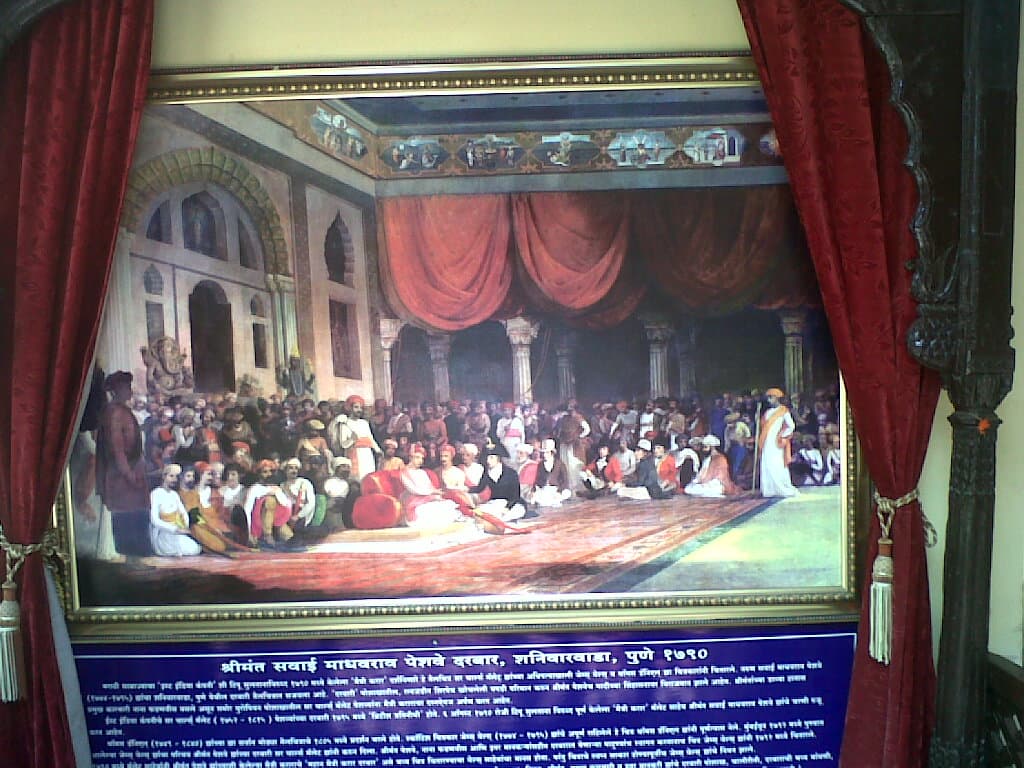
Three years. That is how long the arrangement held before the Marathas, whose neutrality Tipu Sultan was paying for annually, signed on with Lord Cornwallis's coalition alongside the British and the Nizam in 1790.
From Srirangapatna's side of the table there is no soft word for it: this was a betrayal of the settlement's whole purpose. The cavalry his tribute was meant to keep at home rode into Mysore instead, ravaging the very territory the treaty had been designed to protect, while British and allied forces attacked from the other directions. Mysore fought a coalition rather than a single enemy, and the war ended with the Treaty of Seringapatam in 1792 — half the kingdom gone, and two of his sons taken as security.
The man who had reached out at Gajendragad, paid when he did not have to, and asked only that Pune stay out of it, was repaid with the one thing he had spent all that money to prevent.
Why did they do it? Because the Marathas were not simply choosing between Mysore and Britain. Mysore had been a powerful and sometimes aggressive neighbour; the Company offered territory and immediate advantage, while the danger posed by British expansion still appeared distant enough to be manageable. From Pune's perspective, joining the coalition was profitable. From Srirangapatna, it was the stab in the back that decided the war before it began.
The Sringeri episode
The relationship between Mysore and the Marathas was also more complicated than a simple Hindu-versus-Muslim or Indian-versus-British narrative sometimes suggests.
In 1791, Maratha forces raided the Sringeri Sharada Peetham, causing substantial damage and carrying away temple property and valuables. Tipu Sultan responded by condemning the attack, corresponding with the Sringeri authorities, and providing assistance for the restoration of the institution — the correspondence survives, and can be read.
The episode matters because it demonstrates how fluid eighteenth-century political alignments could be. Tipu Sultan was capable of fighting the Marathas fiercely while simultaneously supporting a Hindu religious institution attacked by Maratha troops. The politics of the period cannot be reduced to modern communal categories.
Were the Marathas wrong?
From Mysore's side of the ledger the verdict is written above: a peace honoured with tribute, answered with a coalition. The harder question is what it looked like from Pune.
Tipu Sultan repeatedly recognised that British expansion posed a danger to every major Indian power, while the Company steadily turned military alliances into political control. On that, he simply saw further than his neighbours.
But the Marathas were not irrational. They remembered Mysorean expansion. They had fought Haidar Ali; they had fought his son. They wanted territory, tribute and security on their southern frontier — and they had reason to believe the British could be used as a partner without becoming the master of the Deccan.
That calculation proved catastrophically wrong. But it was not irrational when made. What Tipu Sultan privately thought of Maratha arms — and whether he was right — is its own question.
1799: Mysore stands alone
The final Anglo-Mysore War came in 1799. This time the Marathas did not participate in the campaign against Tipu Sultan — but they did not come to his aid either. Mysore faced the British-led invasion largely alone.
On 4 May 1799, Srirangapatna fell and Tipu Sultan was killed defending the city. Mysore's defeat transformed the balance of power in southern India.
But the story did not end there.
The alliance that consumed its partners
Only four years after Mysore fell, the British turned against the Marathas. In the Second Anglo-Maratha War of 1803–1805, the Company defeated major Maratha armies and dismantled much of the confederacy's power.
At Assaye in September 1803, Arthur Wellesley — the same officer who had fought against Tipu Sultan at Mallavelly in 1799 — won one of the hardest battles of his career.
The strategic irony was complete. The Marathas had helped remove Mysore, the strongest Indian power resisting British expansion in the south. Within a few years, the British were dismantling Maratha power themselves.
What he got right — and what he got wrong
Tipu Sultan was right about one fundamental danger: the East India Company was not merely another Indian power. It was a commercial corporation backed by an expanding imperial state, capable of turning military victories into permanent political control.
He was also right that Mysore could not safely confront the Company while its major Indian neighbours stood on the British side.
Where he failed was in converting that strategic insight into a durable coalition. His concessions at Gajendragad were an attempt to solve the problem pragmatically. But Pune had its own interests, its own memories of Mysorean expansion, and its own calculation of British power.
There was no natural Indian alliance waiting to be formed. There were competing states, competing ambitions and temporary partnerships. That was the deeper tragedy.
The alliance that never was
Tipu Sultan's diplomacy was ultimately a struggle against isolation. He sought partners in France, the Ottoman world, Persia and Afghanistan. He negotiated with neighbouring Indian powers. He fought when diplomacy failed and made concessions when he believed they could buy strategic time.
But with the Marathas, he never found the formula that could turn rivalry into cooperation. The British did. They exploited the divisions between India's major powers, defeated them one at a time, and converted temporary alliances into lasting supremacy.
The Marathas did not betray Mysore in some simple, predetermined sense. They pursued their own interests. The tragedy was that those interests briefly aligned with a power whose ambitions were ultimately much larger than anyone in Pune — or Srirangapatna — could contain.
Tipu Sultan understood the danger before many of his rivals did. He could not persuade them to act on it. And when Mysore fell in 1799, the next major Indian power to face the Company was the Maratha confederacy itself.
Sources for this page
- Mohibbul Hasan, History of Tipu Sultan — chapters on the Maratha wars and the Treaty of Gajendragad.
- Irfan Habib (ed.), State and Diplomacy under Tipu Sultan (2001).
- A. K. Shastry, The Records of the Sringeri Dharmasamsthana (2009) — the 1791 raid and Tipu Sultan's response.
- C. Hayavadana Rao, History of Mysore 1766–1799 (1946).
Full bibliography and how we weigh sources: Sources & Method