The Diplomat · Hyderabad
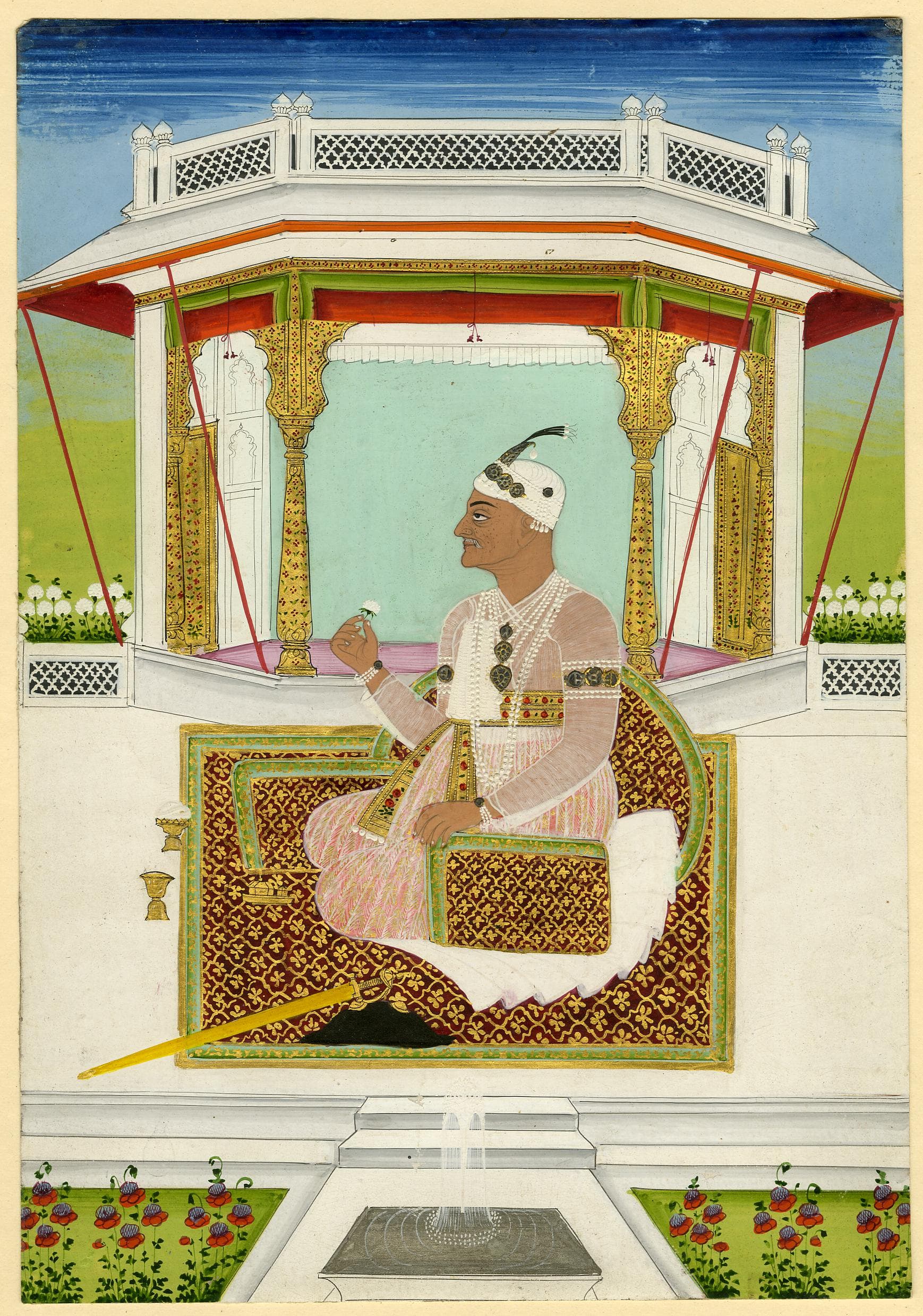
The Nizam
Two Muslim states in the Deccan, sharing a border, a language of legitimacy, and an enemy — who spent the entire period on opposite sides. Hyderabad's choice was the single most useful asset the East India Company acquired in South India.
- Ruler
- Nizam Ali Khan, Asaf Jah II
- Claim
- Mughal viceroy of the Deccan
- Joined Britain
- 1790 and 1799
- Subsidiary alliance
- 1798
A quarrel about status
The Nizams of Hyderabad held the Deccan as viceroys of the Mughal emperor — a legal position of real prestige, and the basis of Nizam Ali Khan's claim to precedence over every other ruler in the south, including the upstart house of Haidar Ali. Mysore had been, in the Nizam's eyes, a Mughal dependency usurped by a soldier.
Tipu Sultan attacked the claim at its root. He dropped the Mughal emperor's name from his coinage, took the title of Padshah, and then obtained recognition as an independent sovereign from the Ottoman caliph — a title in Islamic law superior to a Mughal viceroyalty. Hyderabad could not match it, and did not forgive it.
Ally, then adversary
The two states were not permanently opposed. The Nizam allied with Mysore against the Marathas in the mid-1780s, and Tipu Sultan made repeated attempts to keep him neutral thereafter. But Hyderabad had a standing grievance — territory ceded to Mysore under Haidar — and a standing fear of Mysorean power, and the Company offered a way to address both at someone else's expense.
In 1790 the Nizam joined Cornwallis's triple alliance and shared in the partition of Mysore in 1792. In 1799 his contingent marched with General Harris to Srirangapatna, and he shared again in the spoils.
The Circars, and what the Nizam had already sold
The Nizam's alignment with the Company did not begin with Tipu Sultan; it began with a land transfer in 1766, when Nizam Ali Khan ceded the Northern Circars — the coastal districts north of Madras — to the East India Company. The terms were the germ of everything that followed: in exchange, the Company undertook to furnish him with a subsidiary force in wartime, and to pay him six lakhs of rupees a year when no troops were required, in return for his assistance when called upon.
That is a subsidiary alliance in embryo, signed thirty-two years before the famous one, and it explains the pattern of the Nizam's conduct for the rest of the century. He had already discovered that the Company would pay him to be useful, and would guarantee him against the neighbours he feared. Everything he did in the Anglo-Mysore Wars follows from that arrangement rather than from any view about Mysore.
A weathervane, not a traitor
It is worth resisting the temptation to read him simply as treacherous. Nizam Ali Khan ruled a state wedged between two powers that had each taken territory from him and could each destroy him — Mysore to the south, the Marathas to the north-west. He had no army capable of facing either alone.
His policy was therefore to rent the strongest available protector and switch when the price changed. He joined the coalition against Haidar Ali in 1766, changed sides to fight alongside Mysore in 1767, abandoned that alliance and allied with the Company in 1768, joined Tipu Sultan against the Marathas in the mid-1780s, and then joined Cornwallis against Tipu Sultan in 1790. From Hyderabad this was not inconsistency; it was survival by rotation, and it worked longer than any of the alternatives.
What he took from the partitions
He was paid for it, twice. Under the Treaty of Seringapatam in 1792 the Nizam received a share of the half of Mysore that was stripped from Tipu Sultan — the lands running from the Krishna toward the Pennar. After 1799 he received a further share of the partitioned kingdom. Hyderabad ended the Anglo-Mysore Wars materially larger than it began them, without ever having fought Mysore alone.
The subsidiary alliance, 1798
The decisive move came a year before the last war. In 1798 Wellesley brought Hyderabad into a subsidiary alliance: the Nizam dismissed his French-officered battalions, accepted Company troops stationed in his territory and paid for out of his revenues, and surrendered control of his foreign relations. Hyderabad survived as a state — it outlasted every rival in the region, into the twentieth century — but as a protected one.
The specific casualty was the French. Hyderabad had for years maintained a substantial corps trained and led by French officers under Michel Raymond — the one force in the Deccan that might have been available to a Franco-Mysorean combination. The 1798 treaty disbanded it. At a stroke Wellesley removed a French army from the map of southern India without fighting it, and replaced it with Company troops paid for out of the Nizam's own revenues.
For Tipu Sultan the effect was immediate and fatal. The alliance guaranteed a friendly army on his northern flank and closed the last plausible route to an Indian coalition. When Wellesley's ultimatum came in 1799, Mysore had no neighbour left to turn to. It is the clearest demonstration of the pattern that destroyed him: the Company never fought Mysore alone if it could help it, and rarely needed to.
The arrangement became the template. The subsidiary alliance Wellesley tested on Hyderabad was applied across India over the following decades, and it is the mechanism by which the Company absorbed most of the subcontinent without annexing it. Hyderabad itself survived on those terms for a hundred and fifty years, longer than any of its rivals — as a protected state, which is precisely the status Tipu Sultan refused in 1799 and died rather than accept.
Sources for this page
- Mohibbul Hasan, History of Tipu Sultan — chapters on Hyderabad and the coalitions.
- Irfan Habib (ed.), State and Diplomacy under Tipu Sultan (2001).
- Treaty of subsidiary alliance with the Nizam (1798), in Aitchison's Treaties, Engagements and Sanads.
- C. Hayavadana Rao, History of Mysore 1766–1799 (1946).
Full bibliography and how we weigh sources: Sources & Method