The Diplomat · Oman & the Gulf
Muscat and the Gulf
The least dramatic and most original part of Tipu Sultan's foreign policy: an attempt to build a state-run trading network across the Arabian Sea that the East India Company neither controlled nor taxed.
- Key port
- Muscat
- Instrument
- State kothis
- Partner
- Imam of Oman
- Goal
- Trade outside Company reach
Why the Gulf
The Company's power in India rested on commerce before it rested on armies, and Tipu Sultan understood the sequence. Mysore produced exactly the goods that made the Indian Ocean trade profitable — sandalwood, pepper, cardamom, rice, silk — and every cargo that moved through Company-controlled channels paid, directly or indirectly, for Company troops.
His answer was to make the state itself a merchant, and to run its trade through ports where the British writ did not reach. That meant the Arabian Sea and the Gulf: Muscat, Basra, Ormuz, and the smaller harbours of the Arabian coast, with Mangalore and the Malabar ports as the Indian terminus.
The state trading houses
Mysore established government commercial houses — kothis — at home and abroad, staffed by state servants operating under written commercial regulations. They dealt in Mysore's export commodities, several of which were state monopolies, and they bought on the state's account: horses for the cavalry, metals, arms, and skilled craftsmen recruited to work in the Sultan's factories.
The commercial regulations even provided for subjects to deposit capital with the state against interest-bearing receipts, funding the enterprise from domestic savings. It is one of the more remarkable documents of eighteenth-century Indian statecraft — something close to a state trading corporation with a public investment arm attached.
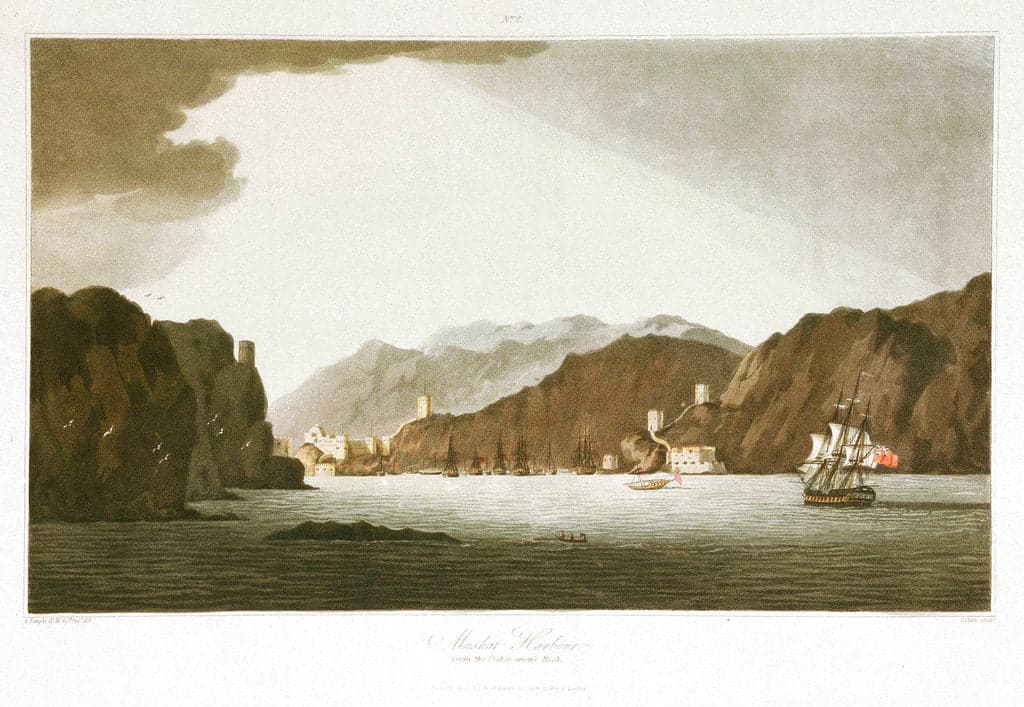
Oman
The central relationship was with the Imam of Oman at Muscat, the principal entrepôt of the northwestern Indian Ocean. Tipu Sultan negotiated directly for trading privileges and a Mysorean commercial presence, and pressed the argument that the Gulf's rulers should build their own factories, weapons, and naval strength rather than depend on European carriers.
The French were also cultivating Oman in these years. The evidence suggests the two sets of relations ran in parallel and were complementary rather than coordinated — Muscat was hedging among all comers, which was the sensible policy for a port city in an ocean contested by four European navies.
Basra, and the corridor to Constantinople
The Gulf strategy and the Ottoman embassy were the same project seen from two ends. Tipu Sultan sought exclusive trading rights at Basra and Muscat, offering reciprocal privileges at Mangalore — and, at the height of his ambition, proposed exchanging Mangalore for Basra outright, which would have given Mysore its own port at the head of the Gulf.
The same corridor carried everything: the 900-strong embassy to Constantinople sailed via Muscat and Basra, its merchants trading along the route and its pilgrims heading for Najaf and Karbala. Commerce, diplomacy, and pilgrimage moved together, which is precisely how eighteenth-century Indian Ocean statecraft worked.
What came of it
Enough to alarm the British, not enough to matter militarily. The network was real and functioning, and the Company watched it closely — an independent Indian state building its own overseas commercial system was a strategic problem, not merely a commercial one. But seventeen years, half of them at war, was not long enough to make Mysore a maritime power, and the naval programme that would have protected the trade was still on the stocks when the war of 1799 came.
Sources for this page
- A. K. Pasha, 'South India and the Gulf: Trade and Diplomacy During the Late Eighteenth Century', in N. N. Vohra (ed.), History, Culture and Society in India and West Asia (2003).
- Irfan Habib (ed.), State and Diplomacy under Tipu Sultan (2001).
- Mohibbul Hasan, History of Tipu Sultan — chapters on trade and commercial policy.
- Tipu Sultan's Commercial Regulations, in Irfan Habib (ed.), Confronting Colonialism (2002).
Full bibliography and how we weigh sources: Sources & Method