Legacy & Memory · Objects & Relics
The War Turban
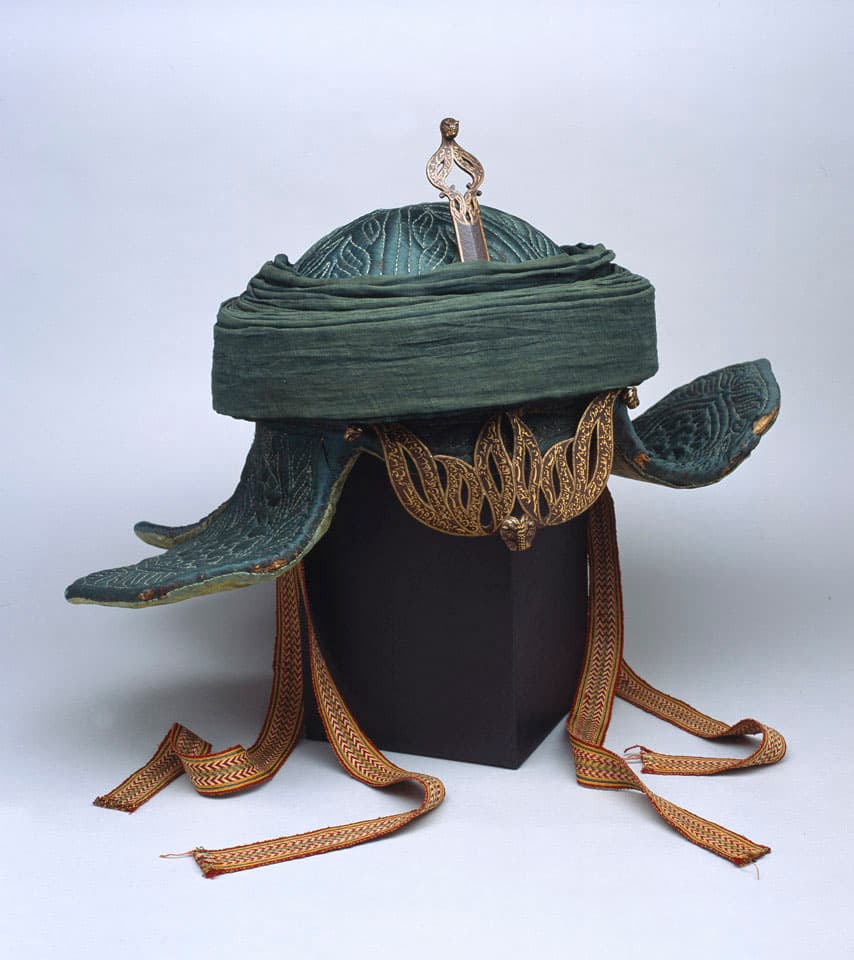
A helmet of quilted green silk wound with muslin, worked all over with tiger stripes, and said to have been dipped in the well of Zamzam to make its wearer invincible. Thirteen days after Tipu Sultan was killed, the army that took his capital voted to send it to the one man who had beaten him before.
- Taken at Srirangapatna
- 4 May 1799
- Voted to Cornwallis
- 17 May 1799
- Given to the museum
- 1971
- Accession
- NAM 1971-07-3-1
What it actually is
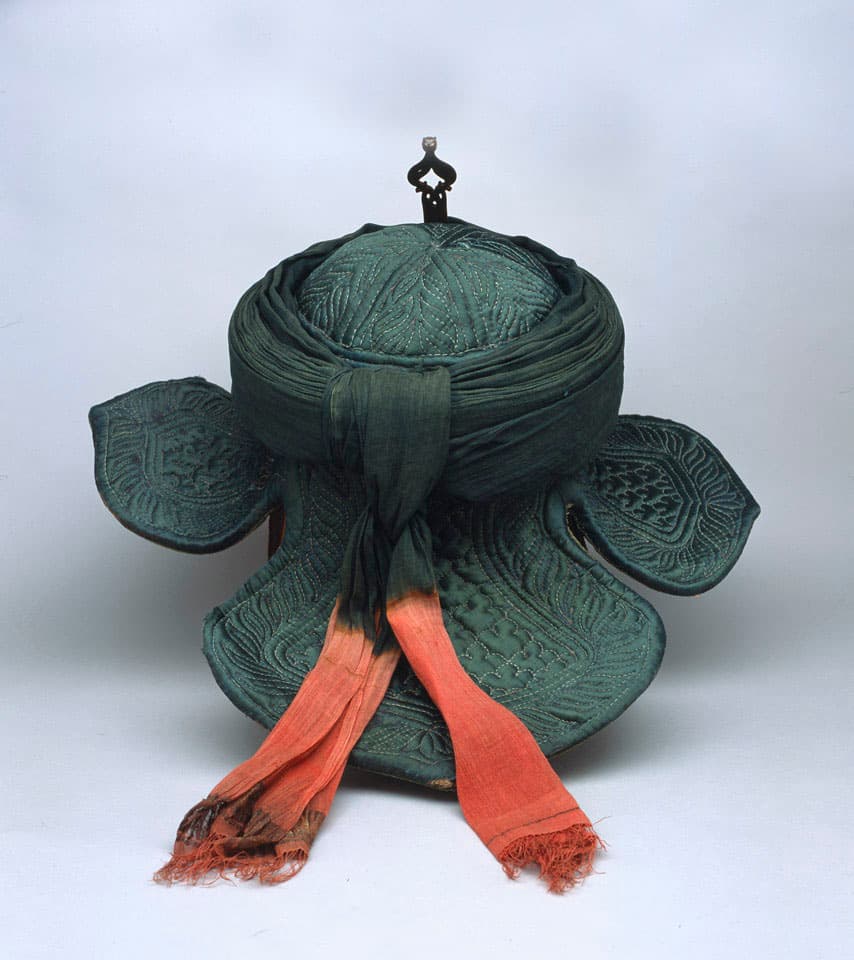
The object the National Army Museum catalogues as Tipu Sultan's war turban is a helmet. The frame is wicker covered in leather; over it lies quilted green silk, and inside it a lining of green silk velvet. Around the body of the helmet is wound a pagri — a length of fine green muslin — its ends tie-dyed pink. It is armour built the way the region had long built light armour: layers of textile over a rigid core, cooler and lighter than steel under a South Indian sun.
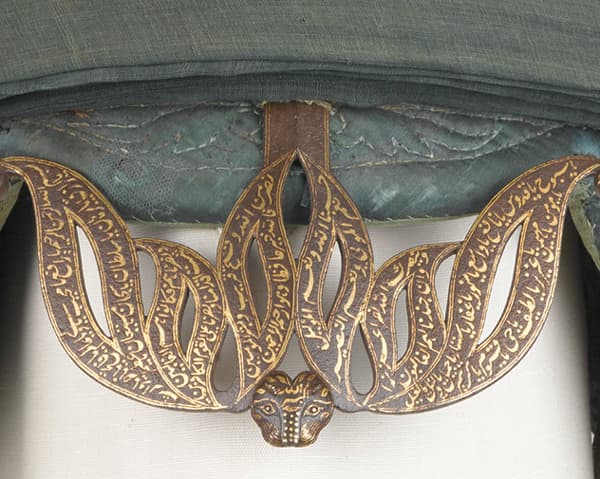
The decoration is what makes it unmistakably his. The quilting is worked in bubris — the stylised tiger stripe Tipu Sultan used as a personal emblem — and the steel guard is blued and damascened in gold with six conjoined bubris, each ending in a tiger's head, framing verses from the Qur'an written in nastaliq, the courtly Persian hand. The tiger and the faith, on one object, worn on the head of the state.
The stripe that signed everything
The bubri was the closest thing the Sarkar-i-Khudadad had to a logotype. It appears on the golden throne, on the uniforms of his regular infantry, on cannon barrels, sword hilts, mortars and flags — and on this helmet, quilted into the very padding. A soldier who picked it up in 1799 did not need to be told whose it was; no other ruler in India dressed his possessions in tiger skin.
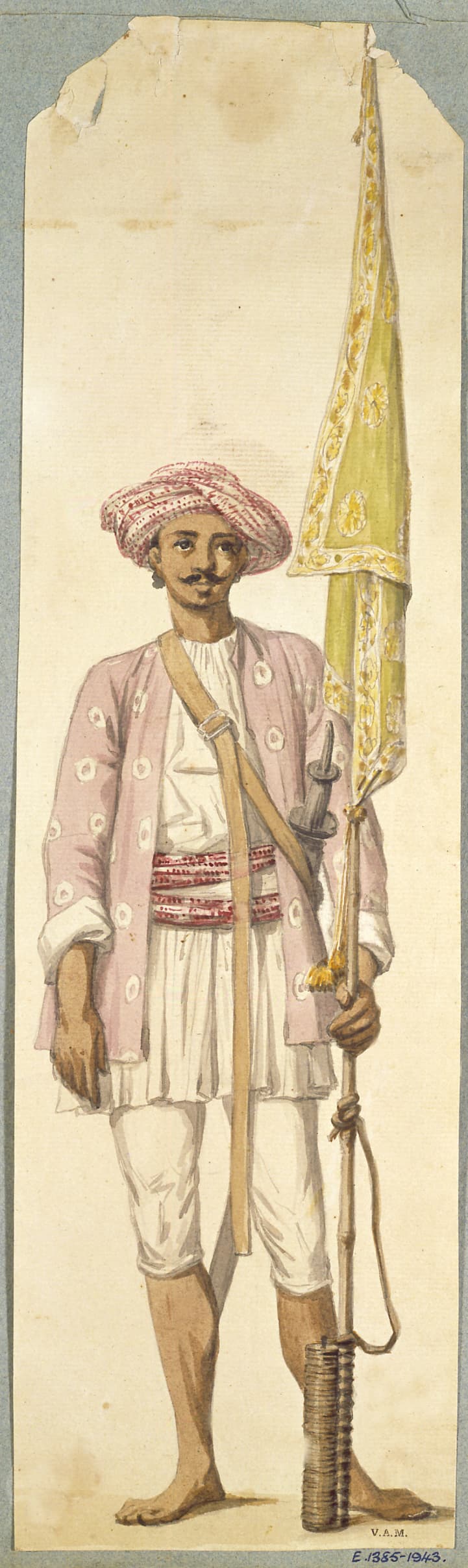
The same emblem dressed his infantry: Robert Home painted a soldier of the army from life in 1793–94, wearing the tiger-patterned jacket that was the uniform of the Sultan's regular troops.
The well of Zamzam
The tradition attached to the helmet — recorded by the museum that holds it — is that it was dipped in the well of Zamzam at Mecca, to render the man who wore it invincible in battle.
There is no way to verify what was done to a helmet two and a half centuries ago, and the claim should be read as what it is: the kind of story that travelled with the object. But it is entirely consistent with the man. Tipu Sultan named his state the God-given government, kept a private register of dreams he mined for signs, and had the guard of this same helmet inscribed with Qur'anic verses. A ruler who understood war as fought under heaven's eye is exactly the ruler whose armour acquires a pilgrimage story.
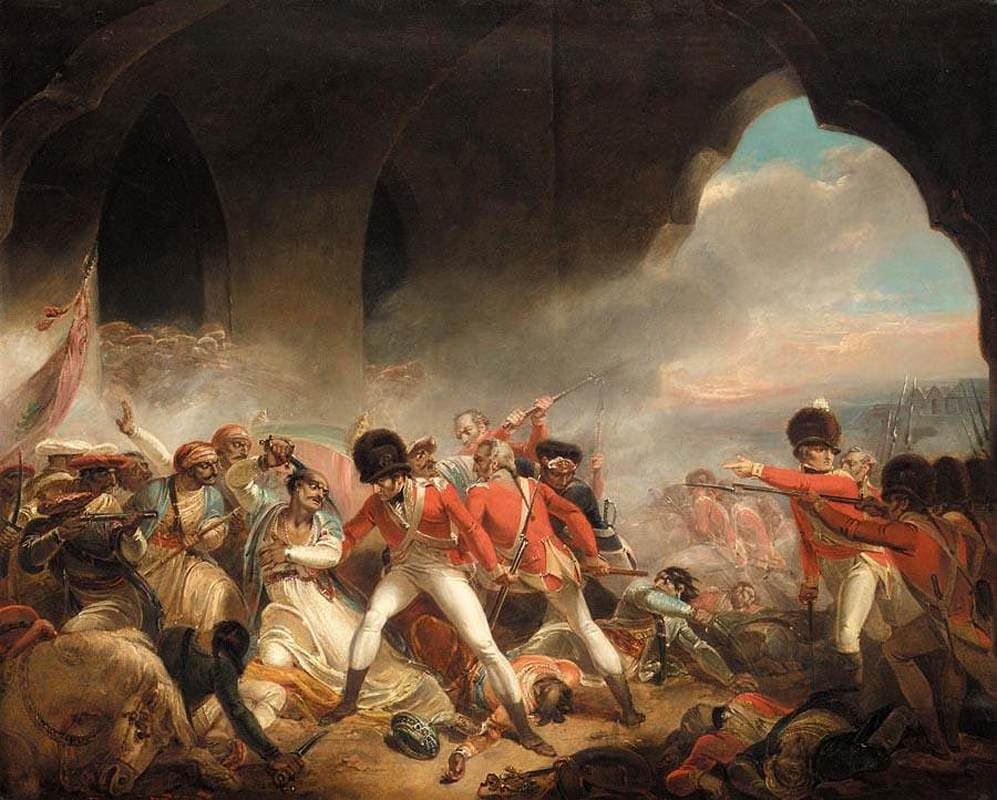
Whatever protection the tradition promised, the record of 4 May 1799 is that its owner died fighting at the Water Gate, and the helmet outlived him into the hands of a prize committee.
Thirteen days from trophy to tribute
Srirangapatna fell on the afternoon of 4 May 1799, and within days the looting had been bureaucratised: prize agents appointed, the palace inventoried, the contents valued and divided by rank. The most spectacular objects were reserved for presentation, and on 17 May 1799 the Committee of Prize resolved “That the war Turban of Tippoo Sultan…be presented to Marquis Cornwallis.”
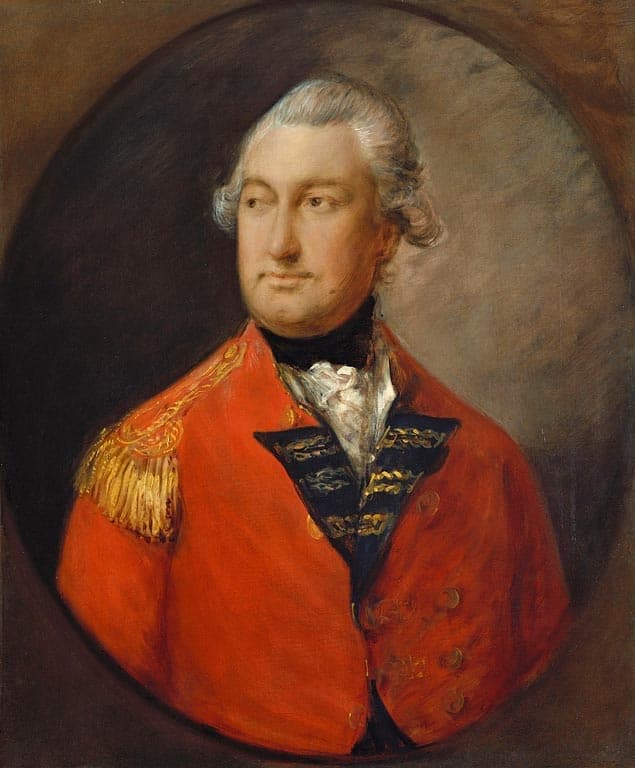
The choice of recipient is the interesting part. Cornwallis was not there. He had left India six years earlier and was by then Lord Lieutenant of Ireland; the army of 1799 was commanded by other men. But it was Cornwallis who had broken Mysore in 1792, taken half its territory and two of Tipu Sultan's sons as security, and the officers of 1799 saw their victory as the completion of his. The committee's chairman, Colonel John Floyd, had commanded cavalry under Cornwallis in that earlier war — the museum's own reading is that the gift to his old commander was very likely Floyd's doing.
So the dead Sultan's helmet was sent, as tribute, from one British general's army to another British general's house — a piece of the man distributed the way everything else he owned was distributed. What the gesture said was plain: the tiger's head-covering for the man who first caged him.
From a family house to a museum case
The helmet stayed with the Cornwallis family for a hundred and seventy years, passing down the generations with the rest of the Srirangapatna presentations, until it came to the National Army Museum in London in 1971, where it is accessioned as 1971-07-3-1. The same museum holds the jewelled khanjar presented to Cornwallis after the fall of the capital, and Robert Home's painting of him receiving the hostage princes in 1792 — donor, trophy and image of the victory, all under one roof.
Elsewhere on this site
The rest of what left the palace is catalogued in Objects & Relics; the day the helmet changed hands is reconstructed hour by hour in The Final Day; and the man the army chose to honour with it has his own page, Lord Cornwallis.
Sources for this page
- National Army Museum, London: object record and collection story for Tipu Sultan's war turban, accession 1971-07-3-1 — materials, decoration, the Zamzam tradition, and provenance.
- Proceedings of the Committee of Prize, Seringapatam, 17 May 1799, as quoted in the National Army Museum's collection notes.
- Mohibbul Hasan, History of Tipu Sultan — on the fall of Srirangapatna and the division of the prize.
- Anne Buddle, The Tiger and the Thistle (1999) — on the Srirangapatna relics and their British afterlife.
Full bibliography and how we weigh sources: Sources & Method