Legacy & Memory · The Question
Was Tipu Sultan a Freedom Fighter?
It is the question most often asked about him, and it cannot be answered with a yes or a no — because the question itself arrived a century and a half after he died. What can be answered, from the documents, is what he fought for, what he refused, and how a dead eighteenth-century sovereign was recruited into twentieth-century arguments he never heard.
- Died
- In battle, 4 May 1799
- Fighting
- The East India Company
- The term arrives
- 20th century
- Tipu Jayanti
- Instituted 2015, ended 2019
The short answer
“Freedom fighter” is the vocabulary of the Indian independence movement — a movement that began a century after Tipu Sultan's death, fought for a nation whose political idea did not exist in 1799. No one in the eighteenth century, in Mysore or anywhere else, was fighting for “India”: the subcontinent was a field of competing sovereignties — Mysore, the Marathas, Hyderabad, Travancore, the Company among them — and Tipu Sultan made war on most of his Indian neighbours at one time or another.
What the documents do support is narrower and, on its own terms, remarkable: he identified the East India Company as the one power that would end every Indian sovereignty including his own, said so for years in his correspondence, refused the vassalage that every comparable ruler eventually accepted, and died sword in hand when the alternative was to reign as a client. That is not the same thing as fighting for national freedom. It is also not nothing — and it is the true kernel inside the freedom-fighter claim.
What he was actually fighting for
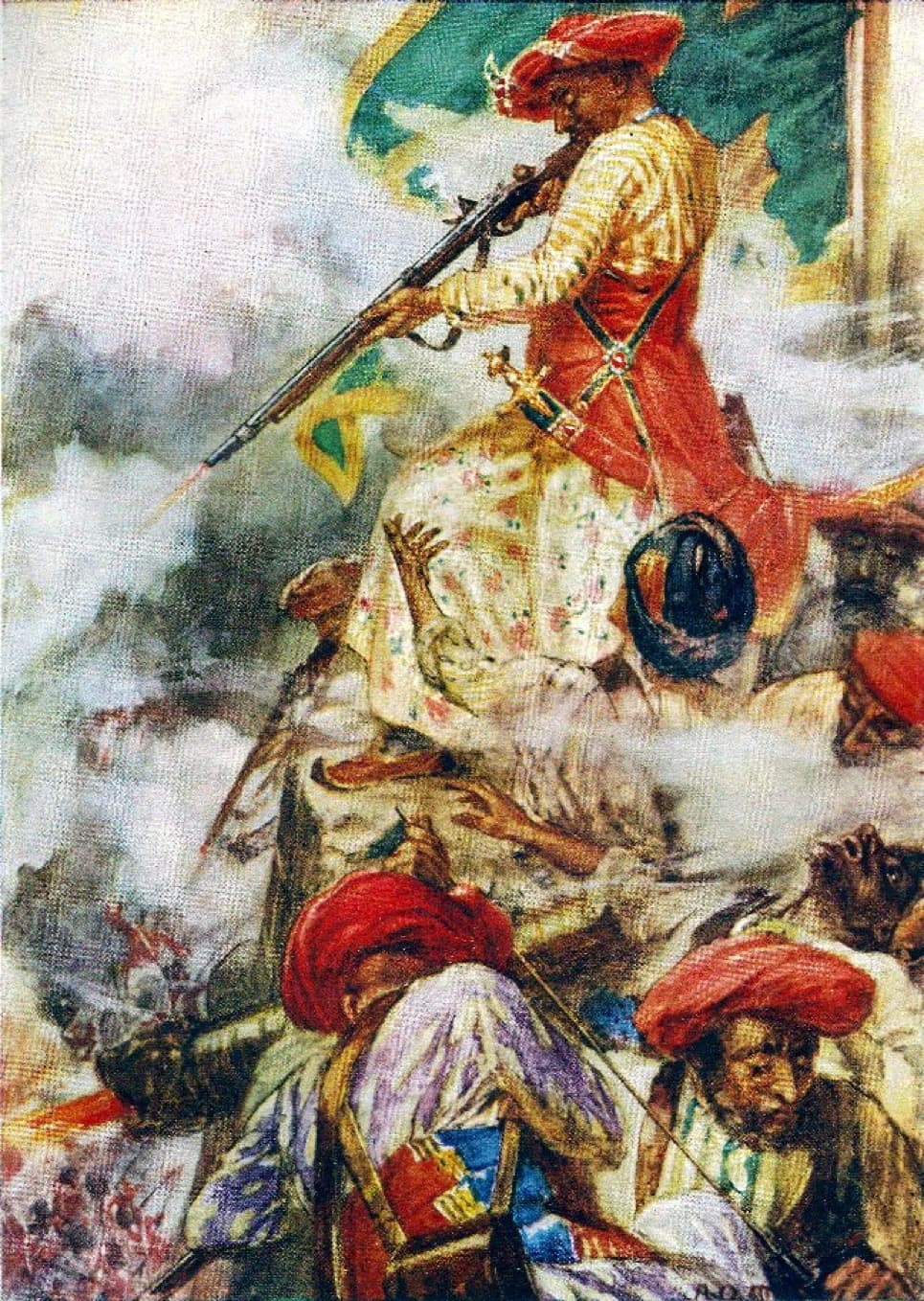
The state he defended was the Sarkar-i-Khudadad — his own “God-given government” — and its sovereignty was the cause. When Governor-General Richard Wellesley demanded a subsidiary alliance in 1798–99 — Company troops garrisoned in Mysore at Mysore's expense, foreign policy surrendered — Hyderabad had already signed, and the restored Wodeyar state would sign within months of Tipu Sultan's death. He was the ruler who would not, and the 1799 war was the price.
But the same record resists any national reading. He sought French alliance to fight the British; he pressed Zaman Shah of Afghanistan for years to invade northern India and open a second front; he fought the Marathas, invaded Travancore, and broke rebellions in Coorg and Malabar with severity his own admirers cannot wish away. Every one of those adversaries except the Company was Indian. He was a sovereign defending a state, with a sovereign's full toolkit — diplomacy, war, and repression — not a proto-nationalist defending a people.
How the freedom fighter was built
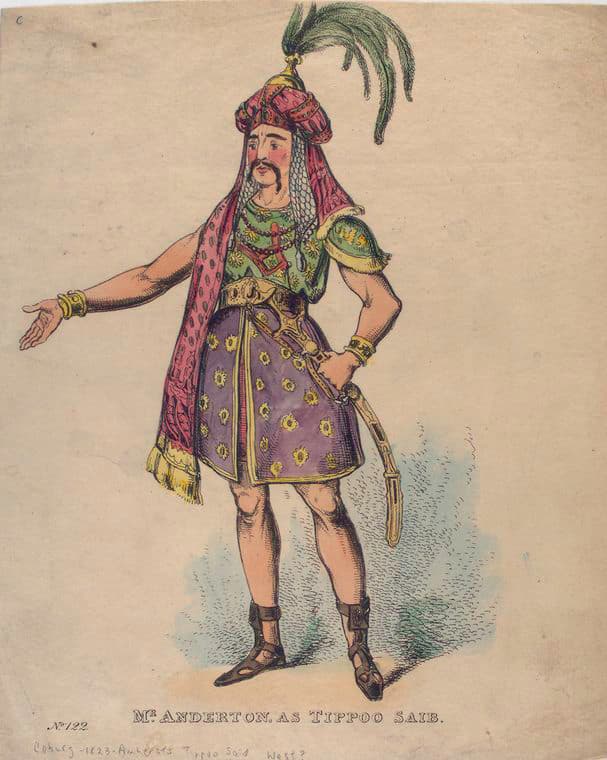
The first people to make Tipu Sultan larger than life were the British. For two decades he was the Company's archetypal enemy — pantomime villain on the London stage, subject of history paintings and panoramas — and propaganda of that intensity preserves its subject like amber. When Indian and Pakistani nationalisms later went looking for ancestors, the British had already built the pedestal.
The reversal came in the twentieth century. Muhammad Iqbal wrote verses on his martyrdom; Pakistan translated his dream register with a foreword by its first prime minister and has kept a warship named Tippu Sultan in commission since 1949. In India, Bhagwan Gidwani's novel The Sword of Tipu Sultan (1976) and the Doordarshan serial made from it (1990) fixed the heroic image for a generation; A. P. J. Abdul Kalam claimed the Mysorean rocket as the ancestry of India's space programme. Karnataka's government made his birthday an official state celebration in 2015. Each of these used the same man for a different present-day purpose.
How the tyrant was built
The counter-image is older, and its foundations are colonial. The Company's chroniclers — Kirkpatrick, Wilks, Beatson — wrote the conquest's justification into the record: a fanatic, a usurper, an oriental despot from whom Mysore had to be rescued. Modern polemic recycles their portrait, usually without knowing its source.
But the tyrant image is not made of nothing, and this site does not pretend otherwise. The deportation of the Mangalore Christians in 1784, the treatment of Coorg and Malabar in revolt — these are documented, and they were harsh even by the standards of eighteenth-century counter-insurgency. The same documents show temple endowments, the Sringeri letters, a Brahmin chief minister — and show him breaking Muslim opponents with exactly the severity he showed anyone else in rebellion. The pattern is political, not confessional. Neither camp's poster survives contact with the whole archive.
Why the controversy will not settle
Since the 2010s the argument has been party politics as much as history. Karnataka instituted Tipu Jayanti in 2015 over protests — deadly ones in Kodagu, the old Coorg — and a successor government abolished it in 2019; textbooks, place names and theatre productions have each taken their turn as the battlefield. The dispute is real, but it is a dispute about the present: which community's memory the state should honour. The eighteenth-century evidence cannot settle it, because both sides are quoting the parts of the archive that serve, and the archive contains both. How recent the controversy is — and how the villain was made — is traced, with dates, on its own page.
The verdict this site can defend
Judge him as what he was: an eighteenth-century absolute sovereign — moderniser, administrator, innovator, devout Muslim ruler of a mostly Hindu state, ruthless to rebellion, and clear-eyed earlier than almost anyone about what the Company intended for India's sovereigns. “Freedom fighter” and “tyrant” are both twentieth-century costumes hung on him, as the history of his legacy shows in detail — and he had already been dressed in costumes by Europe for two centuries before that. The man underneath is more interesting than either.
Sources for this page
- Mohibbul Hasan, History of Tipu Sultan — the base narrative: the subsidiary alliance demands of 1798–99, the refusal, and the fall of Srirangapatna.
- Irfan Habib (ed.), Confronting Colonialism — introduction, on the historiography: colonial construction of the tyrant and nationalist construction of the hero.
- Kate Brittlebank, Tiger: The Life of Tipu Sultan (2016) — on image, memory, and the uses of his name after 1799.
- Kirkpatrick, Wilks and Beatson as primary evidence of the colonial portrait, read adversarially per this site's method.
- Muhammad Iqbal on Tipu Sultan's martyrdom (Zarb-i-Kalim; Javid Nama, 1932); Mahmud Husain (trans.), The Dreams of Tipu Sultan, with foreword by Liaquat Ali Khan; Pakistan Navy ship histories for PNS Tippu Sultan, 1949 to the frigate commissioned May 2023.
- Bhagwan Gidwani, The Sword of Tipu Sultan (1976) and the Doordarshan serial (1990) — the popular heroic image.
- Contemporary reporting on Tipu Jayanti, its institution in 2015, the Kodagu protests, and its abolition in 2019.
- On the Rani of Jhansi's death in the field at Gwalior, June 1858 — against the 'only king' superlative.
Full bibliography and how we weigh sources: Sources & Method