Legacy & Memory
Objects & Relics
Almost everything Tipu Sultan owned was inventoried by his enemies within days of his death, and much of it is still on a shelf somewhere with a number attached. This is what survives, and where you can go and look at it.
How a palace became a catalogue
Srirangapatna fell on the afternoon of 4 May 1799, and the looting that followed was both chaotic and, within days, bureaucratic. Prize agents were appointed, the palace was inventoried, and the contents were valued, divided by military rank, and sold or shipped. The most spectacular pieces were reserved: some were presented to the Crown, some to the East India Company's directors, and some to the commanders in person.
The consequence is that Tipu Sultan is one of the best-documented material lives of any 18th-century Indian ruler, and that the documentation is almost entirely in British hands. The golden throne was broken up for its metal — an act that tells you what the prize committee thought it was for. The library, worth nothing as bullion, survived nearly intact.
The catalogue
Grouped by where the objects are now. Museum numbers are given where a public record exists, so that a claim on this page can be checked against the institution's own catalogue rather than against us. Three objects have full pages of their own: the war turban, the swords and the huma bird.
Victoria and Albert Museum
London
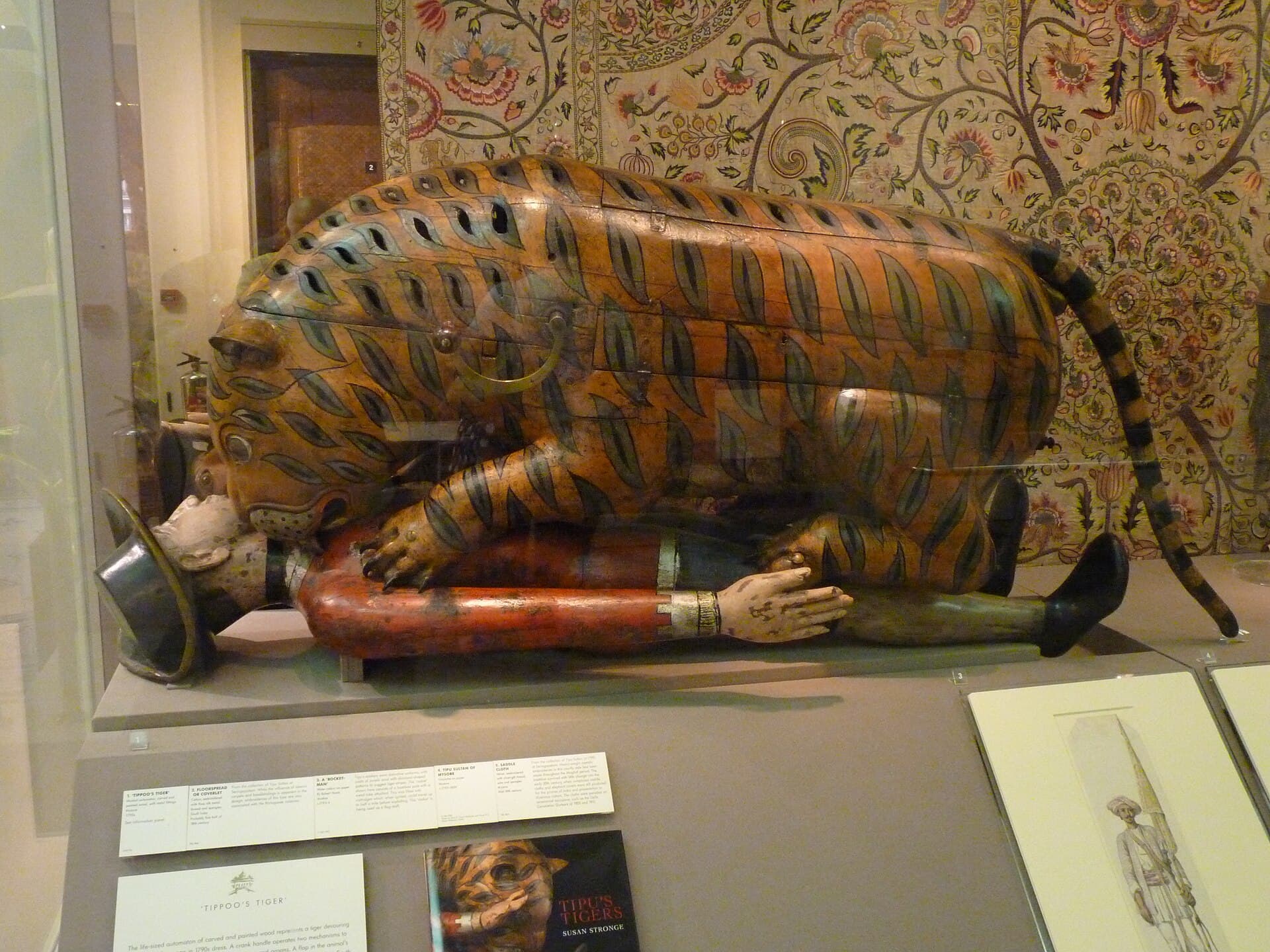
The single most famous object to leave Srirangapatna, and the one that did most to shape how Tipu Sultan is pictured in Britain.
A near-life-size wooden semi-automaton of a tiger mauling a European soldier, with an organ concealed in its flank: a crank works the man's arm, and pipes produce his cries and the tiger's growl.
Museum no. 2545(IS) · catalogued as “Tippoo's Tiger”
Found in the palace music room in 1799 and shipped to London, where it arrived in 1800. Displayed at East India House, transferred to the South Kensington Museum in 1879, and at the V&A since. Display status changes — check the object record before travelling.
Royal Collection Trust
Windsor and London
The golden throne was broken up for prize money before it could be sold whole. Its two most spectacular pieces went to the Crown, and survive.
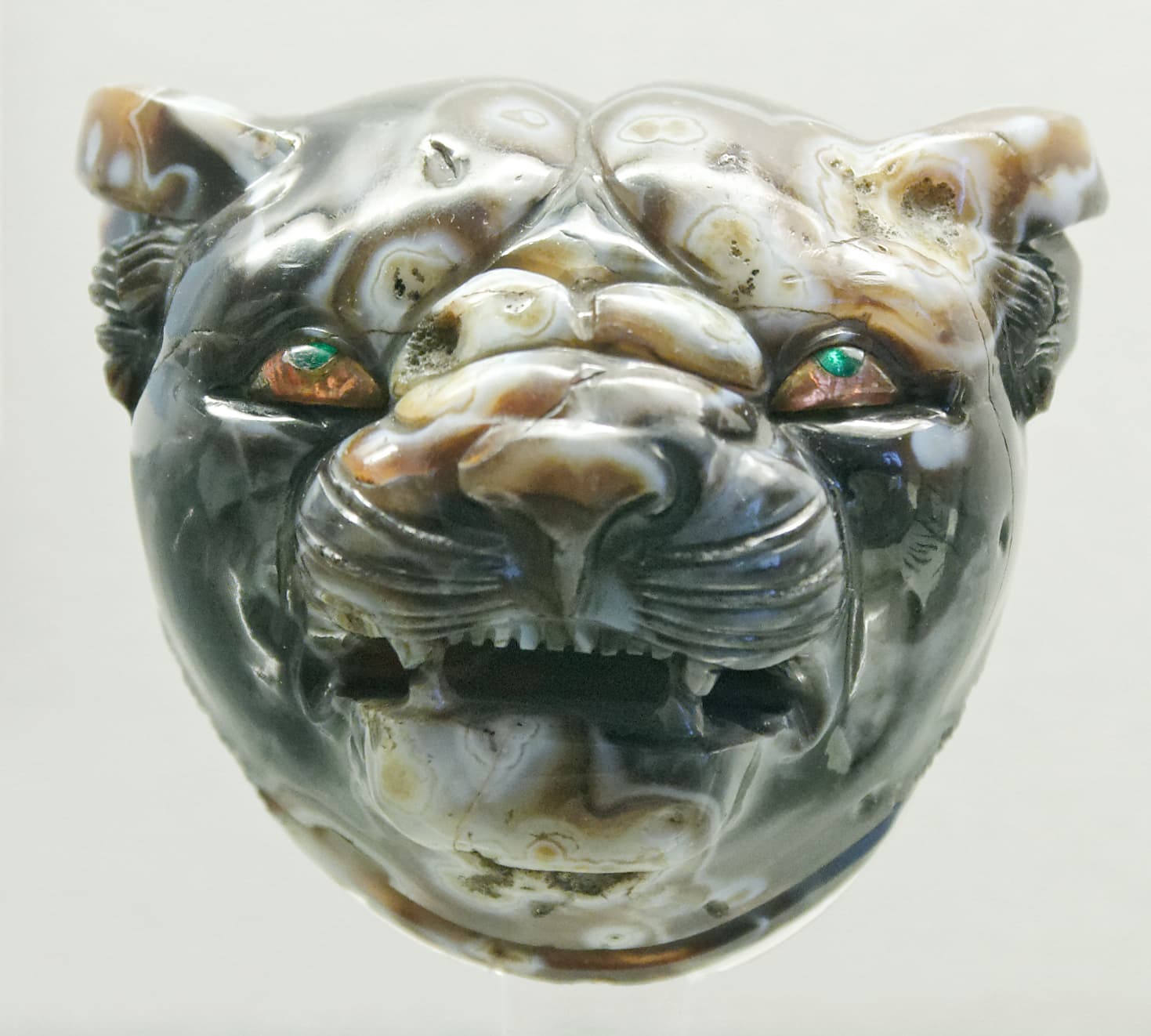
Gold sheet over a wooden core, chased and punched, with rock-crystal eyes and teeth and an articulated gold tongue. It was the centrepiece of the octagonal throne.
RCIN 67212
Presented to William IV by the East India Company in 1831.
The jewelled bird that stood on top of the throne canopy — the mythical bird whose shadow was said to mark out a king.
RCIN 48482
Presented to George III by the Company's directors in 1800; passed to the Prince Regent in 1818 and was remounted by Rundell's in the 1820s. The bird, the myth and the throne have a full page on this site — see below.
Talwar, blunderbuss and banner
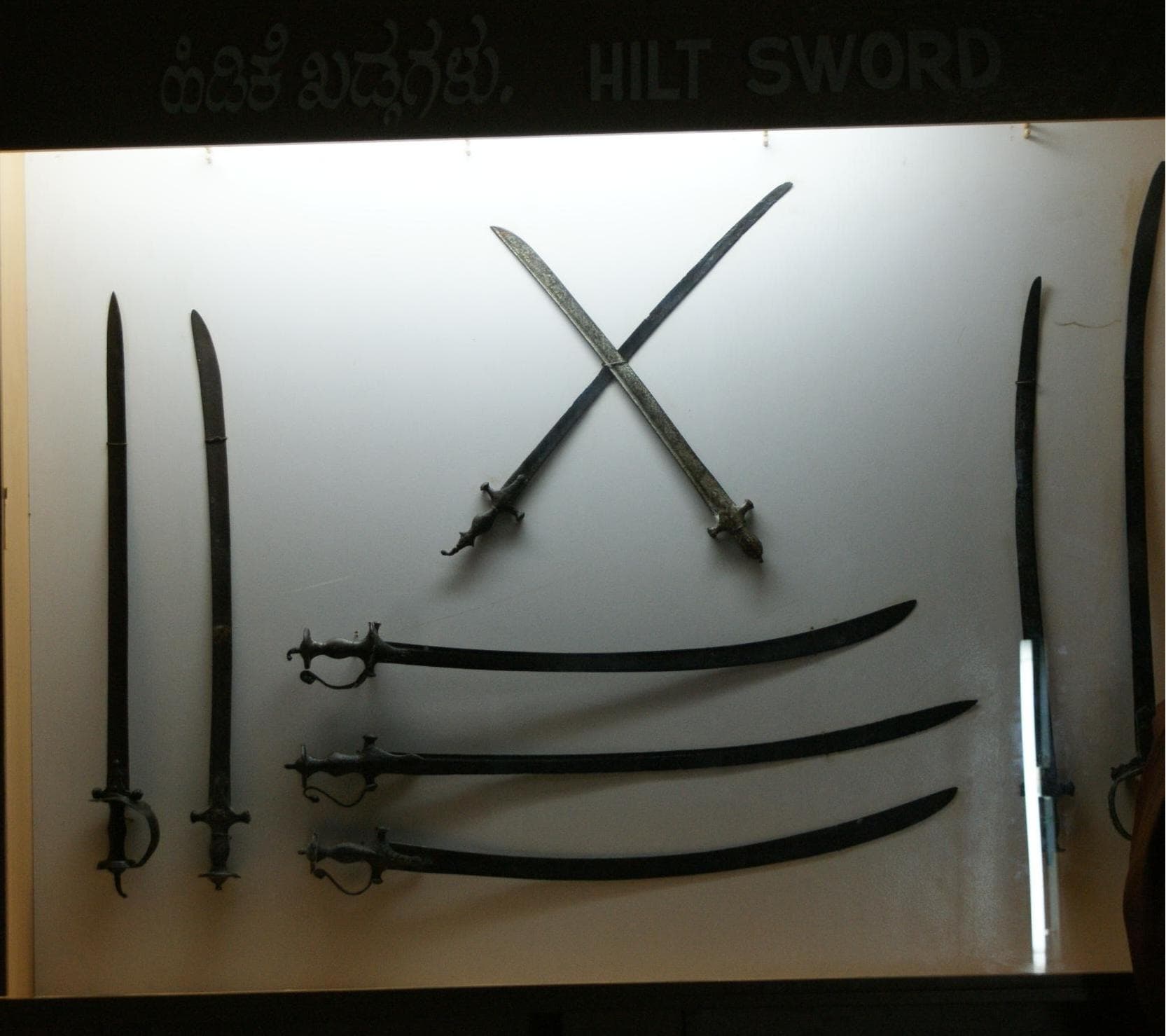
Weapons and a standard taken from Srirangapatna, part of a larger group of Mysore material in the collection.
RCIN 67211, 67238, 72839
National Army Museum
London
The Cornwallis family gave the museum the objects presented to the man who beat Tipu Sultan in 1792 — and to the army that finished the job in 1799.
A helmet of leather-covered wicker overlaid with quilted green silk, lined with silk velvet, with a green muslin pagri wound round it.
Accession 1971-07-3-1 · sent to Lord Cornwallis in 1799; to the museum in 1971
The helmet, the Zamzam tradition and the prize committee's gift have a full page on this site — see below.
A dagger with a jewelled jade hilt, presented to Cornwallis after the fall of Srirangapatna.
Accession 1997-04-121-1
Tiger figurine and the Seringapatam Medal
Loot from the palace, and the medal the Company struck for the men who took it — the victory as the victors chose to commemorate it.
Accessions 1959-07-145-1, 1988-01-20-1
Powis Castle (National Trust)
Powys, Wales
Edward Clive, son of Robert Clive and Governor of Madras in 1799, took a share of the Srirangapatna spoils home to a Welsh castle, where they remain — the largest private-house collection of Tipu Sultan material anywhere.
A vast painted and printed chintz campaign tent from Tipu Sultan's court, one of very few to survive anywhere.
The tent, and how the Clives came by it, are covered on this site's page on the Clives.
Tiger-head finial, sword, and around 700 South Asian objects
A throne finial, arms, furniture and ornaments, displayed in the Clive Museum alongside objects acquired by purchase and gift — a mixture the National Trust now labels rather than blurs.
British Library
London
Tipu Sultan's library was among the most valuable things in the palace, and unlike the gold it was not melted down. It was catalogued, divided, and shipped — and it is the reason so much can be said about how his state actually worked.
Manuscripts from the palace library
Roughly 600 volumes reached the East India Company's library between 1806 and 1808, with more in 1837 — perhaps a quarter of the two thousand volumes the library held in 1799. They include works copied or composed at Srirangapatna, in bindings made at his court.
Linked via the Internet Archive: the British Library's blog has been offline since the cyber-attack of October 2023.
Tipu Sultan's personal Qur'an, and the distinctive seals by which volumes from his library can still be identified in collections around the world — of well over a hundred manuscripts examined, only twenty-eight carry his own seal.
IO Islamic 3562
Karnataka
Srirangapatna, Bengaluru and Shivamogga
What stayed in India is mostly not portable: the buildings, the tombs, and — recently and spectacularly — the ordnance.
The rockets from the Nagara well
In July 2018 an excavation at Bidanur fort near Nagara, Shivamogga district, pulled more than a thousand corroded iron rocket casings out of an abandoned well, some still carrying propellant residue. It is by far the largest surviving quantity of the weapon Mysore is famous for.
Held for display at the Shivappa Nayaka Museum, Shivamogga. Three further rockets are in the Government Museum, Bengaluru.
The palaces, the fort and the Gumbaz
The Daria Daulat Bagh with its Pollilur murals, the fort walls and water gate, the Jama Masjid, and the Gumbaz where he lies beside Haidar Ali and his mother — all standing, all visitable.
Covered in this site's Srirangapatna section.
The objects that come back to the market
Tipu Sultan's weapons have never stopped selling. In 2004 the businessman Vijay Mallya bought a sword at auction and returned it to India. In May 2023 the sword found in his private chambers in 1799 — taken as a trophy, presented to Major-General David Baird, and kept in the Baird family until 2003 — sold at Bonhams in London for £14 million against an estimate of £1.5–2 million, a record for any Indian or Islamic object at auction.
The prices are part of the history rather than a footnote to it. An object's value in a London saleroom is a direct measure of how successfully the story of 1799 was sold to the British public, and the market for it has now outlived the empire that made it by seventy-five years.
Bonhams press release, 23 May 2023 — and the full story of the blades, from the bedchamber to the saleroom, is on The Sword of Tipu Sultan.
Where the argument is now
Nearly every object above was taken by force from a ruler who had just been killed defending his capital, and the institutions holding them increasingly say so on the label. What follows from that is genuinely disputed.
Elsewhere on this site
The buildings that could not be shipped are covered in Srirangapatna; the tent and the Clive family in The Clives; the weapon the rockets became in Mysorean Rockets; and the wider fight over his memory in Legacy & Memory.
Sources for this page
- Victoria and Albert Museum, object record for Tippoo's Tiger, museum no. 2545(IS) — acquisition and display history.
- Royal Collection Trust, object records RCIN 67212 (tiger's head), RCIN 48482 (huma bird), RCIN 67211, 67238, 72839.
- National Army Museum, object records and collection notes on Tipu Sultan's war turban, khanjar, helmet, tiger figurine, and the Seringapatam Medal.
- National Trust and Ashmolean Museum, on the South Asian collection in the Clive Museum, Powis Castle.
- British Library, Asian and African Studies blog: on bindings from Tipu Sultan's court and the seals of Tipu Sultan; IO Islamic 3562.
- Anne Buddle, The Tiger and the Thistle (1999) — on the relics and their British afterlife.
- Bonhams press release, 23 May 2023, on the sale of the bedchamber sword; contemporary reporting on the 2004 repatriation.
- Contemporary reporting and Archaeology magazine on the July 2018 excavation at Bidanur fort, Nagara, Shivamogga district.
Full bibliography and how we weigh sources: Sources & Method