Reference
Legacy & Memory
Tipu Sultan has been dead for over two centuries and argued about for all of them. The argument itself is part of his history — and understanding who has told his story, and why, is the key to reading everything else about him.
The first storytellers were his enemies
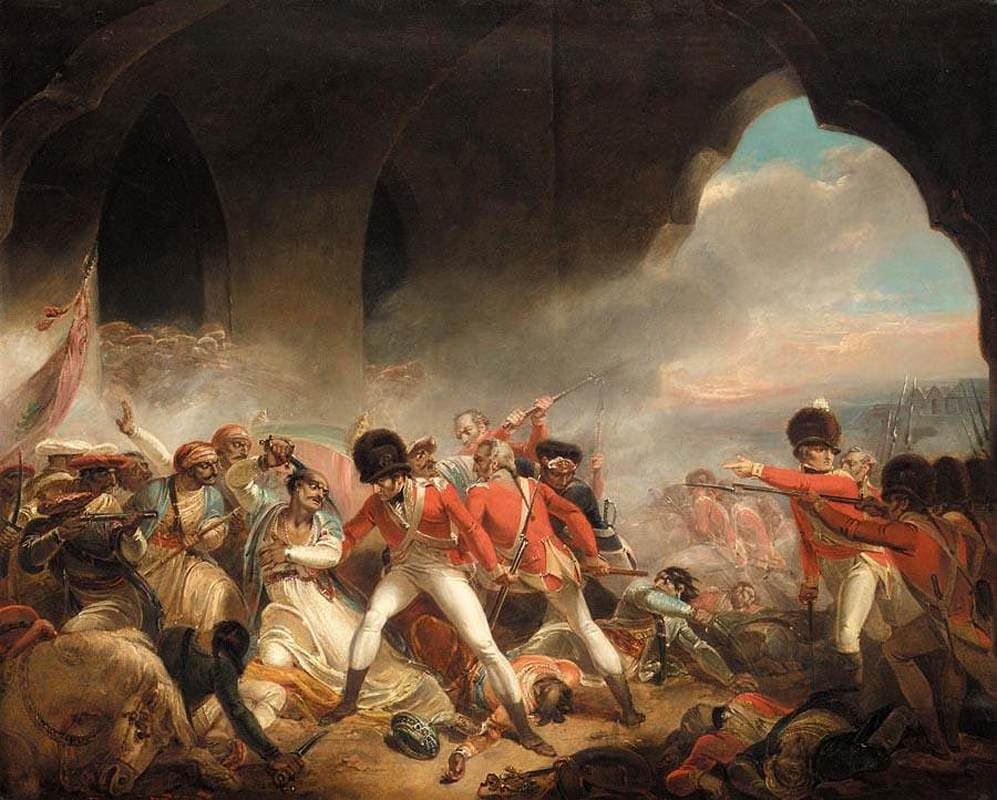
The earliest, most influential accounts of Tipu Sultan were written by the people who killed him. Wartime Britain needed Tipu Sultan to be a monster — the “tyrant of Mysore” justified pre-emptive war, enormous expense, and the seizure of a kingdom — and its pamphlets, histories, plays, and paintings delivered one. The storming of Srirangapatna became a staple of London theatre; the surrender of Tipu Sultan's hostage sons a favourite of history painters. Much of this material is valuable evidence; none of it is neutral, and this site treats it accordingly.
Objects in exile
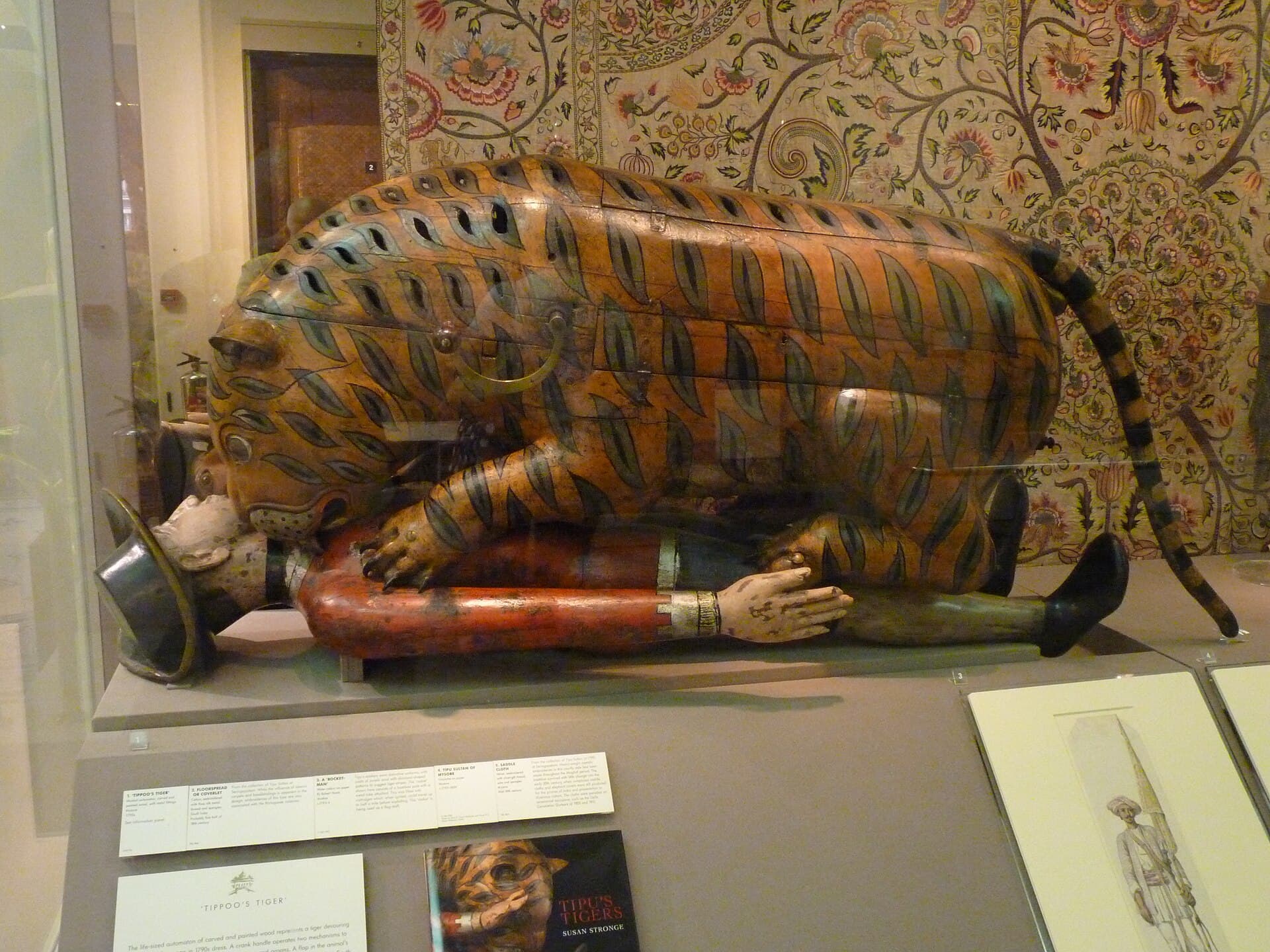
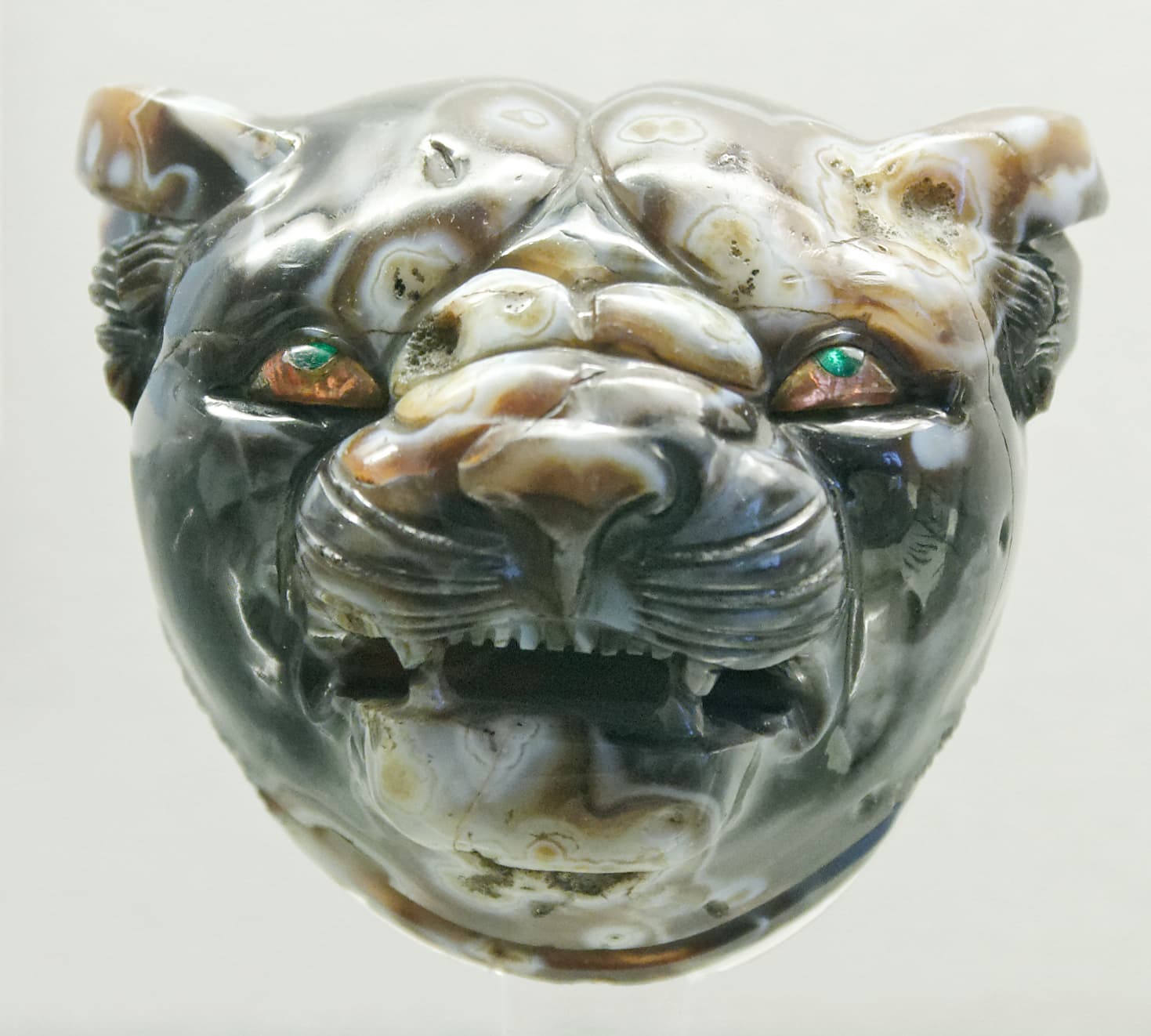
The plunder of Srirangapatna scattered Tipu Sultan's material world across Britain, where it remains the most visited trace of him. Tipu Sultan's Tiger — the near-life-size mechanical organ of a tiger devouring a European soldier, complete with growls and screams — has been a star exhibit in London since 1808 and sits today in the Victoria & Albert Museum. Fragments of the golden tiger throne, broken up for prize money, survive in the Royal Collection and elsewhere. His weapons resurface periodically at auction: Vijay Mallya repatriated a sword in 2004, and in May 2023 a sword from Tipu Sultan's private chambers sold at Bonhams for £14 million — a record for any Indian object at auction.
Objects & Relics: where to see them →After 1799: what became of the family →
Icon of resistance
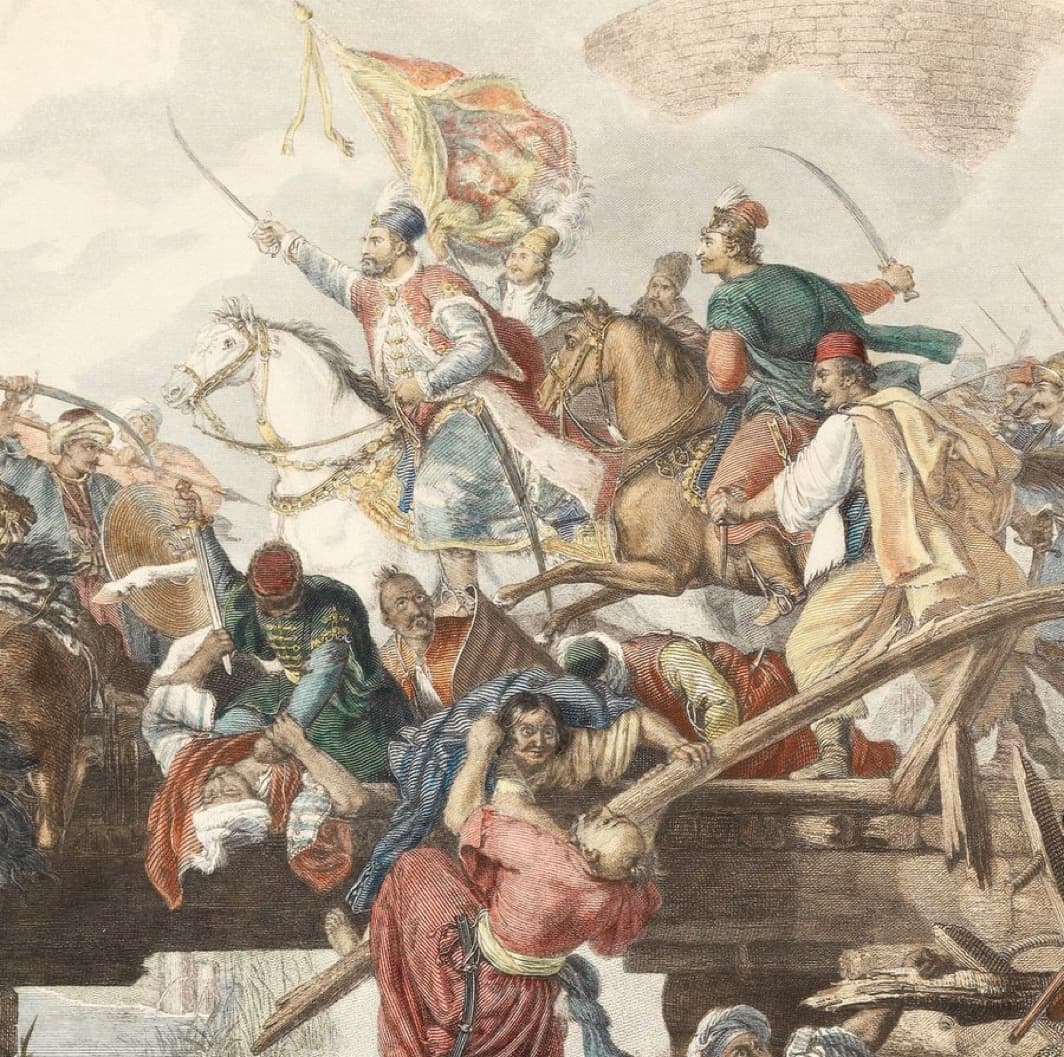
In India the memory ran differently. To many in the independence movement and after, Tipu Sultan stood as the ruler who saw the Company clearly, modernized to fight it, refused every accommodation, and died on the walls — the counter-example to the princes who signed and survived. His rockets entered national iconography (APJ Abdul Kalam, the missile scientist who became President of India, kept a painting of Tipu Sultan's rocketeers and called him a pioneer), his silk industry still employs thousands, and streets, universities, and a famous 1990 television serial carried his name.
The core of that memory is a refusal, and it is worth stating as plainly as the record allows. The instrument by which the Company took India without conquering it was the subsidiary alliance: keep your throne, host our troops, pay for them, and surrender your foreign policy. Nearly everyone signed in the end. Hyderabad signed in 1798, Awadh in 1801, the Marathas at Bassein in 1802. Tipu Sultan was offered the same terms in 1799 and would not take them, and the war that followed killed him inside three months.
Whether that was statesmanship or miscalculation is a fair question, and this site puts the case on both sides on the fourth war page. But it is not what the memory turns on. What survived him is simply that he was asked and said no — and that in a century when almost every other Indian ruler eventually said yes, one did not.
The administration they kept
The more concrete afterlife is the one least often told, because it is unglamorous: the people who destroyed him kept his machinery running, and in places learned from it.
His own finance minister stayed at his desk. Purnaiya had run Tipu Sultan's revenue and military departments; after 1799 he served the restored Wodeyar dynasty as Diwan until 1811. The throne changed hands and the dynasty changed religion, and the administration was handed to the man who already knew how it worked. Purnaiya's conduct in the final war is itself contested — the fourth war page sets out what is known — but the continuity is not in doubt.
The revenue method outlived the state. In the Baramahal districts ceded in 1792, Alexander Read and a young Thomas Munro took over ground where the state already assessed and collected directly from the cultivator rather than through a landholding intermediary. Munro learned survey and assessment there, and carried the principle forward into the ryotwari settlement he extended across the Madras Presidency as governor from 1820 — the system that came to govern the land revenue of a large part of British India, and the deliberate alternative to the Permanent Settlement Cornwallis had imposed in Bengal.
And some of it is still working. The sericulture he established by importing stock and technique has made Karnataka the largest silk-producing state in India, and the lacquered wooden toys of Channapatna — an industry he seeded with Persian craftsmen — carry a geographical-indication tag today. Two centuries after the state was dismantled, people are still making a living from decisions he took.
In the popular imagination
He is not remembered only in the country he ruled in, and the reach is easy to underestimate.
Pakistan has kept a warship named for him for most of its existence as a state. The Navy commissioned the first PNS Tippu Sultan in 1949, a former British destroyer, and has replaced the name down four generations of ship — a Gearing-class destroyer, a Type 21 frigate, and since May 2023 a modern stealth-capable frigate. In poetry the claim is older still: Muhammad Iqbal wrote Sultan Tipu ki Wasiyat — the testament of Tipu Sultan — and in the Javid Nama reserved his condemnation for the men who betrayed Tipu Sultan and Siraj-ud-Daula to the Company. The first translation of the dream register was made by the Pakistani historian Mahmud Husain and published with a foreword by Liaquat Ali Khan, the country's first Prime Minister.
Bangladesh carries the name in old Dhaka, where Tipu Sultan Road runs through Wari — a ruler of the far south of the peninsula remembered in a Bengali city he never saw.
Kolkata holds the strangest memorial, because it was built by the family the Company deported there after 1799. His son Prince Ghulam Muhammad raised the Tipu Sultan Shahi Masjid on Dharmatala Street in 1832, and a second mosque at Tollygunge. The exile intended to end the dynasty put its name permanently on the capital of British India.
Britain keeps him closest of all, in the objects it took. Tipu's Tiger, described above, remains one of the most visited things in the Victoria and Albert Museum — a war trophy that became, against every intention of the men who shipped it, the single most recognisable image of the ruler they destroyed.
And at Srirangapatna the memory is not curated at all. He lies in the Gumbaz beside Haidar Ali and his mother, and people come — locally, continuously, and without anyone organising it. Whatever the argument in the newspapers, that has not stopped.
America sang about his father
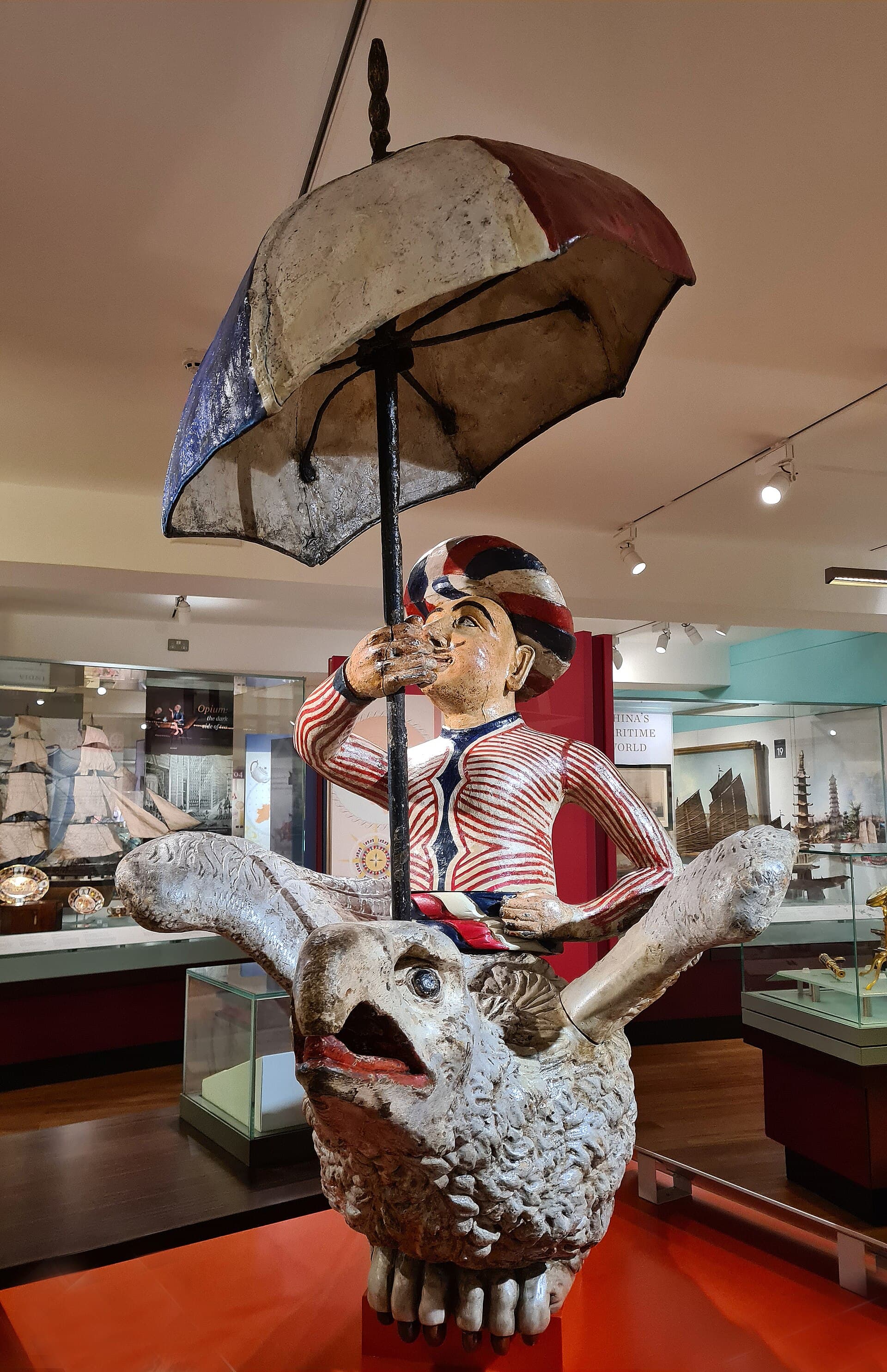
The strangest afterlife begins before his own death. In 1782 the state of Pennsylvania named a warship the Hyder Ally, after Tipu Sultan's father, because he was fighting the same enemy at the other end of the world — and when she beat a heavier Royal Navy sloop in Delaware Bay, Philip Freneau wrote a ballad about it that Americans sang for years.
The modern battleground
Since the 2010s Tipu Sultan has been one of the most politically contested figures in Indian public memory. Karnataka's state government instituted an official Tipu Jayanti celebration in 2015; a successor government abolished it in 2019; textbook treatments, place names, and even theatre productions have become recurring flashpoints. One side invokes the temple patron and anti-colonial martyr; the other, the conqueror of Coorg and Malabar. Both draw on real episodes; both routinely overstate them.
Sources for this page
- Kate Brittlebank, Tiger: The Life of Tipu Sultan (2016) — on image and memory.
- Anne Buddle, The Tiger and the Thistle (1999) — on relics and British representation.
- Victoria & Albert Museum, Tipu Sultan's Tiger object history.
- Irfan Habib (ed.), Confronting Colonialism — introduction, on historiography and propaganda.
- Contemporary reporting on Tipu Jayanti (2015–2019) and the 2023 Bonhams sale.
- On Purnaiya as Diwan of Mysore, 1799–1811, under the restored Wodeyar dynasty.
- On Alexander Read, Thomas Munro and the Baramahal, and the extension of the ryotwari settlement across the Madras Presidency from 1820.
- Muhammad Iqbal, 'Sultan Tipu ki Wasiyat' (Zarb-i-Kalim) and Javid Nama (1932).
- Mahmud Husain (trans.), The Dreams of Tipu Sultan, Pakistan Historical Society — foreword by Liaquat Ali Khan.
- Pakistan Navy ship histories: PNS Tippu Sultan, 1949 to the Tughril-class frigate commissioned May 2023.
- On the Tipu Sultan Shahi Masjid, Dharmatala, Kolkata (1832), built by Prince Ghulam Muhammad.
Full bibliography and how we weigh sources: Sources & Method