Legacy & Memory · Objects & Relics
The Sword of Tipu Sultan
There is no single 'sword of Tipu Sultan'. There was an armoury — tiger-striped hilts, blades inscribed with the qualities of God — and in May 1799 it was divided like everything else he owned. One of those blades now holds the auction record for any Indian object ever sold. This page follows the swords.
- Dispersed from
- May 1799
- Auction record
- £14m · May 2023
- On display in India
- New Delhi & Srirangapatna
- In Britain
- Windsor, Wales, London
One ruler, many swords
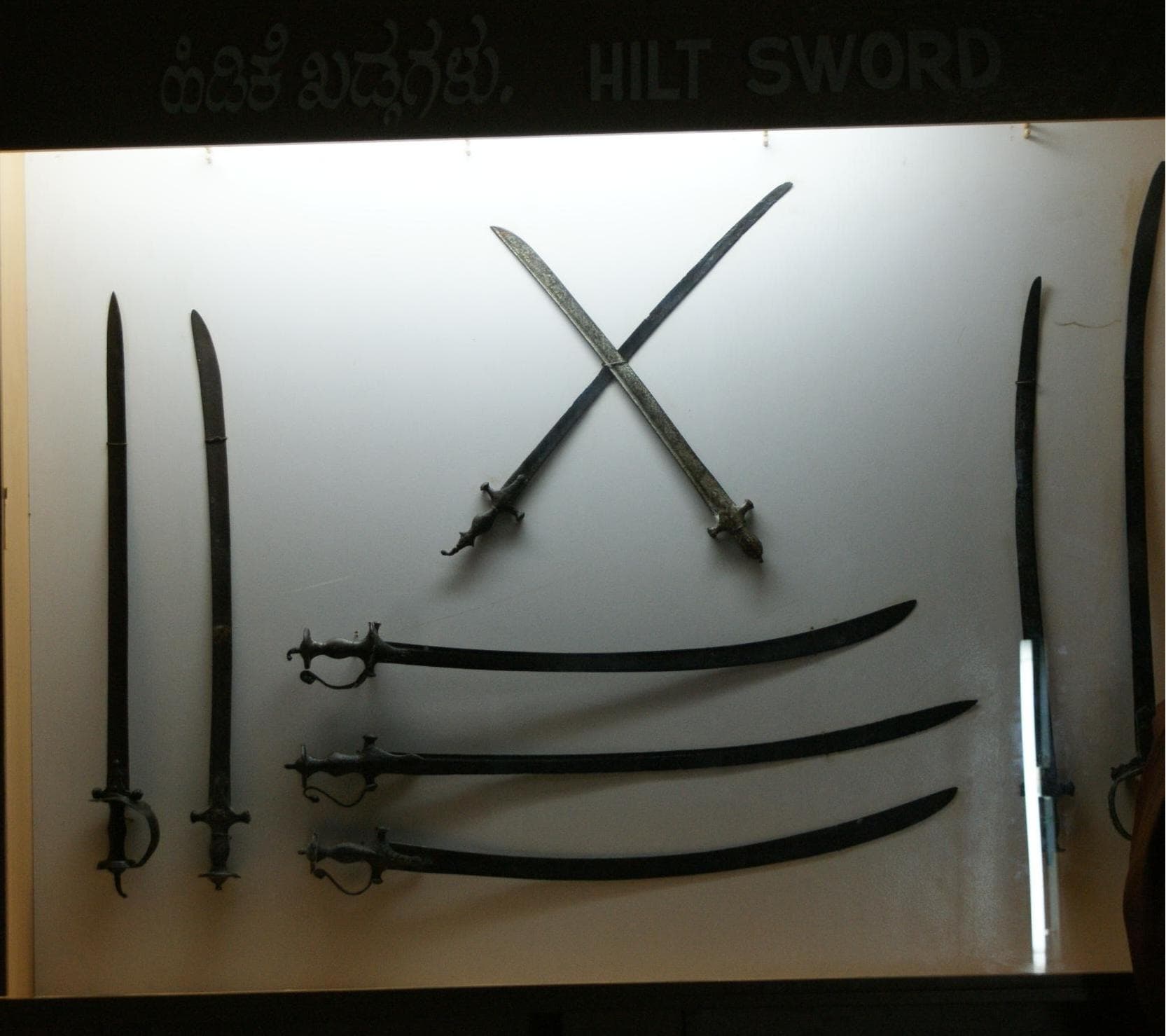
A South Indian ruler of the eighteenth century did not own a sword; he owned swords the way a state owns regalia. Some were sidearms, some were presentation pieces, some were treasury objects that existed to be seen. Tipu Sultan's were instantly recognisable as his: hilts cast with tigers' heads or worked with the bubri tiger stripe he used as a personal emblem, blades damascened in gold with Qur'anic verses, invocations, his name, and dates in the Mauludi calendar his own state had invented.
That legibility is why so many survive. A sword that announced its owner in gold letters was a perfect trophy, and after the fall of Srirangapatna on 4 May 1799 the prize committee and the private looter alike knew exactly what they were holding. The swords were presented to generals, shipped to patrons, and carried home in baggage — which is why the map of where they are now is a map of who won.
The bedchamber sword
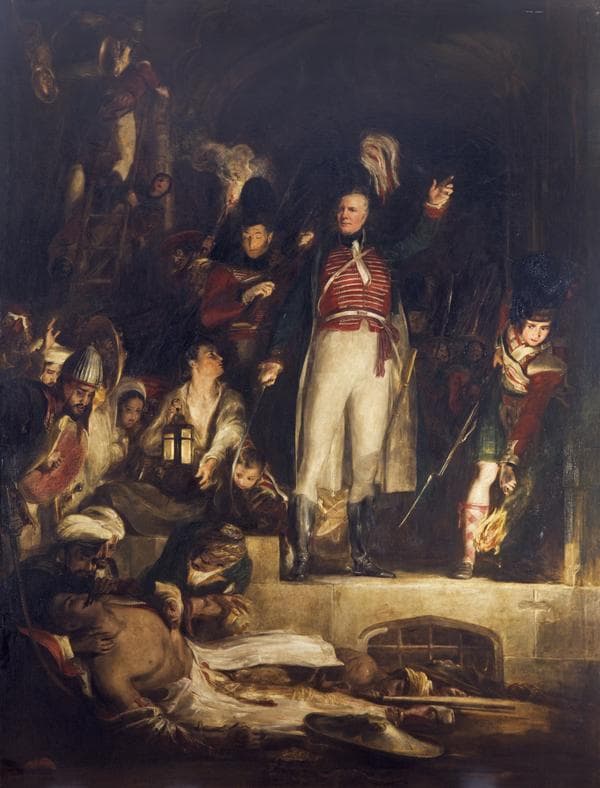
The most storied of them all was not taken from his hand. Tipu Sultan slept, by the accounts the auction house assembled, in a hammock slung from the ceiling of a locked and bolted chamber, with a pair of pistols and a sword within reach. After the storming, that sword was found in his private apartments — and the army presented it to Major-General David Baird, in the words of the presentation, as a token of their high esteem of his courage and conduct in the assault in which Tipu Sultan was slain.
The choice of Baird was as pointed as the turban sent to Cornwallis. Baird had spent nearly four years as a prisoner in Srirangapatna's dungeons after Pollilur, and in 1799 he led the storming column. The army gave the prisoner the gaoler's own bedside weapon.
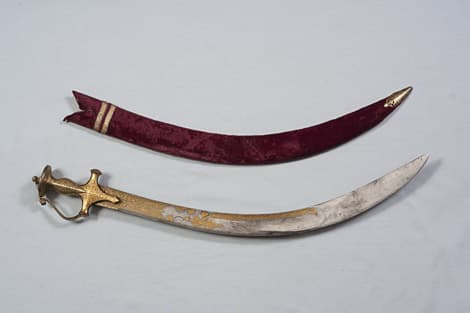
The sword itself is a sukhela — a flexible steel blade — with a hilt of Mughal form covered in gold koftgari. The blade is inscribed “The Sword of the Ruler”; the hilt carries, in gold calligraphy, five of the qualities of God and two invocations calling on Him by name. It is a weapon and a prayer in one object, which is exactly the combination its owner's whole reign ran on.
The £14 million record
The sword descended in the Baird family for two centuries, and came back onto the market in the early 2000s. On 23 May 2023, at Bonhams in London, it sold for £14 million against an estimate of £1.5–2 million — seven times the top estimate, and a world record at auction for any Indian or Islamic object. Neither the seller nor the buyer was named.
Twenty years earlier, in 2004, the businessman Vijay Mallya had bought a sword of Tipu Sultan with the same Baird provenance at a London auction for about ₹1.5 crore and flown it to India, to considerable public celebration — the tiger's sword coming home. In 2016 he told an interviewer he had given it away because it had brought his family bad luck; by 2018 his own lawyers told a London court its whereabouts were unknown.
Either way, the price is part of the history. A blade taken from a dead ruler's bedchamber now trades at the level of a Rothko, and the market's enthusiasm is a direct measure of how durable the story of 1799 has proved — the auction house's own announcement leads with the romance of the locked bedchamber.
The blades in India
Not everything left. The National Museum in New Delhi displays an inscribed sword of Tipu Sultan — the hilt damascened in gold with floral and creeper work, the blade carrying Qur'anic verses together with his name and his capital, Seringapatam. At his summer palace in Bangalore, cased swords from the armoury are part of the standing display. And repatriation by purchase has continued: the 2004 Mallya sword was the most famous case, and blades and other pieces from the armoury still surface at London and New York sales, some of them bought back for India.
The trophies in Britain
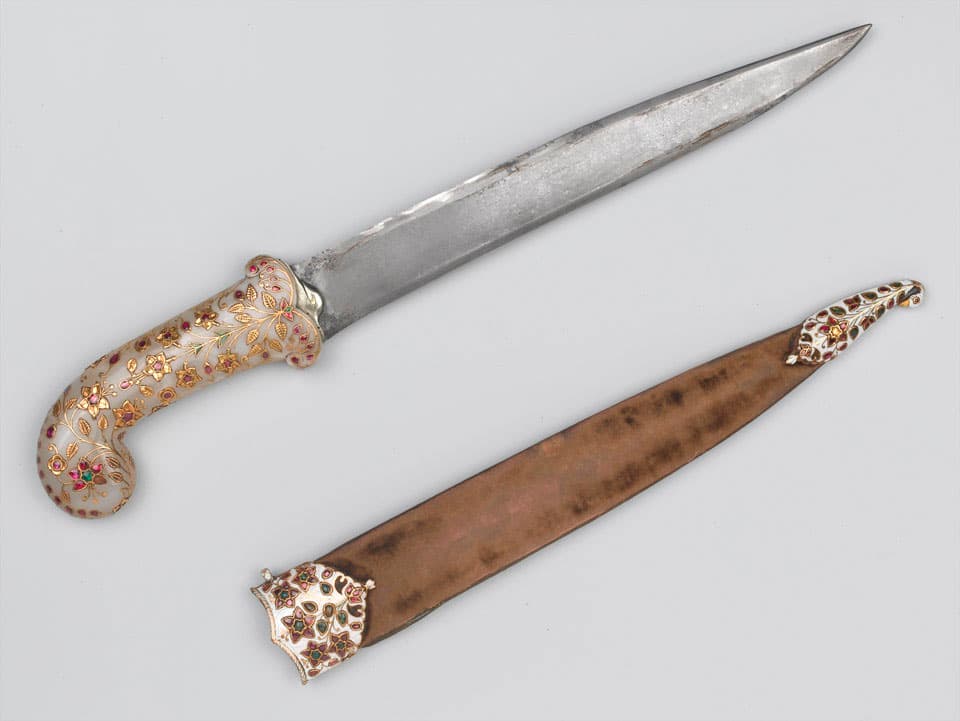
The presentation swords of 1799 are still where the presentations sent them. The Royal Collection holds a talwar from Srirangapatna (RCIN 67211), on view in the Grand Vestibule at Windsor Castle among the other spoils given to the Crown. Powis Castle in Wales has a sword presented to Edward Clive, Governor of Madras during the war of 1799, alongside the rest of the Clive haul. And the blades were not all swords: the National Army Museum has the jewelled khanjar — a jade-hilted dagger inlaid with gold and set with rubies and emeralds — presented to Lord Cornwallis after the fall of the capital, the companion piece to the war turban.
And one London case teaches the necessary lesson in scepticism: the Wallace Collection displays a magnificent jade-hilted sword set with diamonds, rubies and emeralds whose blade carries — in the museum's own words — an apocryphal signature and a spurious claim to have been Tipu Sultan's personal weapon. Within decades of his death, his name was already worth forging onto steel. Not every “sword of Tipu Sultan” in the world's collections was ever in Mysore.
Sources for this page
- Bonhams, press release of 23 May 2023 and accompanying catalogue material on the bedchamber sword: the sukhela and koftgari hilt, the inscriptions, the presentation to Major-General David Baird, and the sale result.
- Contemporary reporting on the 2004 purchase and repatriation of a Baird-provenance sword by Vijay Mallya, his 2016 statements, and the 2023 identification claims (Business Standard, News9, The Art Newspaper) — the identification is reported here as a claim, not a fact.
- National Museum, New Delhi, arms and armour collection — the inscribed sword of Tipu Sultan; image released under the Government Open Data License, India.
- Royal Collection Trust, RCIN 67211 (talwar from Seringapatam); National Trust Collections, object 1180590 (sword at Powis Castle).
- Wallace Collection online catalogue — the jade-hilted sword with an apocryphal attribution to Tipu Sultan, in the museum's own description.
- Mohibbul Hasan, History of Tipu Sultan — on the fall of Srirangapatna and the division of the prize.
Full bibliography and how we weigh sources: Sources & Method