The Person · The Khwabnama
The Expulsion Dream
Two years before the end, in the early hours of a January morning at his capital, Tipu Sultan dreamed that a Maratha envoy came to him with news: the English had been crushed in Europe and were preparing to leave Bengal of their own accord. His answer, in the dream, was the whole strategy of his last decade — troops, money, and the hope that the Nazarenes would be expelled from India.
- Entry
- Dream 26 of 37
- Dreamed
- January 1797
- Where
- Srirangapatna
- Manuscript
- BL IO Islamic 3563, f. 12r
The world in January 1797
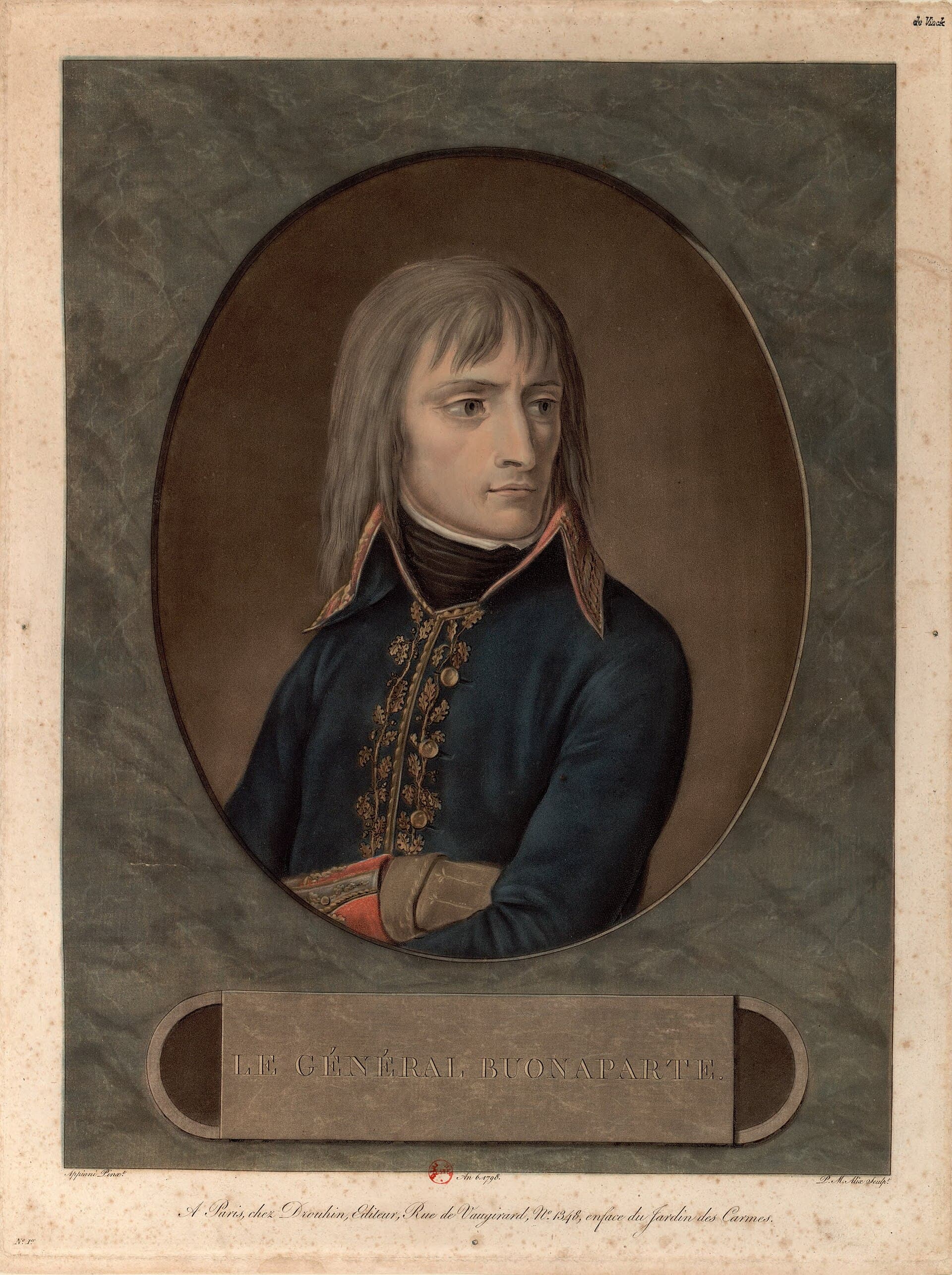
The dream comes from the rebuilding years. The treaty of 1792 had taken half the kingdom, two of his sons, and an indemnity that emptied the treasury; by 1797 the sons were home, the indemnity paid, the army rebuilt — and the news from Europe was, for once, running his way. Revolutionary France had knocked Spain out of Britain's column and into its own, a French fleet had attempted Ireland in December 1796, and a young general named Bonaparte was destroying Britain's allies in Italy. Every newsletter that reached Srirangapatna that winter carried some version of the same message: England was in trouble.
The dream
The entry is dated three ways at once — the 3rd of Razi in his own Mauludi reckoning, the 1st of Sha'ban by the common Muslim calendar, the night of Monday into Tuesday — at the metropolis, in the early hours of the morning. Raghunath Rao, the Maratha agent — an envoy who had come to him before, the entry notes — appeared and announced that the English had suffered a crushing defeat in Europe and were now on the verge of leaving Bengal voluntarily.
The dreamer's reply completes the scene. That is fine, he says: he will despatch troops as well as money — and, God willing, “the Nazarenes shall be expelled from India.”
A dream assembled from intelligence
Almost every element can be matched to his waking preoccupations. The good news from Europe is the newsletter traffic of that winter, improved by sleep from “England pressed hard” to “England crushed and leaving.” The offer of troops and money is his actual diplomatic method — subsidy and coalition — soon to be exercised in earnest in the embassies to Kabul, Persia and Mauritius of 1797–98. And the messenger is the most wishful detail of all: a Maratha envoy, bringing the news and implicitly joining the cause. The Indian ally he courted for a decade and never won finally arrives — in a dream.
That is what makes this entry the most transparent in the register. Where Shahnur produced an omen and a raid, this one produced nothing and predicted nothing; it is the reign's entire late strategy — French victory, Indian coalition, English withdrawal — staged as a single conversation and filed under the date. A man's plans, dreamed back to him as news.
Two years later
None of it came. The French hope died at the Nile in August 1798 with the fleet that was to carry Bonaparte's promises; the Marathas sent no envoy of the dream's kind; and the crushing defeat, when it arrived, was delivered rather than suffered by the English — at his own walls in May 1799. The register's later entries run to within months of that morning. Dream twenty-six is the one to read first, because it shows most clearly what the private record was for: not prophecy, but hope, given the only hearing available to a ruler who could no longer say such things aloud to anyone.
Sources for this page
- British Library, IO Islamic 3563, f. 12r — the dream register.
- Mahmud Husain (trans.), The Dreams of Tipu Sultan (Karachi, 1957), p. 84 — the translation of dream twenty-six paraphrased and briefly quoted here.
- Ursula Sims-Williams, 'Tipu Sultan's dream book (IO Islamic 3563)', British Library Asian and African Studies blog, 11 June 2015 — dating and context.
- Kate Brittlebank, 'Accessing the Unseen Realm', Journal of the Royal Asiatic Society 21:2 (2011).
- Mohibbul Hasan, History of Tipu Sultan — the rebuilding after 1792 and the diplomacy of 1796–98.
Full bibliography and how we weigh sources: Sources & Method