The Person · The Khwabnama
The Shahnur Dream
On the eve of a night attack on the Maratha camp, Tipu Sultan dreamed of a handsome young stranger who let down his hair and proved to be a woman in a man's dress. He read it as an omen about his enemies, rode into their camp with a few hundred men — and then wrote the dream and the victory into his secret register as a single entry.
- Entry
- Dream 13 of 37
- Dreamed
- October 1786
- The raid
- Shahnur, beside Devgiri
- Manuscript
- BL IO Islamic 3563, f. 7r
A war of alliances
The dream belongs to the Maratha–Mysore war of 1785–87. The Marathas, allied with the Nizam of Hyderabad, were trying to recover territory lost to Nawab Haidar Ali Khan in earlier wars; Tipu Sultan had crossed the Tungabhadra in August 1786 to meet them, and by the autumn faced the army of the Maratha general Haripant Phadke near Shahnur, beside Devgiri. The same weeks produced another entry in the register — a dream in which Ali brings him the Prophet's promise to wait for him at the gates of paradise. A commander on campaign, sleeping badly, looking for signs: the register is never more vivid than in this season.
The dream
Written in his own hand, dated by his own calendar — the 6th of Khusrawi, in the year Busd — the entry runs like this. A handsome young man, a stranger, came and sat near him, and Tipu Sultan found himself bantering with the visitor the way a man teases a woman — and caught himself doing it, noting that playful talk was not his habit. The stranger rose, walked a few paces, turned, loosened his hair from beneath his turban and opened the fastenings of his robe: a woman after all. In the dream Tipu Sultan told her that what he had merely guessed was now certain — in Mahmud Husain's translation, “a woman in the dress of a man” — and as they spoke, morning broke and he woke.
Unusually for this most secret of documents, he says he told the dream to others, together with his reading of it: God willing, the Marathas who had put on the clothes of men would prove to be women.
The raid
Two days later, on a Saturday morning, he led a surprise attack on the Maratha camp with only two or three hundred men, and by his own account cut through it as far as Haripant Phadke's own tent. The entry closes the circle in one line — the enemy, he writes, “all fled like women.” Mohibbul Hasan's reconstruction from the military record confirms the substance: the raid struck home, and the next day the Marathas fell back.
The war itself ended in 1787 at Gajendragad, on terms Tipu Sultan kept deliberately generous — he wanted the Marathas neutral in the English war he saw coming, and the omen evidently did not extend to the peace table.
Women in the clothes of men
The gist of the entry is a single verdict: the Marathas are women in the clothes of men — they have put on manhood as a costume, and, God willing, the costume will come off. That verdict is the dreamer's own work, because the dream itself contains no armies, no battle, no Marathas. It is a private, faintly embarrassing encounter: a stranger, some banter he catches himself in, a disguise undone. The interpretation is what turns an uncanny bedroom scene into a judgement on the enemy across the river.
Watch the mechanism. In the dream, a disguise is unravelled — the turban loosened, the robe opened, the claimed identity exposed as costume. The reading transfers that structure to the enemy: the Marathas' manhood is declared to be the same kind of costume, worn clothing rather than true nature, and destined to come undone the same way. In a world where dress was status — where rank arrived as a robe of honour and a turban was an identity — to say of someone that they wear the clothes of a thing without being it was the sharpest available way of calling a claim false.
Notice, too, who the dream flatters. Tipu Sultan is not merely promised victory; he is cast as the one who sees through the disguise — suspecting the truth mid-dream, vindicated when the hair comes down. For a ruler who treated dreams, omens and bibliomancy as instruments of statecraft, that is the self-image at work: the king as the man who can tell what things really are. The omen confirms his enemies are hollow, and his own eye is sharp, in a single stroke.
And the line begins with God willing. It is a prayer wearing the grammar of a prediction — a petition for the outcome it announces. Which explains the most practical fact about it: he repeated it to his officers, on the eve of a raid at absurd odds, three hundred men against a camped army. As analysis it was a taunt; as a thing said aloud to the men who had to ride, it was morale — a commander handing his raiders a guarantee from the unseen that the enemy would break. Two days later, by his account, they did.
What the entry actually shows
Read plainly, the entry is three things at once. It is the idiom of its century: calling a fleeing enemy women was the standard taunt of eighteenth-century martial culture on every side of every war, and the dream speaks that language rather than telling us anything singular about the dreamer. Whether the verdict on the Marathas was also true is a separate question, and it gets a full hearing of its own.
It is divination in action — the clearest case in the whole register of the method the Dream Register page describes: a dream treated as intelligence from the unseen, interpreted, and acted on within days.
And it is a record kept by the victor. The entry contains both the omen and its fulfilment, which means it was written down — or at least finished — after the raid had already succeeded. The scholarship suggests much of the register was compiled retrospectively, perhaps around 1795, from the dreams he considered significant. A private notebook no one else was permitted to see, in which the omens reliably come true, is not evidence of prophecy; it is evidence of how a man at war for his survival curated his own signs — for an audience of exactly one.
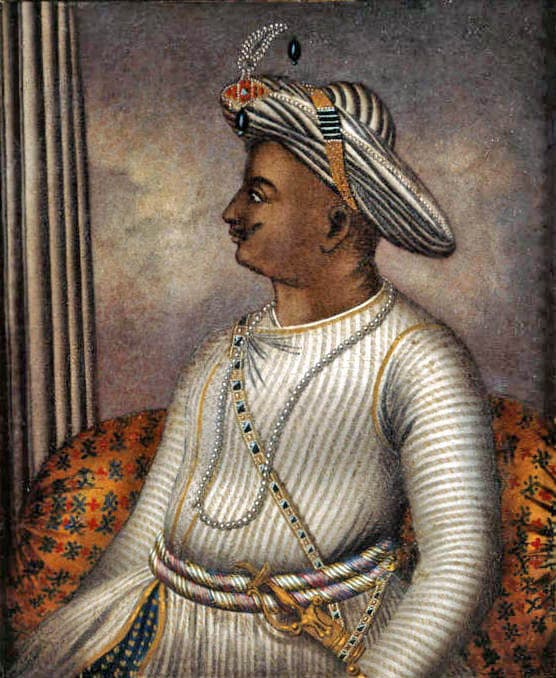
The page it is written on
Folio 7r of British Library IO Islamic 3563 — a small volume of which only the first sixteen leaves were ever filled. The hand is a rapid, difficult shikasta, with the spelling slips of a man writing fast; the dates use his own Mauludi calendar with its renamed months, and the numerals run right to left. Habibullah, the confidential servant who identified the register when Colonel William Kirkpatrick found it among the secret papers at Srirangapatna, testified that the Sultan would let no one so much as glimpse the book while he wrote in it. Alexander Beatson presented it to the East India Company's directors in 1800 on Wellesley's behalf, and it has been in London ever since.
Sources for this page
- British Library, IO Islamic 3563, f. 7r — the dream register; Beatson's presentation note of 1800 records the discovery and Habibullah's testimony.
- Mahmud Husain (trans.), The Dreams of Tipu Sultan (Karachi, 1957), pp. 63–64 — the translation of dream thirteen paraphrased and briefly quoted here.
- Ursula Sims-Williams, 'Tipu Sultan's dream book (IO Islamic 3563)', British Library Asian and African Studies blog, 11 June 2015 — dating, manuscript description, and the Mauludi calendar.
- Kate Brittlebank, 'Accessing the Unseen Realm: The Historical and Textual Contexts of Tipu Sultan's Dream Register', Journal of the Royal Asiatic Society 21:2 (2011) — on the register's retrospective compilation.
- Mohibbul Hasan, History of Tipu Sultan, pp. 112–15 — the night attack at Shahnur and the Maratha withdrawal.
Full bibliography and how we weigh sources: Sources & Method