The Person · The Khwabnama
The Paradise Dream
In the middle of the Maratha war, camped beyond the Tungabhadra, Tipu Sultan dreamed it was the Day of Judgement — and that a stranger with a bright face and a red beard took his hand, named himself Murtaza Ali, and delivered a message from the Prophet: that he would wait, and they would enter paradise together.
- Entry
- Dream 12 of 37
- Dreamed
- Autumn 1786
- Where
- Camp beyond the Tungabhadra
- Manuscript
- BL IO Islamic 3563, f. 6v
The same weeks as Shahnur
The entry sits beside the Shahnur dream in the register, and comes from the same campaign: the Maratha–Mysore war of 1785–87, with Tipu Sultan across the Tungabhadra and the armies of the Peshwa and the Nizam in the field against him. These autumn weeks of 1786 are the densest season in the whole register — a commander at the edge of his kingdom, sleeping in camp, writing down what the nights brought him.
The dream
It seemed to him, the entry runs, that it was the Day of Judgement — the day when no one would be interested in anyone else. Out of that crowd a stranger came to him: a man of great strength and commanding stature, with a bright face and a red beard and moustaches, who took Tipu Sultan's hand in his and asked whether he knew who he was. He did not. The stranger named himself: Murtaza Ali — and said that the Messenger of God had declared, and was declaring still, that “he would not set his foot in paradise without you” — that he would wait, and they would enter together.
The entry closes with the dreamer's own note that he woke feeling happy, and a formula: God is all-powerful, and the Messenger is the intercessor. This suffices.
What a usurper's son needed to hear
Read the dream against the family's position. Nawab Haidar Ali Khan had taken Mysore from within; his son held it by administration and the sword, with no ancient lineage behind him and the deposed Wodeyars still living inside his capital. The state's own name — the Sarkar-i-Khudadad, the God-given government — is the public answer to that weakness. A dream in which Ali himself takes your hand on the Day of Judgement, bearing the Prophet's personal guarantee, is the same answer in private: legitimacy delivered at the highest level a Muslim ruler could imagine, to an audience of one.
There may be a family signature in the messenger, too. Ali's epithet is Haidar — the Lion of God — the name the dynasty's founder carried; scholars have read the court's saturation in tiger imagery, the bubri everywhere on its objects, partly through that association. In this dream the connection needs no decoding: the Lion of God arrives in person, and takes the side of the house of Haidar.
When exactly was it dreamed?
The entry is dated the 21st of Haidari — the month named, as it happens, for Ali — in the year Busd. What that means in the common calendar is genuinely uncertain, because Tipu Sultan renamed and renumbered his months twice: the British Library's reading puts the dream in September 1786, while Kate Brittlebank, counting Haidari in its older position, dates it to November. The disagreement is small, and its existence is the instructive part — even specialists must reverse-engineer the private calendar of a state that renamed time itself. His coinage and calendar reforms are their own story.
Read against 4 May 1799
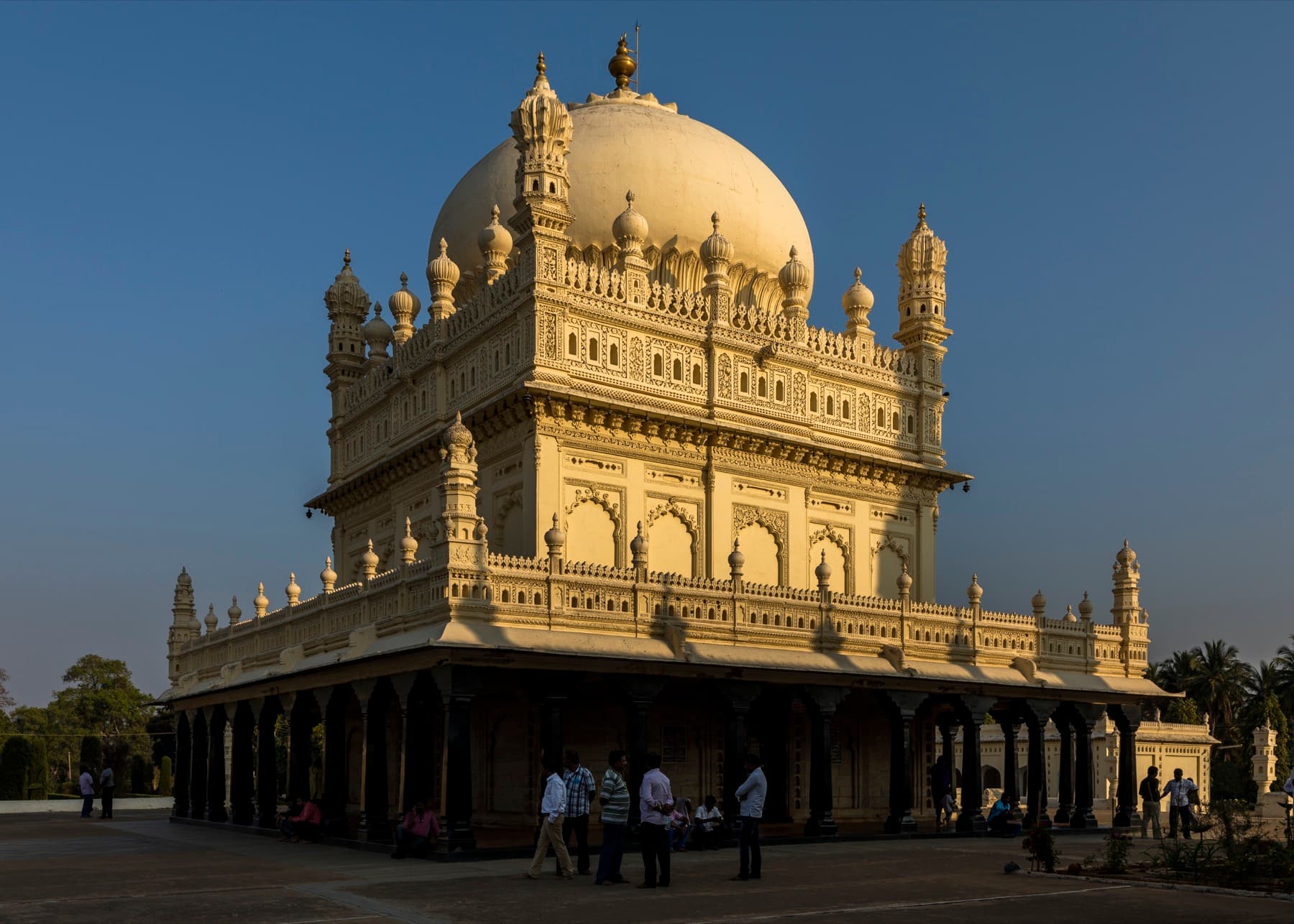
The register gives no sign the dream was ever shared; unlike Shahnur, no interpretation is attached and no event follows. It simply records a promise received. Thirteen years later its owner was killed at the Water Gate rather than surrender his capital, and was buried the next evening at the Gumbaz beside his father. The tradition that grew around his death — the ruler who chose martyrdom over submission — was built by others, later, for their own reasons. This entry is the one place where something like that idea appears in his own hand, privately, with thirteen years still to run: not a legend, just a man in an army camp writing down that the Prophet had promised to wait for him.
Sources for this page
- British Library, IO Islamic 3563, f. 6v — the dream register.
- Mahmud Husain (trans.), The Dreams of Tipu Sultan (Karachi, 1957), pp. 61–62 — the translation of dream twelve paraphrased and briefly quoted here.
- Ursula Sims-Williams, 'Tipu Sultan's dream book (IO Islamic 3563)', British Library Asian and African Studies blog, 11 June 2015 — the September 1786 dating and the calendar problem.
- Kate Brittlebank, 'Accessing the Unseen Realm', Journal of the Royal Asiatic Society 21:2 (2011) — the November 1786 dating, and the register's contexts.
- Kate Brittlebank, Tipu Sultan's Search for Legitimacy (1997) — on legitimation, the Haidari association and the tiger.
- Mohibbul Hasan, History of Tipu Sultan — the Maratha war of 1785–87.
Full bibliography and how we weigh sources: Sources & Method